
The Critical Role of CIP in Food & Beverage Processing
Clean-in-Place (CIP) systems are the backbone of sanitation in food, beverage, and dairy processing. These automated systems clean the interior surfaces of pipes, vessels, and equipment without disassembly—saving labor and ensuring consistent hygiene [1].
30-40%
Water reduction possible [2]
20-30%
Chemical reduction possible [3]
12,000 tons
Annual water savings from CIP upgrades [2]
Yet there's a hidden variable that undermines even the most sophisticated CIP systems: mineral scale accumulation. Scale on tank walls, heat exchanger plates, and pipe interiors creates rough surfaces where soil and bacteria hide—forcing longer wash cycles, higher chemical concentrations, and more frequent cleaning.
Plants are turning to modern closed-loop CIP systems that optimize chemical concentration, wash time, and water usage. One facility reported a 30-40% reduction in water usage and a 20-30% reduction in cleaning chemicals after CIP optimization [3]. These savings are impressive—but they still require ongoing chemical purchases. What if you could eliminate the root cause of poor cleaning altogether?
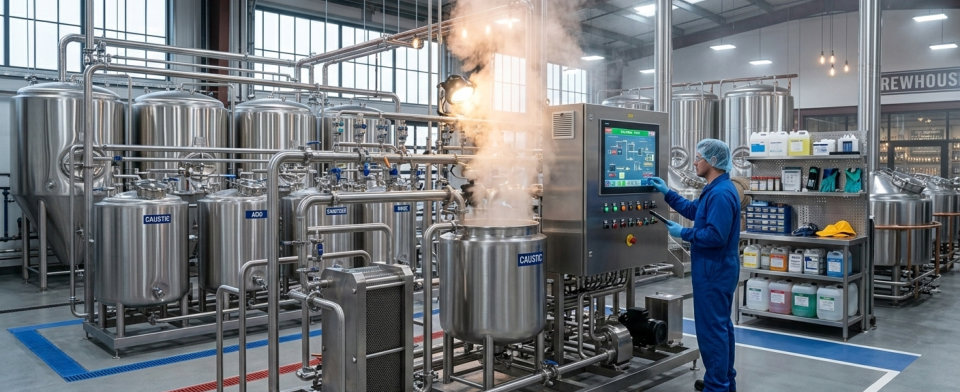
The Hidden Variable
Scale creates surface roughness that traps soil and harbors bacteria. No matter how much chemical you apply, if the surface is rough with scale, you cannot achieve true cleanliness. Scale elimination is the foundation of effective CIP.
How Scale Undermines Your CIP System
Surface Roughness
Scale creates microscopic crevices where bacteria and soil accumulate. Even high-velocity flow cannot dislodge material from rough, scaled surfaces [1].
Chemical Barrier
Scale acts as a physical barrier, preventing sanitizers from reaching bacteria trapped beneath. Microorganisms survive between cleanings and recontaminate product [4].
Heat Transfer Loss
Scale on heat exchanger plates reduces heating efficiency, meaning longer wash cycles to reach target temperatures—wasting water and chemicals.
Flow Restriction
Scale-narrowed pipes reduce flow velocity, decreasing the mechanical scrubbing action essential for CIP effectiveness [1].
Case studies show that CIP upgrades can cut annual water discharge by 12,000 tons while achieving zero-defect quality certifications [2]. But these upgrades assume clean surfaces to begin with.

Vulcan installed on main process water line—keeps surfaces smooth for effective CIP
The CIP Process: Where Scale Interferes at Every Step
1. Pre-Rinse
Removes gross soil. Scale traps soil particles, requiring longer rinsing [1].
2. Caustic Wash
Dissolves organic residues. Scale insulates surfaces, reducing temperature and effectiveness.
3. Intermediate Rinse
Removes caustic. Scale creates dead zones where rinse water doesn't reach [4].
4. Acid Wash
Removes mineral deposits. This step exists because of scale—without scale, it could be eliminated [1].
5. Final Rinse
Removes acid. Scale traps chemical residues, risking product contamination.
6. Sanitization
Kills remaining bacteria. Scale protects bacteria from sanitizers [4].
A typical CIP system uses chemicals, heat, turbulence, and time to clean [1]. Scale undermines all four factors, forcing longer cycles and higher chemical concentrations.
Critical Distinction: Chemical CIP vs. Scale Prevention
Most processors accept the acid wash step as unavoidable. But the acid wash exists only to remove scale. If scale never forms, the acid wash becomes unnecessary—along with its costs and hazards.
- Acid wash required - Added step to remove scale [1]
- Chemical hazards - Acid handling, PPE, storage
- Water waste - Additional rinse cycles for acid removal
- Corrosion risk - Acid attacks stainless steel over time
- Energy waste - Heating additional chemical volumes
- Wastewater treatment - Neutralizing acid before discharge
- Longer cycles - More steps = longer production downtime
The acid wash step adds 15-30 minutes to every CIP cycle [4]. For a facility running 3 CIP cycles daily, that's 273-547 hours of downtime annually.
- No acid wash needed - Scale never forms
- Zero chemical hazards - No acid handling
- Water savings - Fewer rinse cycles
- Equipment protection - No acid corrosion
- Energy savings - Less water to heat
- Simplified wastewater - No acid neutralization
- Shorter cycles - 15-30 minutes saved per CIP run

The Processor's Math
A dairy processing plant running 2 CIP cycles per day, each with a 20-minute acid wash step, loses 243 hours of production time annually to acid cleaning. At $500/hour of production value, that's $121,500 in lost capacity—plus the cost of acid, water, and wastewater treatment. Vulcan eliminates this entirely.
Real Proof: Indonesian Food Processing Plant
Facility: Food Processing Plant (Delicatessen)
Location: Indonesia
Application: Boilers, heat exchanger, sterilizers
The Challenge
The food processing facility was experiencing severe scaling issues across multiple systems. They sought to replace traditional water softeners with a chemical-free solution that would make old scale manageable and prevent future deposits [5].
The Vulcan Solution
- 1 x Vulcan 3000 for the boilers
- 1 x Vulcan 3000 for the heat exchanger
- 1 x Vulcan 5000 for 2 sterilizers system
- Results: 0.5mm scale cleared within 2 months; 15-year scale buildup disappeared within 3 months [5]
CIP Impact
With scale eliminated from sterilizers and heat exchangers, this facility could:
- Eliminate acid wash steps
- Reduce CIP cycle time
- Lower chemical usage
- Improve sterilization reliability

Real Proof: Salles Frères, French Food Confectioner
Facility: Salles Frères
Location: France
Application: Food confectionery processing equipment
The Challenge
This French food confectioner faced scale buildup on processing equipment, affecting product quality and requiring frequent cleaning cycles [6].
The Results
- Scale eliminated from processing equipment
- Improved product quality consistency
- Reduced cleaning frequency [6]
- Chemical cleaning reduced
CIP Optimization
With scale eliminated, Salles Frères could:
- Shorten CIP cycles
- Reduce chemical usage
- Increase production uptime
- Maintain consistent quality
Water and Chemical Savings from Scale-Free Surfaces
Water Consumption Impact
For food and beverage processing, CIP systems represent a significant portion of total water use. Modern closed-loop CIP systems can reduce water usage by 30-40% [3]. But even optimized systems waste water when scale is present:
- Longer rinse times to remove soil from rough surfaces
- Additional rinse steps for acid wash
- Inefficient heat transfer requiring longer cycles
Case studies show CIP upgrades can cut annual water discharge by 12,000 tons while achieving zero-defect quality certifications [2].
Chemical Reduction Potential
With scale eliminated, processors report:
- 20-30% reduction in cleaning chemicals [3]
- Elimination of acid wash step (15-30 minutes per cycle)
- Reduced caustic usage as soil releases more easily from smooth surfaces
- Lower wastewater treatment costs from reduced chemical loading
A facility running 3 CIP cycles daily saves $15,000-$25,000 annually in chemical costs alone.
CIP Optimization Strategies for Scale-Free Systems
1. Eliminate Acid Wash
With Vulcan preventing scale formation, the acid wash step becomes unnecessary. Remove it from your CIP sequence and save 15-30 minutes per cycle [1].
2. Reduce Caustic Concentration
Smooth surfaces require less aggressive cleaning. Gradually reduce caustic concentration while monitoring cleanliness.
3. Shorten Rinse Times
Without scale to trap soil, rinse water flows freely. Reduce pre-rinse and intermediate rinse durations.
4. Lower Temperatures
Without scale insulation, heat transfers efficiently. You may achieve target temperatures faster with less energy input.
5. Implement Recovery Systems
With chemical loads reduced, consider recovering final rinse water for pre-rinse in the next cycle [3].
6. Monitor and Validate
Use ATP testing or surface swabs to verify cleanliness. Document improvements for quality audits.
ROI Calculator: Medium-Size Food Processing Plant
| Baseline CIP Costs (With Scale) | |
| CIP cycles per day | 3 cycles |
| Acid wash chemical cost per cycle | $25 |
| Annual acid chemical cost | $27,375 |
| Additional caustic usage due to scale | $8,000 |
| Water cost (extra rinse cycles) | $6,500 |
| Wastewater treatment (acid neutralization) | $4,200 |
| Energy cost (heating extra water) | $3,800 |
| Total annual scale-related CIP cost | $49,875 |
| With Vulcan (Zero Scale) | |
| Acid chemical cost eliminated | $27,375 saved |
| Caustic savings | $8,000 saved |
| Water savings | $6,500 saved |
| Wastewater treatment savings | $4,200 saved |
| Energy savings | $3,800 saved |
| Production uptime value (273 hours @ $500/hr) | $136,500 |
| Total Annual Savings | $186,375 |
The Quality Value
Beyond direct savings, scale-free surfaces ensure consistent sanitation and reduce contamination risk. A single product recall can cost millions—Vulcan provides insurance against scale-related quality failures.
Get Exact Pricing for Your Facility
For precise pricing tailored to your processing specifications:
- Existing customers: Log in to your account to view model-specific pricing
- New users: Create a free account to access detailed pricing and configuration options
- Need assistance? Contact our team for a CIP system assessment
Account registration takes less than 2 minutes.
Recommended Vulcan Models for CIP Systems
Different facility sizes require different models. Create an account for detailed specifications and pricing.
Vulcan S50 / S100
Up to 5,000 sq ft facility
Individual process vessels
Heat exchangers
Small CIP skids
✓ Eliminates acid wash step
Vulcan S150 / S250
5,000-20,000 sq ft facility
Multiple process lines
Central CIP system
Hot water loops
✓ Zero maintenance, zero consumables
Vulcan X-PRO Series
20,000+ sq ft / multiple buildings
Multiple CIP circuits
Plant-wide process water
Heat recovery systems
✓ Permanent scale prevention
CIP Optimization Without Chemicals Checklist
- Audit current CIP cycles: Document cycle times, temperatures, chemical usage
- Inspect equipment surfaces: Look for visible scale buildup
- Calculate acid wash cost: Chemical + water + energy + time [1]
- Install Vulcan on main process water line: Prevent scale at source
- Re-evaluate CIP program: Eliminate acid wash, reduce caustic concentration
- Monitor rinse times: Reduce as scale disappears
- Validate cleanliness: ATP testing, surface swabs [4]
- Document savings: Track water, chemical, and time reductions
References
- De Smet Engineers. (2025). CIP - Clean In Place.
- AJ Mechanical Engineering. CIP Systems for Optimal Cleaning and Sanitation.
- Veolia UK. (2025). Brewery and Distillery Operations Towards Net Zero.
- Goodway. (2018). Heat Exchanger and Boiler Maintenance: Chemical Descaling.
- Vulcan Indonesia. (2024). Food Processing Plant Installation Case Study.
- Vulcan Descaler. Salles Frères Food Confectioner Case Study.
- Vulcan Descaler. CCI Factory Vietnam Case Study.
- Vulcan Descaler. Cargill Nicaragua Case Study.
Questions for Your CIP Optimization Audit
- How many CIP cycles do we run per day?
- Do we use an acid wash step? What does it cost per cycle?
- Are our heat exchangers achieving target temperatures?
- Is scale visible on tank walls or equipment surfaces?
- How much water do we use per CIP cycle?
- What is our annual spend on CIP chemicals?
- Could we eliminate 15-30 minutes per cycle with scale-free surfaces?
Vulcan provides the answers—and the solution.
Optimize Your CIP Without Chemicals
Join food and beverage processors in eliminating the acid wash step—saving water, chemicals, and production time.
About the Author
Waslix (Vulcan Mineral Descaler) provides non-chemical, maintenance-free scale prevention for food, beverage, and dairy processors worldwide. Our physical impulse technology eliminates the need for acid wash steps, reduces CIP chemical usage by 20-30%, and cuts water consumption by 30-40%—proven in thousands of processing facilities globally. Create an account for detailed model specifications and pricing.

