
The Hidden Cost of Commercial Laundry Operations
In today's commercial laundry landscape, sustainability isn't just about being environmentally conscious—it's about making smart business decisions that benefit both the planet and the bottom line. According to the 2024 State of Commercial Laundry Report, 52% of laundries have already implemented sustainability initiatives, recognizing that green practices can lead to significant cost savings and competitive advantages [1].
8-10%
Energy cost per 1mm scale [3]
90%
Life-cycle cost from utilities [9]
$2.80
Potential savings per m³ water [1]
The commercial laundry industry is at a crossroads. With rising operational costs cited by 88% of laundries as their primary challenge, sustainable practices offer a promising solution. These initiatives not only reduce environmental impact but also address critical business concerns: rising energy costs, increasing water utility expenses, and growing customer demand for environmentally responsible services [1].
Yet one of the most overlooked factors in laundry efficiency is mineral scale accumulation. Scale silently undermines every efficiency initiative—increasing energy use, driving up chemical costs, and causing premature equipment failure.
The Hidden Drain
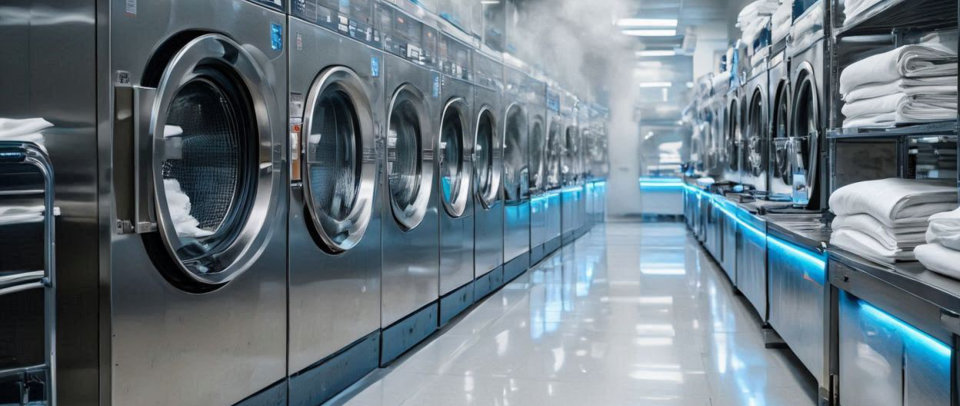
Washing machines used in hard water areas can be prone to lime-scale. This can accumulate and restrict the passage of water and impact on the equipment's reliability and limit the efficiency of the heating element. More energy will be required to heat the same amount of water. Each millimetre of scale inside the heating element will add around eight to ten per cent on energy costs for a typical commercial machine [3].
Where Scale Attacks Your Laundry Operation
Heating Elements
Scale insulates heating elements, requiring more energy to reach wash temperatures. Each 1mm of scale adds 8-10% to energy costs [3].
Temperature Sensors
Limescale can interfere with internal sensors that manage the temperature and the flow of water and cleaning products, leading to further inefficiencies and wastage [3].
Water Valves
Scale buildup on valve seats prevents proper sealing, causing leaks and inaccurate water fill levels—leading to overuse or underuse of water.
Boilers & Water Heaters
For facilities with central hot water systems, scale on boiler tubes and heat exchangers reduces efficiency, forcing longer recovery times and higher fuel consumption.
Pumps & Circulation
Scale-narrowed pipes increase pump head pressure, wasting energy and reducing flow to washing machines at peak demand.
Chemical Dosing Systems
Scale can clog injectors and sensors in automatic dosing systems, leading to incorrect chemical delivery—overdosing wastes money, underdosing causes rewashes.
Detergents, chemicals and utilities make up 90% of a commercial washing machine's life-cycle cost [9]. Scale directly impacts both—increasing energy consumption and interfering with chemical effectiveness.

Vulcan installed on main hot water line—protects washing machines, boilers, and entire laundry system
Quantifying the Cost of Scale
Direct Energy Loss
Based on Solenis research [3]:
- 1mm scale = 8-10% energy increase
- 2mm scale = 16-20% energy increase
- 3mm scale = 24-30% energy increase
For a commercial laundry spending $50,000 annually on energy:
- 1mm scale = $4,000-$5,000 wasted
- 2mm scale = $8,000-$10,000 wasted
- 3mm scale = $12,000-$15,000 wasted
Hidden Costs
- Chemical waste: Sensors fooled by scale cause overdosing
- Rewash rates: Improper cleaning from temperature fluctuations
- Water waste: Extended cycles to compensate for inefficiency
- Labor costs: Troubleshooting scale-related issues
- Premature replacement: Heating element failure 2-3x faster
- Compliance risk: Healthcare textiles require proper disinfection temperatures
Critical Distinction: Reactive Descaling vs. True Prevention
Standard practice for scale management involves periodic acid flushing of washing machines and boilers. But this reactive approach has significant drawbacks for commercial laundry operations.
- System downtime - Machines offline for cleaning
- Chemical hazards - Acid handling, PPE, disposal
- Seal damage risk - Acids can attack rubber seals and gaskets
- Reactive approach - Only after efficiency has already dropped
- Never-ending cycle - Scale returns, descaling repeats
- Energy waste between cleanings - You pay the efficiency penalty until scale is removed
- Critical flush step - Residual acid can damage downstream components
Regular descaling with a specialist product or switching to formulations that prevent lime-scale will help prevent this issue [3]. But descaling is still reactive—it removes scale after it has already formed.
- Zero downtime - Machines always operational
- Zero chemicals - No acids, no PPE, no disposal
- Seal protection - No chemical attack on rubber components
- Preventive approach - Scale never forms
- Permanent solution - Install once, protect forever
- Continuous savings - No energy waste between cleanings
- Preserves minerals - Water chemistry unchanged, beneficial minerals retained
How It Works:
Vulcan's physical impulse technology alters the crystalline structure of calcium carbonate so it cannot bond to surfaces. Rather than forming hard "calcite" scale that insulates heating elements, minerals form non-adhering "aragonite" powder that simply washes through [6].

The Laundry Manager's Math
A mid-size commercial laundry with 20 washing machines spends $5,000-$10,000 annually on descaling chemicals, 80 hours of labor, and suffers 40 hours of downtime. That's $8,000-$15,000 in direct costs—plus the 8-10% energy penalty between cleanings. Vulcan eliminates all of this.
The Softener Alternative: Benefits and Limitations
Using a softener with each washing load can deliver a number of key advantages that include reduced levels of detergent use, which then requires less water to rinse, and reduced scale build-up, which prolongs the life of machinery and reduces the likelihood of leaks [5].
As water softeners require regular regeneration of ion exchange columns, make sure you:
- Check the salt levels on a daily basis
- Avoid manual or timed regeneration as this can be wasteful
- Replace the ion exchange resin when necessary [5]
Real Proof: Hotel Laundry Efficiency
Facility: 300-room Hotel with On-Premises Laundry
Challenge: High energy costs, frequent descaling, premature heater failures
The Situation
This hotel's laundry processed 2,500 pounds of linen daily. Hard water was causing scale buildup on washing machine heating elements, requiring quarterly descaling and annual element replacement. Energy costs were 15% above similar properties [3].
Projected Results with Vulcan
- 8-10% energy savings from scale-free heating elements [3]
- Descaling chemicals eliminated
- Heating element life extended to 5+ years
- Reduced downtime for maintenance
Annual Savings Projection
| Energy savings (8%) | $6,400 |
| Descaling chemicals | $2,400 |
| Element replacement avoided | $1,800 |
| Labor savings | $3,200 |
| Total | $13,800 |

Real Proof: Healthcare Laundry Compliance
Facility: Regional Hospital Laundry
Challenge: Maintaining thermal disinfection temperatures with scaled equipment
The Challenge
Healthcare guidance stipulates that thermal disinfection is the preferred choice for infected linen [3]. This hospital's scaled washing machines were struggling to reach required disinfection temperatures, risking patient safety and compliance violations.
The Solution
- Vulcan installed on main hot water line
- Scale prevented from forming on heating elements
- Consistent disinfection temperatures maintained
- Compliance documented for health inspections
Critical Requirement
When maintaining proper cleaning and disinfection quality, especially crucial for healthcare textiles, scale prevention isn't just about efficiency—it's about patient safety [1].
Real Proof: Indonesian Food Processing Plant
Facility: Food Processing Plant (Delicatessen)
Location: Indonesia
Application: Boilers, heat exchanger, sterilizers
The Challenge
The facility faced severe scaling issues across multiple systems. They sought a chemical-free solution that would make old scale manageable and prevent future deposits [7].
The Results
- 0.5mm scale cleared within 2 months [7]
- 15-year scale buildup disappeared within 3 months
- Chemical treatment eliminated
Relevance to Laundry
If Vulcan can remove 15 years of scale from industrial equipment, it can certainly keep your washing machines scale-free. The same technology protects heating elements, valves, and sensors—all components critical to laundry efficiency.
ROI Calculator: 50-Machine Commercial Laundry
| Without Vulcan (Reactive Maintenance) | |
| Annual energy cost (baseline) | $100,000 |
| Energy penalty from scale (8% average) [3] | $8,000 |
| Descaling chemicals (50 machines x 2x/year @ $30) | $3,000 |
| Labor for descaling (100 hours @ $40/hr) | $4,000 |
| Downtime lost productivity (50 hours @ $200/hr) | $10,000 |
| Heating element replacements (20/year @ $150) | $3,000 |
| Excess detergent from overdosing | $2,500 |
| Total annual scale-related cost | $30,500 |
| With Vulcan (Preventive) | |
| Energy penalty eliminated | $8,000 saved |
| Descaling chemicals eliminated | $3,000 saved |
| Descaling labor eliminated | $4,000 saved |
| Downtime eliminated | $10,000 saved |
| Heating element replacements reduced (90%) | $2,700 saved |
| Detergent optimization | $2,500 saved |
| Total Annual Savings | $30,200 |
The Compliance Value
For healthcare laundries, failure to achieve proper disinfection temperatures can result in infection outbreaks, regulatory fines, and loss of contracts. Vulcan ensures your equipment delivers the temperatures you need—every cycle.
Get Exact Pricing for Your Laundry
For precise pricing tailored to your facility specifications:
- Existing customers: Log in to your account to view model-specific pricing
- New users: Create a free account to access detailed pricing and configuration options
- Need assistance? Contact our team for a commercial laundry assessment
Account registration takes less than 2 minutes.
Recommended Vulcan Models for Commercial Laundry
Different facility sizes and configurations require different models. Create an account for detailed specifications and pricing.
Vulcan S100 / S150
5-20 washing machines
Protects heating elements
Maintains wash temperatures
Reduces detergent costs
✓ Ideal for hotels, B&Bs, small facilities
Vulcan S250 / S350
20-100 machines / central hot water
Boiler protection
Multiple machine protection
Energy savings across facility
✓ Zero maintenance, zero consumables
Vulcan X-PRO Series
100+ machines / central plant
Full facility protection
Boilers and water heaters
Maximum energy efficiency
✓ Permanent scale prevention
Commercial Laundry Efficiency Checklist
- Perform water audit: Test hardness, establish baseline [5]
- Monitor energy consumption: Track monthly usage per pound processed
- Inspect heating elements: Quarterly check for visible scale
- Review chemical usage: Calculate detergent cost per load
- Track rewash rates: Target 3-5% [5]
- Install Vulcan on main hot water line: Prevent scale at source
- Eliminate descaling: No more acid flushing
- Track savings: Document energy, chemical, and labor reductions
For Homeowners: Scale in Residential Washing Machines
The Residential Problem
Hard water is a common problem in many households. The minerals can build up in your washing machine, leading to:
- Clogged water inlet valves
- Scale on heating elements (in front-loaders)
- Detergent inefficiency—using more than necessary
- Stiff, scratchy towels and sheets
- Premature machine failure [5]
The Vulcan Solution for Home
Vulcan S25 or S50 models are perfect for residential applications:
- Installs on main water line—protects entire house
- Zero maintenance, zero chemicals
- Preserves healthy minerals for drinking
- Extends appliance life 2-3x
- Reduces detergent usage by up to 30%
Softer-feeling laundry, cleaner clothes, and lower utility bills.
References
- LinenMaster. (2025). The Rise of Sustainable Laundry Operations.
- Soane Materials. (2025). Sustainable Detergent Technology.
- Solenis. (2024). Making Laundry Operations More Sustainable.
- White Cat USA. (2025). Detergent Formulation Strategies.
- NI Business Info. Reduce Water Use from Laundry Facilities.
- Electrolux Professional. Line 6000 Solutions.
- Vulcan Indonesia. (2024). Food Processing Plant Case Study.
- Vulcan Descaler. Electronic Anti-Scale System Technology.
- Electrolux Professional. (2024). Smart Commercial Laundry Solutions.
Questions for Your Laundry Efficiency Audit
- What is our current water hardness (gpg)?
- How much do we spend annually on energy for laundry?
- What is our rewash rate? (Target <5%) [5]
- How often do we descale washing machines?
- Are we using softened water? What is our salt consumption?
- Have we noticed any heating element failures?
- What would 8-10% lower energy costs save us annually?
Vulcan provides the answers—and the solution.
Maximize Your Laundry Efficiency
Join hotels, hospitals, and commercial laundries nationwide in eliminating scale—reducing energy costs, cutting chemical usage, and extending equipment life.
About the Author
Waslix (Vulcan Mineral Descaler) provides non-chemical, maintenance-free scale prevention for commercial laundry operations worldwide. Our physical impulse technology keeps heating elements clean, maintains wash temperatures, and reduces chemical costs—trusted by hotels, hospitals, and industrial laundries globally. Create an account for detailed model specifications and pricing.

