
The Mall Water Challenge: Why Blowdown Matters
Shopping malls are among the largest commercial water consumers, with cooling towers accounting for the majority of usage. A typical regional mall can consume 5-10 million gallons annually for cooling alone—and most of that water ends up as blowdown discharged to the sewer [4].
50-70%
Blowdown reduction achievable [2]
5-10M
Annual gallons per mall [4]
10,000 µS
Achievable conductivity [8]
Blowdown is the wastewater discharged from a cooling tower to control the concentration of dissolved solids [1]. By increasing cycles of concentration (CoC)—a measure of how much water is recycled before being disposed of—the need for blowdown can be drastically reduced. A higher CoC means that each drop of water is used more efficiently before it is replaced by fresh water [1].
The financial impact is substantial: for example, raising CoC from 5 to 10 in a 500,000 sq ft office building saved approximately $6,000 annually in water and sewer costs [8]. For a regional mall, savings can reach $50,000+ per year.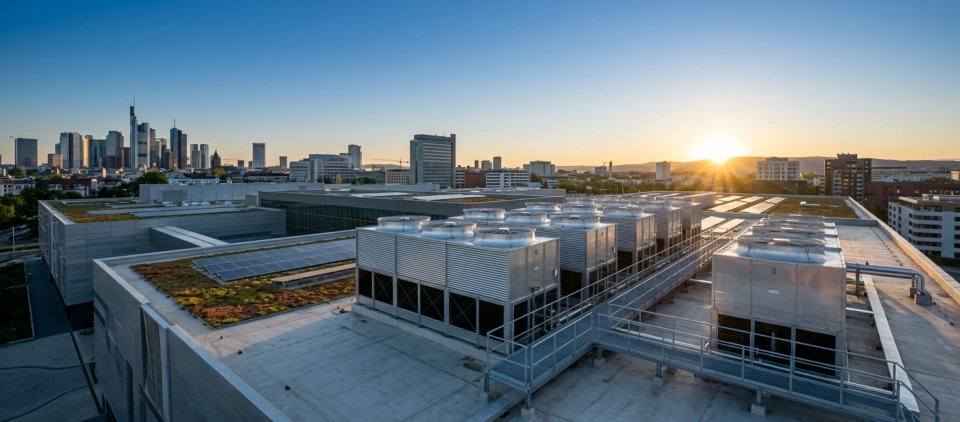
The Scale Barrier
The primary obstacle to higher cycles is scale formation. As dissolved solids concentrate, calcium and magnesium precipitate onto heat transfer surfaces—reducing efficiency and eventually causing equipment failure. Without effective scale prevention, malls are forced to blow down water prematurely.
Cycles of Concentration: The Math of Water Savings
Cycles of concentration is the ratio of dissolved minerals in the recirculating water compared to the dissolved minerals in the fresh water make-up [4]. When water evaporates, only pure H₂O is driven off, leaving dissolved solids behind. Higher CoC means less blowdown and less makeup water.
The Blowdown Equation
Blowdown % = (1 / CoC) × 100
For example, raising CoC from 2 (50% blowdown) to 4 (25% blowdown) will reduce total water consumption by 25% [1].
| Cycles | Blowdown % | Water Savings vs. Baseline |
|---|---|---|
| 3 | 33% | — |
| 5 | 20% | 13% reduction |
| 8 | 12.5% | 20.5% reduction |
| 10 | 10% | 23% reduction |
| 15 | 6.7% | 26.3% reduction |
Conductivity as a Proxy
Conductivity (measured in microsiemens per centimeter, µS/cm) directly correlates with dissolved solids. For most municipal water supplies:
- Typical makeup: 300-600 µS/cm
- Standard operation: 1,500-3,000 µS/cm (3-6 cycles)
- Optimized operation: 5,000-8,000 µS/cm (8-15 cycles)
- Advanced treatment: 10,000+ µS/cm (15+ cycles) [8]
A commercial center achieved 15 cycles of concentration (approx 7,500-9,000 µS/cm) through optimized chemical treatment and controls [8].
The savings effected by a recirculating system compared to a once-through system are maximized at about four to six cycles with traditional chemical treatment. At high cycles (e.g., eight to 10), the additional water savings generally are not commensurate with the increased difficulty of effective chemical treatment [1]. Chemical-free technologies break this barrier.
The Three R's of Cooling Water Conservation
The USGBC promotes a holistic approach to cooling water management: Reduce, Replace, Reuse [1].
1. Reduce
Lower consumption through efficient practices:
- Minimize blowdown by increasing cycles
- Fix leaks and overflows promptly
- Install wireless monitoring systems [1]
2. Replace
Utilize alternative water sources:
- Reclaimed municipal water
- Stormwater harvesting
- Groundwater under property [2]
3. Reuse
Reuse wastewater from other processes:
- RO concentrate
- Deionization discharge
- Condensate from air handlers [4]
Implementing these strategies not only contributes to environmental conservation but also provides significant cost savings. In some cases, the return on investment can be realized in under three years [1].
Critical Distinction: How to Achieve 10,000 µS/cm
Multiple approaches can increase cycles of concentration—but they are not equal. Understanding the difference between chemical management and physical scale prevention is essential for sustainable blowdown reduction.
Acid Treatment
Sulfuric or ascorbic acid can improve efficiency by controlling scale buildup [4]. Requires careful management for safety and corrosion prevention.
Ozonation / Ionization
Alternative treatment options that can reduce water and chemical usage [4].
Electrochemical Reactors
Side-stream electrolytic treatment that removes scale and reduces blowdown up to 80% [3]. Requires electricity, periodic cleaning, and generates waste stream.
Solid Concentrate Chemicals
A commercial center increased cycles from 5 to 10 using solid chemicals [5]. Still requires chemical purchasing, handling, and discharge.
Side-Stream Softening
Continuously removes solids from makeup water [4]. Effective but capital-intensive with ongoing maintenance.
- No chemicals, no acid, no salt - Zero consumables
- No side-stream equipment - Installs externally on main pipe
- Zero electricity for treatment - Minimal power for impulse generation
- No waste stream - No blowdown disposal concerns
- Zero maintenance - No cleaning, no moving parts
- Preserves healthy minerals - Does not remove calcium/magnesium, just prevents bonding
How It Works:
Vulcan's impulse bands wrap around the pipe, radiating treatment 9-16 feet in both directions. The impulses break the sticky structure of scale crystals into smooth rod-shaped mono-crystals that cannot bond to surfaces [2].
The Bottom Line for Malls
All approaches can increase cycles. Only Vulcan does so with zero ongoing costs, zero chemical handling, zero maintenance, and zero discharge concerns—critical for retail properties with lean facility staff.
Real Proof: Westfield Century City Mall, Los Angeles
Facility: Westfield Century City Mall
Location: Los Angeles, California
Challenge: Reduce reliance on potable water in cooling system
The Situation
When Westfield Century City Mall was undergoing a redesign, planners saw an opportunity to change the way the property handled its water needs. The aim was to reduce reliance on potable water in its cooling system, and instead make use of the groundwater located under the property [2].
The Vulcan Connection
Westfield achieved impressive savings through water source replacement—using groundwater instead of potable supply.
Imagine combining source replacement with Vulcan scale prevention:

- Groundwater (typically harder) treated by Vulcan to prevent scale
- Even higher cycles of concentration achievable
- No chemical treatment needed for hard water
- Blowdown further reduced
Real Proof: Del Mar Gateway / Unire Real Estate Group
Facility: Del Mar Gateway
Location: California
Application: Cooling tower system
The Challenge
Due to the forward-looking leadership team at Unire Real Estate Group, they sought to reduce cooling tower waste while providing high quality protection for newly installed chillers [2].
The Results
- 70% reduction in cooling tower waste [2]
- High quality protection for new chillers
- Achieved through alternative water source utilization
The Vulcan Advantage
70% blowdown reduction is impressive—but Vulcan can push it further:

- Achieve 10,000+ µS/cm conductivity without scaling
- Eliminate chemical treatment entirely
- Protect new chiller investment permanently
- Reduce waste by 90%+ in optimal conditions
Real Proof: Large Commercial Center (5 Cooling Towers)
Facility: Large commercial center
Location: United States
System: Five cooling towers and chillers, 1,000 tons each
The Challenge
A very large commercial center had been using liquid water treatment products for many years with acceptable results. However, management became increasingly focused on environmental issues and sought to improve sustainability metrics [5].
The Results
- Cycles increased from 5 to 10 [5]
- Significant water savings achieved
- Reduced chemical usage
- PLC controllers installed for automatic corrosion measurement
Critical Distinction
This case used blended solid concentrate chemicals [5].
While effective, the facility still requires:
- Ongoing chemical purchases
- Chemical storage and handling
- Discharge compliance monitoring
- PLC maintenance
Vulcan achieves the same cycles with zero chemicals.
Real Proof: Office Complex Achieves 15 Cycles
Facility: Two high-rise office buildings (500,000 sq ft each)
Location: Southeastern United States
Baseline: 8 cycles of concentration
The Analysis
Using computer simulation, Chemtex calculated that 15 cycles could safely be run based on local water quality [8].
The Results
- 15 cycles of concentration achieved [8]
- Blowdown reduced by 27,857 gallons per month
- $6,000 annual savings
- Savings paid for significant portion of chemical treatment
The Vulcan Difference
This case demonstrates that 15 cycles is achievable—but it required:
- Fluorescent traced inhibitor chemicals
- Little Dipper probe and controller
- Ongoing chemical purchases
Vulcan delivers the same 15 cycles with zero chemicals.
Alternative Water Sources for Mall Cooling Towers
Condensate Recovery
Condensed water collected from air handlers is a good source of high-quality makeup water because it's relatively pure and requires little additional treatment [4].
Simple, cost-effective
Rainwater Harvesting
Stormwater can serve as a viable replacement for potable water in cooling systems [1].
Intermittent but valuable source
Groundwater
As demonstrated at Westfield Century City, groundwater beneath the property can supplement cooling tower makeup [2].
Often harder water—requires scale prevention
RO Concentrate
Reverse osmosis concentrate (waste stream) can be reused as makeup water in cooling systems [1].
Deionization Discharge
DI system wastewater can be reused in cooling towers [1].
Reclaimed Water
Many municipalities offer reclaimed water that can be used in cooling systems [1].
Vulcan Enables Alternative Sources
Alternative water sources often have higher hardness or variability. Vulcan's physical impulse technology prevents scale regardless of water chemistry—making these sources viable without chemical treatment.
Mall Cooling Tower Blowdown Reduction Checklist
- Audit current water use: Measure makeup and blowdown volumes, current cycles
- Test water chemistry: Hardness, alkalinity, conductivity, pH
- Identify alternative sources: Groundwater, condensate, rainwater potential
- Install advanced controls: Conductivity controllers to automate blowdown [4]
- Implement scale prevention: Vulcan on main cooling tower makeup line
- Increase setpoints gradually: Methodically raise conductivity to 8,000-10,000 µS/cm
- Monitor heat transfer: Verify chiller efficiency maintained
- Document savings: Track water, sewer, and chemical cost reductions
ROI Calculator: 500,000 sq ft Regional Mall
| Baseline Assumptions (8 cycles, 3,000 µS/cm) | |
| Annual makeup water | 5,000,000 gallons |
| Blowdown volume (25%) | 1,250,000 gallons |
| Annual water + sewer cost @ $15/kgal | $75,000 |
| With Vulcan (15 cycles, 9,000+ µS/cm) | |
| Blowdown volume (6.7%) | 335,000 gallons |
| Blowdown reduction | 915,000 gallons |
| Annual water + sewer savings | $13,725 |
| Chemical treatment elimination | $5,000 - $10,000 |
| Maintenance labor reduction | $2,500 - $5,000 |
| Total Annual Savings | $21,225 - $28,725 |
The Hidden Cost: Chemical Compliance
Chemical treatment programs require storage, handling, safety training, and discharge permits—costs that don't appear on the chemical invoice. Vulcan eliminates these entirely.
Get Exact Pricing for Your Mall
For precise pricing tailored to your cooling tower specifications:
- Existing customers: Log in to your account to view model-specific pricing
- New users: Create a free account to access detailed pricing and configuration options
- Need assistance? Contact our team for a mall cooling tower assessment
Account registration takes less than 2 minutes.
Recommended Vulcan Models for Mall Cooling Towers
Different mall sizes require different models. Create an account for detailed specifications and pricing.
Vulcan S100 / S150
Up to 500 tons cooling load
Individual cooling towers
Small food courts / anchor stores
Standalone retail
✓ 9-16 foot treatment zone each direction
Vulcan S250 / S350
500-2,000 tons / multiple towers
Central plant cooling
Multiple tower systems
District cooling loops
✓ Zero maintenance, zero consumables
Vulcan X-PRO Series
2,000+ tons / campus-style
Multiple building complexes
Mixed-use developments
Large central utility plants
✓ Permanent scale prevention
References
- USGBC. (2024). The three R's of cooling water conservation: Reduce, replace, reuse.
- Capture H2O. (2024). Case Studies: Westfield Century City Mall, Del Mar Gateway, Westpak.
- Ecomax Solutions. (2024). ECOMax-CT Electrolytic Cooling Tower Water Treatment.
- Los Angeles Department of Water and Power. (2023). Cooling Towers: Saving Water Saves Money.
- AP Tech Group. Large Commercial Center Case Study.
- Chemtex. (2019). Case Study: Office Complex Achieves 15 Cycles of Concentration.
- Building Design+Construction. (2010). Water Performance Action Plan.
- Control Global. (2018). Optimization of cooling towers.
Questions for Your Mall Cooling Tower Assessment
- What is our current cycles of concentration?
- What is our current blowdown volume (gallons/month)?
- Do we have access to alternative water sources (groundwater, condensate)?
- What is our annual spend on cooling tower chemicals?
- Have we experienced scaling-related chiller efficiency loss?
- Are we tracking conductivity in real-time?
- What would 10,000 µS/cm operation save us annually?
Vulcan provides the answers—and the solution.
Achieve 10,000 µS/cm in Your Mall
Join leading retail properties in reducing blowdown by 70%+ while eliminating chemical treatment.
About the Author
Waslix (Vulcan Mineral Descaler) provides non-chemical, maintenance-free scale prevention for commercial properties worldwide. Our physical impulse technology enables malls to achieve 10,000+ µS/cm conductivity, reduce blowdown by 70%+, and eliminate chemical treatment costs—proven in thousands of installations globally. Create an account for detailed model specifications and pricing.

