
The Energy Challenge: Why Brewing Demands Efficiency
The global alcoholic drink market exceeds $1.5 trillion annually, with significant energy consumption and CO₂ emissions [1]. Brewing sits among the UK's more energy-intensive manufacturing sectors—heat, hot water, cooling, and constant process control mean energy is in use almost every hour of the day [2].
55-66 kWh
Energy per barrel of beer [2]
70%
Energy for heating processes [3]
34.54 Mt
Annual CO₂ from beer production [1]
For a microbrewery turning out 15,000 barrels a year, energy usage adds up to around 825,000 kWh annually. That's like leaving a light bulb on for four to five hours per pint—before packaging and transportation even begins [2]. Heating, cooling, and steam processes account for up to 70% of a brewery's total energy use, with systems like kettles, stills, and CIP operations often not optimized for recovery [3].
Under coal-fired boiler heating, annual CO₂ emissions from global beer production reach 34.54 million metric tons [1]. With energy costs surging by over 80% since 2021, brewers face unprecedented challenges to maintain profitability while ensuring production continues smoothly [3].
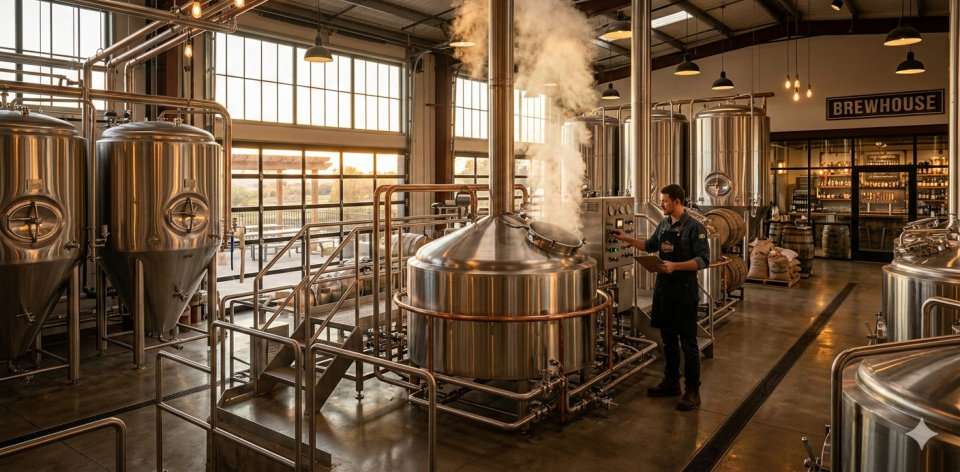
The Hidden Drain
Scale buildup on heat transfer surfaces directly increases energy consumption. Every millimeter of scale forces your brewery to burn more fuel to achieve the same temperatures—money literally going up the stack.
Where Energy Is Used in the Brewing Process
Mashing
Hot water at 62-72°C to convert starches to sugars. Scale on heat exchangers slows heat transfer and extends mashing time [1].
Wort Boiling
Requires 120-125°C steam for 60-90 minutes. The most energy-intensive step—up to 35% of brewhouse energy [4].
Cooling
Wort chillers must rapidly cool from boiling to fermentation temperature. Scale-insulated plates reduce efficiency and increase cooling time.
Fermentation
Temperature-controlled tanks require constant cooling. Scale on chiller tubes forces compressors to work harder [3].
Pasteurization
Flash pasteurizers heat beer to 72°C. Scale reduces heat transfer, increasing energy consumption by 7-12% per 1mm [5].
CIP Systems
Clean-in-place systems require hot water and chemicals. Scale on tank walls and heat exchangers makes cleaning less effective [6].
GEA's QBOIL system demonstrates the scale of energy use in wort boiling—fractionated boiling with a stripping column reduces total evaporation from 4% to less than 0.5%, delivering up to 35% energy savings [4]. This shows the massive potential for optimization when systems are running efficiently.
The Scale-Energy Connection: Quantifying the Loss
Where Scale Forms
- Brew kettles - Scale insulates heating surfaces, requiring longer boil times
- Plate heat exchangers - Narrow channels clog, reducing flow and heat transfer
- Steam boilers - 1mm scale = 7-10% efficiency loss [5]
- Cooling jackets - Scale prevents proper temperature control during fermentation
- Pasteurizers - Scale forces higher energy input to reach target temperatures
The Cost of Scale
Industry studies show that for every 1mm increase in scale thickness, energy usage increases by 7% [5]. For a brewery spending $100,000 annually on process heat:
- 1mm scale = $7,000/year wasted
- 2mm scale = $14,000/year wasted
- 3mm scale = $21,000/year wasted
- 4mm scale = $28,000/year wasted
Over a 10-year period, these losses compound dramatically [5].
Critical Distinction: Acid Cleaning vs. Vulcan Prevention
Most breweries address scale reactively—waiting until heat transfer drops, then scheduling acid cleaning of heat exchangers and boilers. This approach has hidden costs beyond the service invoice.
- Production downtime - Cleaning requires shutdown, disrupting brewing schedules
- Chemical hazards - Acid handling, disposal costs, environmental concerns
- Equipment stress - Repeated acid cleaning thins metal, shortens equipment life
- Reactive approach - You only address scale after efficiency has already dropped
- Never-ending cycle - Scale returns, efficiency drops again, repeat cleaning
- Energy waste between cleanings - You pay the efficiency penalty until scale is removed
- Water waste - CIP systems use significant water for chemical rinsing [6]
Acid cleaning can cost $2,000-$5,000 per event for medium-sized breweries, plus lost production time.
- Zero downtime - External installation, no production interruption
- Zero chemicals - No acid, no disposal, no hazards
- Equipment protection - Prevents scale, extends equipment life
- Preventive approach - Scale never forms, efficiency never drops
- Permanent solution - Install once, protect forever
- Continuous savings - No energy waste between cleanings
- Reduced water use - Less frequent CIP cleaning needed [6]

The Brewer's Math
A craft brewery with two annual acid cleanings at $4,000 each spends $8,000 yearly on reactive maintenance—plus the 7-12% energy penalty between cleanings. Over five years, that's $40,000 in cleaning costs plus $50,000+ in wasted energy. Vulcan eliminates both.
Real Proof: Hepworth Brewery, Sussex
Facility: Hepworth Brewery
Location: Sussex, UK
Technology: Greensteam heat pump with TurboClaw compressor
The Challenge
Wort boiling requires 120-125°C steam and generates 100°C waste heat, which is often vented. This represents a massive energy loss—heat that could be recovered and reused [7].
The Results
"The pilot proves that Greensteam offers strong energy savings, economic benefits, and a practical route for industrial decarbonisation." [7]
The Vulcan Connection
Heat recovery systems like Greensteam are most effective when heat exchangers are scale-free. Scale acts as insulation, reducing the temperature of recovered heat and lowering system efficiency.
With Vulcan:
- Heat exchangers maintain design efficiency
- Maximum waste heat recovery
- No scale-induced temperature loss
Real Proof: GEA QBOIL Wort Boiling System
Technology: GEA QBOIL fractionated wort boiling
Application: Most energy-intensive brewing step
The Innovation
GEA QBOIL combines a stripping column with a fractionated boiling process. This reduces thermal stress on wort, lowers total evaporation from 4% to less than 0.5%, and reliably removes unwanted aroma compounds [4].
The Results
- Up to 35% energy savings compared to modern energy storage systems [4]
- Validated in industrial reference plants
- No compromise on quality or flavor
- Retrofit-ready for existing breweries
"For breweries, this means that the most energy-intensive process step can now run far more resource-efficiently—without compromising on quality, flexibility or flavor." — Dr. Daniel Heller, GEA Innovation Manager [4]
The Scale Factor
Even the most efficient wort boiling system cannot overcome scale insulation. If heat transfer surfaces are fouled, the energy savings potential drops dramatically.

Vulcan + GEA QBOIL = 35% process savings + 7-12% scale prevention savings
Water Use and CIP Efficiency: The Scale Connection
Water Consumption in Brewing
For spirits production, distilleries require an average of 26.21 liters of water per liter of spirits produced [3]. With increasing pressures on abstraction licensing, effluent consents, and rising discharge fees, water is no longer just a utility—it's a strategic resource [3].
Modern CIP systems with closed-loop recirculation can reduce water usage by 30-40% [6]. But scale buildup undermines these savings:
- Scale traps soil, requiring longer wash cycles
- Rough surfaces harbor bacteria, demanding more aggressive chemistry
- Scale-insulated heat exchangers require more rinses to reach temperature
Vulcan's Contribution
By preventing scale, Vulcan:
- Keeps surfaces smooth—soil rinses away more easily
- Eliminates scale hiding places for bacteria
- Maintains heat exchanger efficiency for faster temperature recovery
- Reduces CIP frequency and duration
Case studies show CIP upgrades can cut annual water discharge by 12,000 tons while achieving zero-defect quality certifications [6].
Industrial Heat Pumps: The Future of Brewery Energy
Recent research demonstrates that industrial heat pumps (IHPs) offer significant lifecycle decarbonization potential—up to 15.94–19.66 Mt CO₂ annually in beer production [1]. Under a 100% renewable electricity supply, "net-zero" brewing is technically feasible [1].
Heat Pump Applications in Brewing
The Scale Barrier
Heat pumps are most efficient when they recover heat from sources like wort coolers and fermentation jackets. Scale on these heat exchangers reduces the temperature of recovered heat, lowering the heat pump's coefficient of performance (COP).
Vulcan ensures:
- Maximum heat recovery temperatures
- Optimal heat pump efficiency
- Longer equipment life for heat exchangers
With carbon taxation, IHPs show superior cost-effectiveness compared to conventional boilers [1]. Adding Vulcan scale prevention makes the economic case even stronger.
ROI Calculator: 15,000 Barrel Craft Brewery
| Baseline Energy Costs | |
| Annual energy consumption (55 kWh/barrel × 15,000 barrels) | 825,000 kWh |
| Energy cost @ $0.12/kWh | $99,000 |
| Natural gas for steam generation | $35,000 |
| Total annual energy cost | $134,000 |
| With 2mm Scale (14% efficiency loss) [5] | |
| Additional energy cost | $18,760 |
| Maintenance & Cleaning Costs | |
| Chemical cleaning (2x/year @ $4,000 each) | $8,000 |
| Additional CIP chemical usage due to scale | $3,500 |
| Extra water use for rinsing | $2,000 |
| With Vulcan (Zero Scale) | |
| Energy penalty eliminated | $18,760 saved |
| Chemical cleaning eliminated | $8,000 saved |
| CIP chemical savings | $3,500 saved |
| Water savings | $2,000 saved |
| Extended equipment life (value) | $5,000 - $8,000 |
| Total Annual Savings | $37,260 - $40,260 |
Decarbonization Value
With carbon taxation, eliminating energy waste also reduces your carbon liability. Industrial heat pumps offer superior cost-effectiveness compared to conventional boilers [1]—and scale prevention makes them even more efficient.
Get Exact Pricing for Your Brewery
For precise pricing tailored to your brewhouse specifications:
- Existing customers: Log in to your account to view model-specific pricing
- New users: Create a free account to access detailed pricing and configuration options
- Need assistance? Contact our team for a brewery assessment
Account registration takes less than 2 minutes.
Recommended Vulcan Models for Breweries
Different brewery sizes require different models. Create an account for detailed specifications and pricing.
Vulcan S50 / S100
Up to 5,000 barrels/year
Hot water heaters
Plate heat exchangers
Small brew kettles
✓ 7-12% energy savings
Vulcan S150 / S250
5,000-50,000 barrels/year
Steam boilers
Wort chillers
Multiple heat exchangers
✓ Zero maintenance, zero consumables
Vulcan X-PRO Series
50,000+ barrels/year
Central steam plants
Multiple brewhouse lines
Heat recovery systems
✓ Permanent scale prevention
Brewery Energy Efficiency Checklist
- Audit current energy use: Establish baseline per barrel
- Inspect heat exchangers: Look for visible scale buildup
- Monitor boiler stack temperature: Elevated temps indicate scale [5]
- Track CIP water usage: Scale increases wash times
- Calculate cleaning chemical spend: Acid, caustic, sanitizers
- Install Vulcan on main process water line: Prevent scale at source
- Consider heat recovery: Wort chillers, condensers [7]
- Document savings: Track energy and chemical costs post-installation
References
- ScienceDirect. (2025). Electrification and decarbonization in global brewing industry driven by industrial heat pumps. Energy, Volume 325.
- The Brewers Journal. (2025). Renewable energy: The next big shift for breweries.
- Veolia UK. (2025). Brewery and Distillery Operations Towards Net Zero.
- FoodTechBiz. (2025). GEA QBOIL: From pilot project to industrial benchmark.
- Rinnai UK. (2025). Limescale protection in commercial heating and hot water systems.
- AJ Mechanical Engineering. CIP Systems for Optimal Cleaning and Sanitation.
- The Argus. (2025). Futraheat demonstrates heat pump for brewers' net zero.
- BFBi. (2025). Black Isle Brewery low-alcohol beer case study.
- Energy Journal. (2025). Electrification and decarbonization in global brewing industry.
- FAO/AGRIS. (2025). Optimisation of lab-scale continuous alcohol-free beer production.
Questions for Your Brewery Energy Audit
- What is our current energy cost per barrel?
- How often do we chemically clean heat exchangers?
- What is our boiler stack temperature compared to baseline?
- Are our wort chillers achieving target outlet temperatures?
- How much CIP water and chemicals do we use per brew?
- Do we recover waste heat from any process?
- What would 7-12% lower energy costs save us annually?
Vulcan provides the answers—and the solution.
Brew More Efficiently, Brew More Profitably
Join craft breweries and industrial brewers in eliminating scale-driven energy waste—without chemicals, without downtime.
About the Author
Waslix (Vulcan Mineral Descaler) provides non-chemical, maintenance-free scale prevention for breweries worldwide. Our physical impulse technology keeps heat exchangers efficient, boilers scale-free, and CIP systems effective—proven in craft breweries and industrial brewing operations globally. Create an account for detailed model specifications and pricing.

