
The Silent Threat to Marine Engines
A gradual increase in the freshwater temperature is usually an indication of excessive scale on a cooler element. As scale formation increases, there is a gradual increase in the pressure difference between the inlet and outlet of the heat exchanger [7].
130°F
Max seawater temp to minimize scale [7]
75%
Breakdowns from poor maintenance [5]
$5-15k
Annual engine maintenance costs [5]
7-12%
Efficiency loss per 1mm scale [10]
For luxury yacht owners, the engine room represents the single largest investment in the vessel. High-performance diesel engines from manufacturers like MTU, MAN, and Caterpillar deliver thousands of horsepower—but they generate enormous heat that must be efficiently rejected through cooling systems [8].
Scale deposits generally form faster on the saltwater side than on the freshwater side, because of the greater amount of dissolved salt present in the water. Complete prevention of scale formation is not possible with traditional methods, but steps can be taken to reduce its formation by using proper cleaning methods and procedures [7].
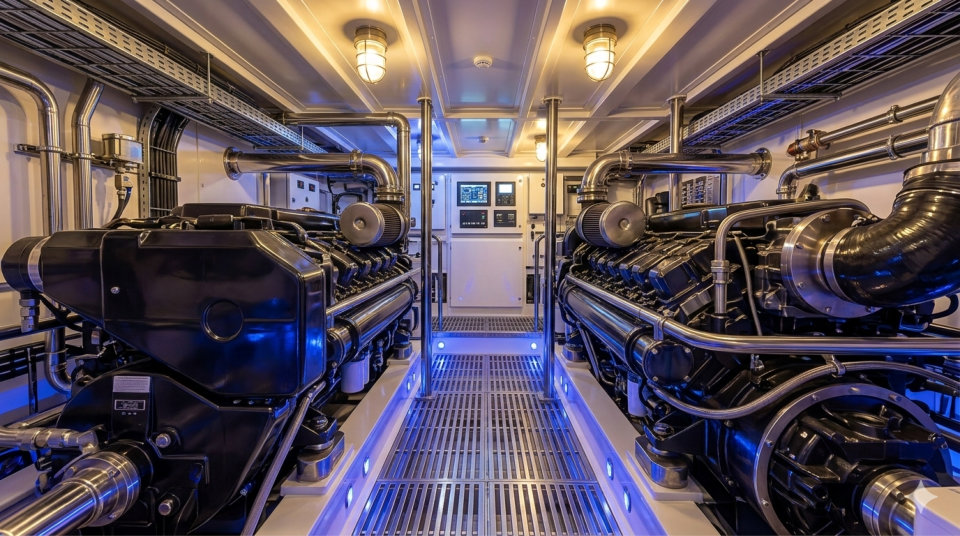
The Luxury Yacht Reality
Over 75% of unexpected marine breakdowns result from poor maintenance or lack of maintenance [5]. For owners running hard between harbors, staying ahead of cooling system maintenance is the key to preserving reliability and protecting a significant investment in propulsion [8].
Where Scale Forms in Marine Cooling Systems
Heat Exchangers
Scale on tube surfaces insulates heat transfer. A gradual increase in pressure difference between inlet and outlet indicates scale formation [7].
Aftercoolers
Charge air coolers are particularly vulnerable. Fouled aftercoolers lead to reduced engine power and increased exhaust temperatures [8].
Keel Coolers
External hull-mounted coolers accumulate marine growth and mineral scale, reducing heat rejection capacity [10].
Oil Coolers
Scale restricts oil cooling passages, leading to higher oil temperatures and accelerated engine wear [8].
Raw Water Circuits
Scale-narrowed passages reduce flow to critical components, causing hot spots and premature failure.
Expansion Tanks
Scale debris can circulate through the system, blocking small passages in injectors and coolers.
According to marine engineering sources, the principal causes of clogged or restricted cooler elements include not only hard deposits chemically precipitated from circulating water, but also marine life, grease, and debris of various types [7].
Critical Distinction: Reactive Chemical Descaling vs. True Prevention
Most marine engines are maintained reactively—waiting until performance drops, then scheduling acid cleaning of heat exchangers. For luxury yacht owners, this approach carries hidden costs that go far beyond the service invoice.
- Requires haul-out or dry-docking - Major disruption to yacht schedule
- Chemical hazards - Acid handling, disposal, environmental concerns
- Equipment stress - Repeated acid cleaning thins tube walls, shortens heat exchanger life [10]
- Reactive approach - You only address scale after efficiency has already dropped
- Never-ending cycle - Scale returns, performance drops again, repeat cleaning
- Downtime during peak season - Lost charter revenue, ruined vacations
- Marine growth chemicals - Biocides and treatments that harm marine environment [1]
A single heat exchanger chemical cleaning can cost $2,000-$5,000 plus lost time—and the scale returns within months.
- Zero downtime - External installation, no haul-out required
- Zero chemicals - No acid, no biocides, no environmental harm
- Equipment protection - Prevents scale, extends heat exchanger life
- Preventive approach - Scale never forms, efficiency never drops
- Permanent solution - Install once, protect forever
- Always ready - No unexpected downtime, always available for cruising
- Eco-friendly - No chemical discharge into sensitive marine waters

The Yacht Owner's Math
A 60-foot luxury yacht with twin MTU 12V2000 engines (2,000+ hp each) faces annual maintenance costs between $12,000-$15,000 [5]. A single overheat event can cause $50,000+ in engine damage and ruin a Mediterranean summer charter season. Vulcan provides insurance against scale-related failures—for a fraction of annual maintenance costs.
MTU Maintenance Schedule: Where Scale Prevention Fits
High-performance yacht engines like the Rolls-Royce MTU 12V2000 M96 deliver over 2,000 horsepower—but they demand disciplined maintenance [8].
OEM-Required Maintenance
| Interval | Required Service |
|---|---|
| 250 hours / 6 months | Inspect zinc anodes, check coolant concentration |
| 500 hours / yearly | Replace zincs, impellers, flush raw water system with descaling solution [8] |
| 1000 hours / 2 years | Aftercooler core flush and pressure test, replace coolant |
Note the annual requirement: "flush raw water system with an appropriate descaling solution" [8]. This is reactive maintenance—removing scale after it has already formed.
The Vulcan Advantage
With Vulcan installed, the descaling step becomes unnecessary. Scale never forms, so:
- No annual acid flushing required
- Heat exchangers remain at design efficiency
- Aftercoolers stay clean between 1000-hour intervals
- Zinc anodes last longer (less galvanic activity from scale)
- Coolant remains clean, extending change intervals
Vulcan doesn't replace maintenance—it makes maintenance more effective by eliminating the root cause of cooling system degradation.
Real Proof: Norwegian Cruise Ship
Vessel: Norwegian Cruise Ship
Application: Marine engine cooling systems
The Challenge
Marine vessels face constant scaling challenges in engine cooling circuits due to seawater exposure. Scale buildup reduces heat transfer efficiency and increases fuel consumption [6].
The Results
- Scale eliminated from engine cooling systems
- Improved heat transfer efficiency
- Reduced maintenance frequency [6]
- Chemical treatment reduced
Operational Impact
For cruise vessels operating continuously, every hour of downtime is lost revenue. By eliminating scale, this Norwegian cruise ship achieved:
- Reliable engine cooling
- Reduced maintenance intervals
- Lower chemical costs
- Extended equipment life

Real Proof: Moriarty Travel Center
Facility: Moriarty Travel Center
Application: Pool and shower systems (parallel to marine cooling)
The Challenge
Scale buildup in water circulation systems was increasing maintenance frequency and reducing equipment life [5].
The Results
- Scale eliminated from circulation systems
- Maintenance costs significantly reduced [5]
- Equipment life extended
Marine Parallel
The same circulation dynamics that cause scale in Moriarty's systems also affect marine engine cooling circuits. If Vulcan can eliminate scale in a commercial facility, it can do the same for your yacht's engines.
The Seawater Challenge: Why Marine Systems Are at Higher Risk
Scale Formation Accelerated
Scale deposits generally form faster on the saltwater side than on the freshwater side, because of the greater amount of dissolved salt present in the water [7].
Seawater discharge temperature should be maintained below a specified limit (130°F), because the rate of scale formation is increased as the temperature increases [7].
Multiple Fouling Mechanisms
Not only the hard deposits chemically precipitated from the circulating water, but also such items as marine life, grease, and debris of various types may clog or restrict cooler elements [7].
Marine systems face combined threats: mineral scale + biological fouling + sediment. Vulcan addresses the mineral component that provides attachment surfaces for biofouling.
The water used in closed cooling systems must be as pure as possible. Distilled water is recommended for a freshwater cooling system, but since distilled water is not absolutely pure, additional steps must be taken to control acidity and alkalinity [7].
ROI Calculator: 70' Luxury Motor Yacht
| Without Vulcan (Reactive Maintenance) | |
| Annual engine maintenance (MTU 12V2000 x 2) | $12,000 - $15,000 [5] |
| Heat exchanger chemical cleaning (every 2 years) | $2,500 avg. annualized |
| Aftercooler descaling (every 2 years) | $2,500 avg. annualized |
| Zinc anode replacement (annual) | $800 |
| Coolant changes (every 2 years) | $1,200 avg. annualized |
| Total annual cooling system cost | $19,000 - $22,000 |
| With Vulcan (Preventive) | |
| Chemical cleaning eliminated | $5,000 saved |
| Extended zinc life (2x longer) | $400 saved |
| Extended coolant life | $600 saved |
| Fuel savings (5% efficiency gain) | $3,500 - $5,000 |
| Extended heat exchanger life | $2,000 - $3,000 |
| Avoided overheat risk (insurance value) | Priceless |
| Total Annual Savings | $11,500 - $14,000+ |
The Catastrophic Risk
A single overheat event due to scale-clogged coolers can cause $50,000+ in engine damage—plus towing, haul-out, and ruined vacation time. Vulcan provides insurance against this risk.
Get Exact Pricing for Your Vessel
For precise pricing tailored to your engine configuration:
- Existing customers: Log in to your account to view model-specific pricing
- New users: Create a free account to access detailed pricing and configuration options
- Need assistance? Contact our team for a marine systems assessment
Account registration takes less than 2 minutes.
Recommended Vulcan Models for Marine Vessels
Different vessel sizes and engine configurations require different models. Create an account for detailed specifications and pricing.
Vulcan S100 / S150
Single or twin engines up to 1,000 hp
Engine heat exchangers
Generator cooling
Air conditioning systems
✓ Ideal for 40-60 foot vessels
Vulcan S250 / S350
Twin MTU/CAT/MAN 1,000-3,000 hp
Main engine cooling circuits
Keel cooler circuits
Hydraulic oil coolers
✓ Zero maintenance, zero consumables
Vulcan X-PRO Series
Multiple engines, ship-wide systems
Main engine raw water circuits
Central cooling systems
HVAC chillers and condensers
✓ Permanent scale prevention
Marine Engine Cooling System Maintenance Checklist
- Daily checks: Coolant level, engine temperature, raw water flow [8]
- Monthly: Inspect zinc anodes, check for signs of scale
- 250 hours / 6 months: Inspect drive belts, electrical connections
- 500 hours / yearly: Replace zincs, impellers,
flush with descaling solution(not needed with Vulcan) - 1000 hours / 2 years: Aftercooler inspection, coolant replacement
- Install Vulcan on raw water intake: Prevent scale at source
- Monitor trends: Log temperatures, pressure differentials to catch issues early [7]
References
- RX Marine International. Marine Cooling System Protection.
- Carver Yachts. (2004). Owner's Guide - Mechanical Systems.
- University of Texas at Austin. (2024). Model-based controller design for marine chiller.
- European Commission. (2022). COOL4SEA Maritime Cooling Technology.
- Legacy Motors & Marine. (2025). Guide to Maintaining Yacht Performance.
- Vulcan Descaler. Norwegian Cruise Ship Case Study.
- Integrated Publishing. (2024). Marine Engineering - Cooling Water Systems.
- 805 Marine Diesel Mechanic. (2023). MTU Marine Diesel Maintenance Schedule.
- Leonardo DRS. (2023). Navy Refrigeration Systems.
- Apex Engineering Products. (2025). Descaling Marine Equipment Guide.
Questions for Your Marine Technician
- What is our current heat exchanger approach temperature?
- How much pressure drop is across our aftercoolers?
- When were heat exchangers last chemically cleaned?
- Are we seeing any temperature rise at cruise RPM?
- How often do we replace zinc anodes?
- Is scale visible on any heat transfer surfaces?
- What would 5% better fuel efficiency save us annually?
Vulcan provides the answers—and the solution.
Protect Your Investment, Protect Your Peace of Mind
Join discerning yacht owners and marine professionals in eliminating scale-driven cooling system failures—without chemicals, without downtime.
About the Author
Waslix (Vulcan Mineral Descaler) provides non-chemical, maintenance-free scale prevention for marine engines worldwide. Our physical impulse technology keeps heat exchangers clean, aftercoolers efficient, and cooling systems reliable—trusted by luxury yacht owners and marine technicians globally. Create an account for detailed model specifications and pricing.

