
The Fitness Center HVAC Challenge: Why Efficiency Matters
According to the U.S. Department of Energy, HVAC systems can account for up to 40% of energy use in commercial buildings, with poorly maintained systems consuming even more [3]. For fitness centers operating 24/7 with high occupancy and intense physical activity, that percentage can be significantly higher.
40%
HVAC portion of energy use [3]
7-12%
Efficiency loss per 1mm scale [1]
$450,000+
Annual savings for 57 clubs [10]
Fitness centers face unique HVAC challenges. The constant motion of athletes means body heat builds up fast, putting additional stress on cooling systems. Large open areas with high ceilings, constant foot traffic, and significant cooling loads create energy demands unlike traditional offices or retail spaces [3].
Maintaining a comfortable climate is always a priority for gyms, but facilities with childcare centers, pools, and diverse activity zones face even greater challenges. A 40-year-old Healthtrax location had aging HVAC units causing poorly regulated temperatures, circulation issues, and leaks that disturbed members—with energy costs ranking as their highest operational expense after payroll [7].
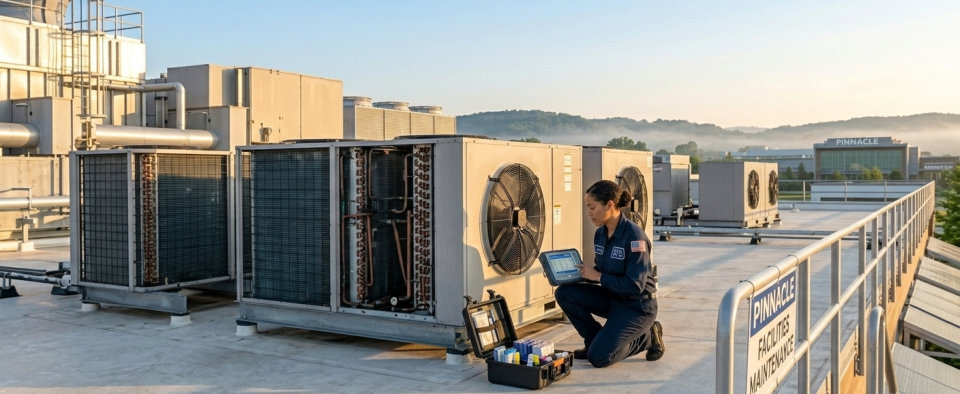
The Hidden Drain
Unoptimized HVAC systems don't just waste energy—they drive reactive maintenance costs 3-5 times higher than planned maintenance and reduce equipment lifespan by up to 30% [9].
Where Scale Undermines Fitness Center HVAC
Condenser Coils
Scale acts as insulation, reducing heat transfer. Just 1.6mm of scale can reduce system efficiency by 12% [1].
Cooling Towers
Scale on fill surfaces reduces heat rejection, increases fan energy, and forces more blowdown—wasting water and chemicals.
Chillers
Scale on chiller tubes increases approach temperature, reducing chiller efficiency and capacity while increasing energy consumption.
Heat Exchangers
Scale impedes heat transfer efficiency, forcing equipment to input more energy to retain the same level of performance [1].
Condenser Water Loops
Scale-narrowed pipes increase pumping pressure, wasting energy and reducing flow to remote areas of the facility.
Temperature Control
Scale-insulated coils respond slowly, causing temperature swings and member discomfort [7].
Industry studies show that for every 1mm increase in scale thickness, energy usage increases by 7% [1]. Over a 10-year period, these losses compound dramatically—a small hotel with 4mm of scale faces 28% higher operating costs [1].
The Scale-Energy Connection: Quantifying the Loss
The Math of Scale
Based on commercial building studies [1]:
- 1mm scale = 7% energy increase
- 2mm scale = 14% energy increase
- 3mm scale = 21% energy increase
- 4mm scale = 28% energy increase
For a medium-sized fitness center spending $50,000 annually on HVAC energy, 4mm of scale costs $14,000 per year in wasted energy alone.
The Savings Opportunity
A case study of 57 fitness centers across North America demonstrated:
- 18% average energy savings through HVAC optimization [10]
- $450,000+ total annual savings
- Precise zone control achieved
- Consistent member comfort maintained
These savings came from controls optimization—scale prevention would add even more.
Critical Distinction: Reactive Cleaning vs. True Prevention
Most fitness centers address condenser scale reactively—waiting until efficiency drops, then hiring contractors for chemical cleaning. This approach has hidden costs beyond the service invoice.
- System downtime - Cleaning requires shutdown, disrupting member experience
- Chemical hazards - Acid handling, disposal costs, environmental concerns
- Equipment stress - Repeated acid cleaning thins tube walls, shortens equipment life
- Reactive approach - You only address scale after efficiency has already dropped
- Never-ending cycle - Scale returns, efficiency drops again, repeat cleaning
- Energy waste between cleanings - You pay the efficiency penalty until scale is removed
Emergency repairs cost 3-5 times more than planned maintenance [9]. Chemical cleaning is no exception.
- Zero downtime - External installation, no system shutdown
- Zero chemicals - No acid, no disposal, no hazards
- Equipment protection - Prevents scale, extends equipment life
- Preventive approach - Scale never forms, efficiency never drops
- Permanent solution - Install once, protect forever
- Continuous savings - No energy waste between cleanings

The Fitness Center Math
A medium-sized gym with 8 rooftop units, each cleaned twice annually at $500 per cleaning, spends $8,000 yearly on reactive maintenance—plus the 7-12% energy penalty between cleanings. Vulcan eliminates both the maintenance cost and the efficiency loss [1].
Real Proof: Fergus Falls Area Family YMCA
Facility: Fergus Falls Area Family YMCA
Location: Minnesota
Challenge: High energy costs, HVAC units "fighting each other"
The Challenge
"We had HVAC units fighting each other and our equipment was not working properly. Our energy costs were also much higher than they should have been." — Steve Nelson, Facilities Manager [5]
Schedules were not being used, and rooftop units were running 24/7 rather than only during regular operating hours.
The Results
- 40% annual energy savings [5]
- Proper scheduling implemented
- Gym temperature optimized for members
- Savings repurposed for facility improvements
"Things have improved significantly. Our Trane controls technician is top-notch and the temperature is where it needs to be. We are saving energy costs and that savings is being used for other improvements to our facility." [5]
The Vulcan Connection
The YMCA achieved 40% savings through controls optimization—but their condensers remained at risk of scale.
Imagine combining controls optimization with Vulcan scale prevention:
- 40% savings from scheduling + 7-12% from scale prevention
- No chemical cleaning costs
- Extended equipment life
- Consistent year-round efficiency
Real Proof: 57 Fitness Centers Save $450,000+
Facility: 57 corporate-owned fitness centers
Location: United States and Canada
Challenge: Uncoordinated HVAC units driving peak demand charges
The Challenge
Each location operated 4-7 AC units with individual thermostats. Managers frequently adjusted settings in response to member complaints, overriding schedules and creating inefficiency. If all units operated simultaneously, utility companies billed maximum demand charges [10].
The Results
- 18% average energy savings per location [10]
- $450,000+ total annual savings
- Precise zone temperature control
- Centralized monitoring and diagnostics
"The internal climate is now consistently precise, with little variation from the set point. This is good for our members and good for our bottom line." — Alan Buell, Construction Head [10]
The Scale Opportunity
These savings came from control optimization alone. The facilities did NOT address condenser scale—meaning their 18% savings could have been even higher.

With Vulcan, the same facilities could achieve:
- 18% control savings + 7-12% scale prevention savings
- Eliminated chemical cleaning costs
- Extended equipment life
Real Proof: Healthtrax Fitness & Wellness, Rhode Island
Facility: Healthtrax Fitness & Wellness
Location: East Providence, Rhode Island
Size: 30,000 sq ft with squash courts, pools, daycare
The Challenge
A 40-year-old facility with aging HVAC units causing poorly regulated temperatures and leaks. Different zones (squash courts, ride studios, yoga, pools, daycare) all had unique temperature requirements. HVAC was the highest operational cost after payroll [7].
The Results
- 12 HVAC units replaced with zero member disruption
- Improved temperature control and air quality
- Energy and water savings achieved [7]
"There was no major inconvenience for us or members. The coordination was great — cranes, timing, communication — it all went smoothly. I didn't hear a single complaint. First-class operation." — Steve Capezzone, Owner [7]
Preventive Protection
Healthtrax invested in new HVAC equipment—a perfect time to add Vulcan protection and ensure those new units stay scale-free for their entire lifespan.
New equipment + Vulcan =
- No scale accumulation
- Design efficiency maintained
- No chemical cleaning needed
- Maximum equipment life
HVAC Maintenance Best Practices for Fitness Centers
Essential Maintenance Tasks
ROI Calculator: 30,000 sq ft Fitness Center
| Baseline HVAC Energy Costs | |
| Annual HVAC electricity consumption | 500,000 kWh |
| Electricity rate | $0.12/kWh |
| Annual HVAC energy cost | $60,000 |
| Natural gas for heating (if applicable) | $15,000 |
| Total HVAC energy cost | $75,000 |
| With 1mm Scale (7% efficiency loss) [1] | |
| Additional energy cost | $5,250 |
| With 2mm Scale (14% efficiency loss) | |
| Additional energy cost | $10,500 |
| Chemical cleaning (2x/year @ 8 rooftop units) | |
| Annual chemical cleaning cost | $8,000 |
| With Vulcan (Zero Scale) | |
| Energy penalty eliminated | $5,250 - $10,500 saved |
| Chemical cleaning eliminated | $8,000 saved |
| Extended equipment life (value) | $3,000 - $5,000 |
| Total Annual Savings | $16,250 - $23,500 |
Member Comfort Value
A fitness franchise reported that precise temperature control eliminated member complaints and improved retention [10]. The value of reduced churn far exceeds direct energy savings.
Get Exact Pricing for Your Fitness Center
For precise pricing tailored to your HVAC system specifications:
- Existing customers: Log in to your account to view model-specific pricing
- New users: Create a free account to access detailed pricing and configuration options
- Need assistance? Contact our team for a fitness center assessment
Account registration takes less than 2 minutes.
Recommended Vulcan Models for Fitness Centers
Different facility sizes require different models. Create an account for detailed specifications and pricing.
Vulcan S50 / S100
Up to 5,000 sq ft
Rooftop units
Small split systems
Individual HVAC zones
✓ 7-12% efficiency gain
Vulcan S150 / S250
5,000-20,000 sq ft
Multiple rooftop units
Central HVAC systems
Cooling towers
✓ Zero maintenance, zero consumables
Vulcan X-PRO Series
20,000+ sq ft / multiple buildings
Central plants
Pool dehumidification
Large cooling towers
✓ Permanent scale prevention
Fitness Center HVAC Efficiency Checklist
- Audit current HVAC energy use: Establish baseline consumption [3]
- Check filter condition: Replace monthly in high-use facilities
- Inspect condenser coils: Look for visible scale buildup
- Review temperature setpoints: 72-75°F recommended [3]
- Implement smart scheduling: Match occupancy patterns
- Install Vulcan on main HVAC lines: Prevent condenser scale
- Track energy bills: Document savings post-installation
- Schedule annual professional tune-up: Maintain peak efficiency
References
- Rinnai UK. (2025). Limescale protection in commercial heating and hot water systems.
- Drez Air. (2025). Indoor sports air conditioner maintenance tips to lower energy costs.
- U.S. Department of Energy via Drez Air. (2025). HVAC energy use in commercial buildings.
- Goodway. (2025). How to Assure 'Right Sizing' HVAC Systems for Efficient Operation.
- Trane. (2025). Fergus Falls Area Family YMCA Case Study.
- Budderfly. (2025). Healthtrax Transforms 30,000 sq ft Gym.
- Budderfly. (2025). Healthtrax case study.
- Climate Solutions. (2025). Smart Climate Control in Health & Fitness Centers.
- Sensibo. (2025). How to Reduce HVAC Operating Costs for Commercial Buildings.
- Save Energy Systems. (2017). Fitness Franchise Energy Savings Case Study.
Questions for Your HVAC Efficiency Audit
- What is our current HVAC energy cost per month?
- When were condenser coils last inspected for scale?
- How often do we chemically clean our condensers?
- Do different zones (weight room, yoga, cardio) maintain different temperatures?
- Are HVAC schedules aligned with actual occupancy patterns?
- Do we have any member complaints about temperature or air quality?
- What would 7-12% lower HVAC energy costs save us annually?
Vulcan provides the answers—and the solution.
Keep Your Condensers Clean, Your Costs Low
Join leading fitness centers in eliminating scale-driven energy waste—without chemicals, without downtime.
About the Author
Waslix (Vulcan Mineral Descaler) provides non-chemical, maintenance-free scale prevention for fitness center HVAC systems worldwide. Our physical impulse technology keeps condensers clean, maintains design efficiency, and eliminates chemical cleaning costs—proven in thousands of commercial installations. Create an account for detailed model specifications and pricing.

