
The Shocking Reality: Ice Machines Are the #1 Health Code Violation
It can be surprising to think that ice can "go bad." After all, ice is often used to keep other foods and drinks safe. Yet in 2019, dirty ice machines were cited 20 percent of the time on health inspections [1].
20%
Inspections cite ice machines [1]
95%
Machines have hidden mold [2]
#1
Most cited violation [1]
$2k-5k
Machine replacement cost
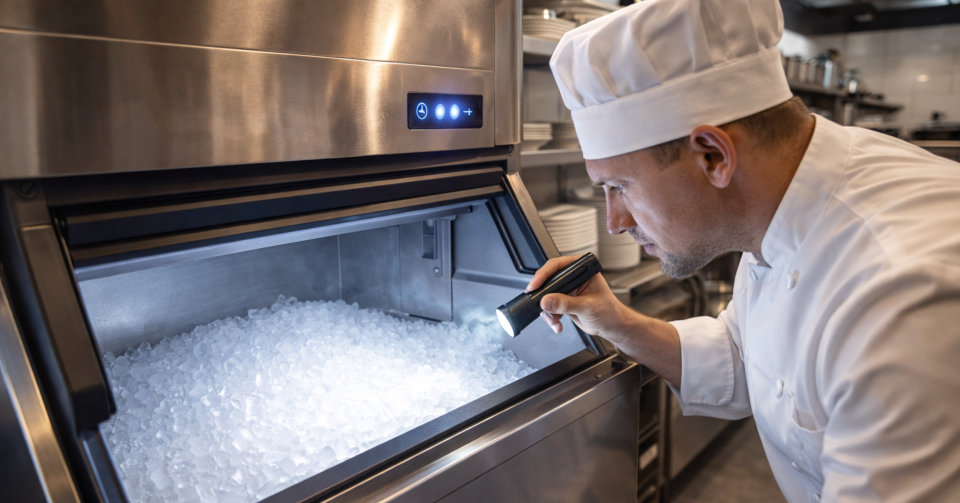
The reality is that ice machines can easily become the dirtiest place in the restaurant. The culprits are biofilm, or slime, and scale, which is calcium and magnesium buildup. Ice is considered a ready-to-eat food and thus subject to cross contamination [3].
Just one recent inspection report tells the story: "Buildup on deflector plate of the ice machine. Facility must melt ice and clean and sanitize machine." [4] Another hospital inspection found "whitish flakey mineral deposits were observed on the ice machine, above the ice chute and surrounding areas" and "white crusty discoloration and brownish substance on the rim of the chute" [5].
The Legal Reality
According to the FDA Food Code 2022 Section 4-601.11, "Equipment, food-contact surfaces and utensils shall be clean to sight and touch." [5] Failure to comply can result in citations, fines, and even closure during peak service hours.
Real-World Failure: Glenn Medical Center
Facility: Glenn Medical Center
Location: California
Date: January 2024
The Findings
During an inspection on January 9, 2024, surveyors observed "whitish flakey mineral deposits were observed on the ice machine, above the ice chute and surrounding areas." When the ice chute was removed, "white crusty discoloration and brownish substance on the rim of the chute was observed." [5]
The Root Cause
- No documented preventive maintenance program
- Staff claimed cleaning every 3 months but had no records
- Manufacturer's manual missing—no cleaning procedure available
- Maintenance logs non-existent [5]
"The facility failed to have a preventive maintenance program to ensure that all essential mechanical, electrical and patient-care equipment was maintained in a safe, sanitary, and operating condition." [5]
The Violation
USDA Food Code 2022 Section 4-601.11: Equipment, food-contact surfaces and utensils shall be clean to sight and touch.
This facility's failure to maintain their ice machine had the potential to cause foodborne illnesses within the medically vulnerable population of 18 patients [5].

Where Scale and Biofilm Hide in Your Ice Machine
Evaporator Plate
Scale acts as insulation, reducing ice production and creating uneven surfaces where bacteria hide. Cloudy ice is a sign the evaporator needs attention [2].
Water Distribution System
Ice machines have water distribution systems that have a tendency to grow mold. These parts should be pulled off quarterly to clean or replace them [2].
Ice Chute & Dispenser
The Glenn Medical Center inspection found "whitish flakey mineral deposits" above the ice chute—a common hiding spot [5].
Ice Bin Interior
Approximately 95 percent of the time, we find mold inside the ice bin because it has not been emptied, cleaned and sanitized [2].
Condenser Coils
On remote units, inspect condenser coils quarterly. Dirty coils reduce efficiency and can cause premature failure [2].
Drain Lines
Improper drainage can lead to backup into the machine. An air gap under the machine's drainage is required to prevent contamination [1].
The Two-Step Problem: Scale and Biofilm
Keeping an ice machine clean is a two-part process [3]:
Descaling is ridding the machine of the minerals that build up on components, which can impede the movement of the parts and cause premature wear [3].
Why it's critical: "Descaling is important because scale is very hard and creates an uneven surface that can host colonies of microscopic bacteria, known as biofilm." [3]
Signs of scale: White mineral deposits, cloudy ice, ice sticking to evaporator [2]
Sanitizing gets rid of biofilm, or slime. Green or pink slime indicates the ice machine needs sanitizing [3].
Why it's critical: Biofilm protects harmful bacteria from sanitizers. If you don't remove the slime, you're not killing the bacteria underneath.
Signs of biofilm: Pink, yellow, or brown slime in ice bin or on surfaces [1]
The harsh reality: if scale is present, you cannot effectively sanitize. The scale creates a rough surface that shelters bacteria from chemicals. You're just sanitizing the top layer while bacteria thrive underneath.
Critical Distinction: Reactive Chemical Cleaning vs. True Prevention
Most restaurants accept descaling and sanitizing as unavoidable tasks. But the chemicals themselves create risks—and the cycle never ends.
- Machine downtime - 1-2 hours out of service [3]
- Chemical handling hazards - Acids require PPE, careful storage
- Rinsing required - Multiple flushes to remove chemical residue
- Reactive approach - Only after scale has already formed
- Never-ending cycle - Scale returns, descaling repeats
- Chemical taste risk - Improper rinsing contaminates ice [2]
- Damage risk - "Never use a blade or a screwdriver to remove scale. This can ruin the evaporator or gouge the plastic components, which creates an ideal space for biofilm to take root." [3]
A single descaling uses harsh acids that must be completely flushed to avoid contaminating ice [2].
- Zero downtime - Machine always operational
- Zero chemicals - No acids, no PPE, no storage
- No rinsing required - Water chemistry unchanged
- Preventive approach - Scale never forms
- Permanent solution - Install once, protect forever
- No chemical taste - Ice tastes like water, not chemicals
- Smooth surfaces - No scale, no hiding places for biofilm
The Key Difference:
Vulcan does NOT remove minerals—it temporarily changes the molecular structure of minerals so they do not bond to surfaces [10]. Scale never forms, so biofilm never has a rough surface to attach to.
The Restaurant Owner's Math
A busy restaurant grosses $300-$800 per hour. A 2-hour descaling session costs $600-$1,600 in lost revenue—plus the $50-100 in chemicals and labor. Four descaling cycles per year = $2,600-$6,800 in lost revenue and direct costs. Vulcan eliminates this entirely.
Real Proof: Avril Supermarket, France
Facility: Avril Supermarket
Location: France
Application: Multiple water systems including ice machines
The Challenge
The supermarket faced persistent scale buildup across multiple systems. Scale was clogging nozzles and affecting equipment performance [8].
The Results
- "No more clogged nozzles" or scale buildup [8]
- Scale eliminated from all systems
- Reduced maintenance calls
Direct Translation to Ice Machines
"No more clogged nozzles" means:
- Clean evaporator plates
- Clear water distribution
- No mineral buildup on ice chute
- Zero descaling required
This case proves Vulcan delivers scale-free operation in food service environments.
Real Proof: Indonesian Food Processing Plant
Facility: Food Processing Plant (Delicatessen)
Location: Indonesia
Application: Boilers, heat exchanger, sterilizers
The Challenge
The facility faced severe scaling issues across multiple systems. They sought a chemical-free solution that would make old scale manageable and prevent future deposits [9].
The Results
- 0.5mm scale cleared within 2 months [9]
- 15-year scale buildup disappeared within 3 months
- Chemical treatment eliminated
Relevance to Ice Machines
If Vulcan can remove 15 years of scale from industrial equipment, it can certainly keep your ice machine scale-free. The same technology protects evaporators, water distribution systems, and ice chutes.

5 Warning Signs Your Ice Machine Needs Attention
- Cloudy ice: A visible and extreme indication that there's a problem is when the ice isn't uniform in size and shape. This may signify that the evaporator needs attention [2].
- Pink, yellow, or brown slime: Dirty ice doesn't always look like you'd expect—mold in an ice machine can be pink, yellow, or brown [1].
- Ice sticking to evaporator: "One common sign of scale buildup is when ice sticks to the evaporator and doesn't harvest." [3]
ROI Calculator: Busy Restaurant (1 Ice Machine)
| Without Vulcan (Reactive Descaling) | |
| Descaling chemical (4 treatments @ $50 each) [3] | $200 |
| Labor/technician time (4 x 2 hours @ $50/hr) | $400 |
| Downtime lost revenue (4 x 2 hours @ $300/hr) | $2,400 |
| Energy penalty (scaled evaporator) [10] | $150 |
| Premature component replacement (annualized) | $300 |
| Health inspection re-fees (if cited) | $200-500 potential |
| Total annual descaling cost | $3,650-3,950 |
| With Vulcan (Preventive) | |
| Descaling chemical eliminated | $200 saved |
| Labor/technician time eliminated | $400 saved |
| Downtime eliminated | $2,400 saved |
| Energy savings | $150 saved |
| Component replacement eliminated | $300 saved |
| Inspection risk eliminated | $200-500 saved |
| Total Annual Savings | $3,650-3,950 |
The Reputation Value
A single health inspection failure can be posted online, shared on social media, and damage your restaurant's reputation for years. Vulcan provides insurance against ice machine violations.
Get Exact Pricing for Your Kitchen
For precise pricing tailored to your ice machine specifications:
- Existing customers: Log in to your account to view model-specific pricing
- New users: Create a free account to access detailed pricing and configuration options
- Need assistance? Contact our team for a kitchen equipment assessment
Account registration takes less than 2 minutes.
FDA-Compliant Ice Machine Maintenance Checklist
- Daily: Inspect ice for clarity and odor. Never store drinks or food in ice bin [3].
- Weekly: Clean ice scoop holder, wash scoop in dishwasher [3].
- Monthly: Empty ice bin completely, clean and sanitize interior surfaces [2].
- Quarterly: Inspect and clean water distribution system components [2].
- Quarterly: Check condenser coils for dirt accumulation [2].
- Install Vulcan on water line: Prevent scale at source—no more descaling needed.
- Maintain logs: Document all cleaning and maintenance for health inspectors [5].
- Keep manual available: NSF requires cleaning instructions on inside of front panel [3].
Recommended Vulcan Models for Food Service
Different kitchen sizes require different models. Create an account for detailed specifications and pricing.
Vulcan S50 / S100
1 ice machine + coffee equipment
Protects ice machine evaporator
Eliminates descaling downtime
Prevents health code violations
✓ Ideal for single ice machine
Vulcan S150 / S250
2-3 ice machines + beverage systems
Multiple ice machine protection
Soda dispensers
Coffee/espresso equipment
✓ Zero maintenance, zero consumables
Vulcan X-PRO Series
Multiple ice machines, dishwashers, kitchen-wide
Full kitchen water protection
Dishwashers and steamers
Complete compliance assurance
✓ Permanent scale prevention
References
- Argentum. (2020). Keep an Essential Product Clean: Take Good Care of Your Ice Machine.
- Foodservice Equipment & Supplies. Cleaning & Maintaining Remote Ice Machines.
- Pizza Today. (2021). Descaling and sanitizing ice machines can prevent equipment failure.
- Reno Gazette-Journal. (2025). Ice machine buildup among health code violations.
- HospitalInspections.org. (2024). Glenn Medical Center Inspection Report.
- Health Inspection Database. (2025). Ice machine violation citation.
- OregonLive. (2018). Safeway ice machine drainage violation.
- Vulcan Descaler. Avril Supermarket Case Study.
- Vulcan Indonesia. (2024). Food Processing Plant Installation Case Study.
- Vulcan Descaler. Electronic Anti-Scale System - Technology Overview.
Questions Your Health Inspector Will Ask
- "When was this ice machine last cleaned?"
- "Where are your maintenance logs showing cleaning dates?" [5]
- "Do you have the manufacturer's cleaning manual?"
- "What is your preventive maintenance schedule?"
- "Have you noticed any mineral buildup or slime?"
- "Can you show me how you descale and sanitize this machine?"
With Vulcan, your answers are simple: "No mineral buildup, no slime. Here's our documentation."
Pass Every Inspection, Every Time
Join thousands of food service operators in eliminating the #1 health code violation—scale-free ice machines without chemicals, without downtime.
About the Author
Waslix (Vulcan Mineral Descaler) provides non-chemical, maintenance-free scale prevention for food service operations worldwide. Our physical impulse technology keeps ice machines free of mineral buildup, eliminates descaling downtime, and ensures compliance with FDA Food Code requirements—trusted by restaurants, hotels, and commercial kitchens globally. Create an account for detailed model specifications and pricing.

