
The Science of Ice Quality: Why Water Chemistry Matters
Ice may look simple, but it is a complex material. Small changes in water chemistry can significantly affect how it freezes, its strength, and its response to pressure [8]. Research from Toronto Metropolitan University's Jet Ice Research Chair shows how minerals, gases, and impurities can become trapped during freezing—directly affecting ice clarity, strength, and friction [8].
80-100 ppm
Ideal TDS for hockey ice [2]
1°C
TDS reduction equals temperature effect [2]
40-50%
Ideal humidity range [1]
A landmark 2026 study in Sports Engineering examined how water quality affects ice hardness and skate-to-ice friction under controlled rink conditions. The results showed that temperature influences ice hardness and static friction, with colder ice being harder and exhibiting higher static friction. Critically, water quality plays an equivalent role: lower total dissolved solid (TDS) levels reduce static friction, with effects comparable to a 1°C increase in ice temperature [2].
The study found that ultra-pure water produced softer ice, while moderate TDS levels (80-100 ppm) maintained ice hardness with only minor friction increases. These findings support hockey rink recommendations to maintain TDS near 80 to 100 ppm to balance ice hardness with friction performance [2].
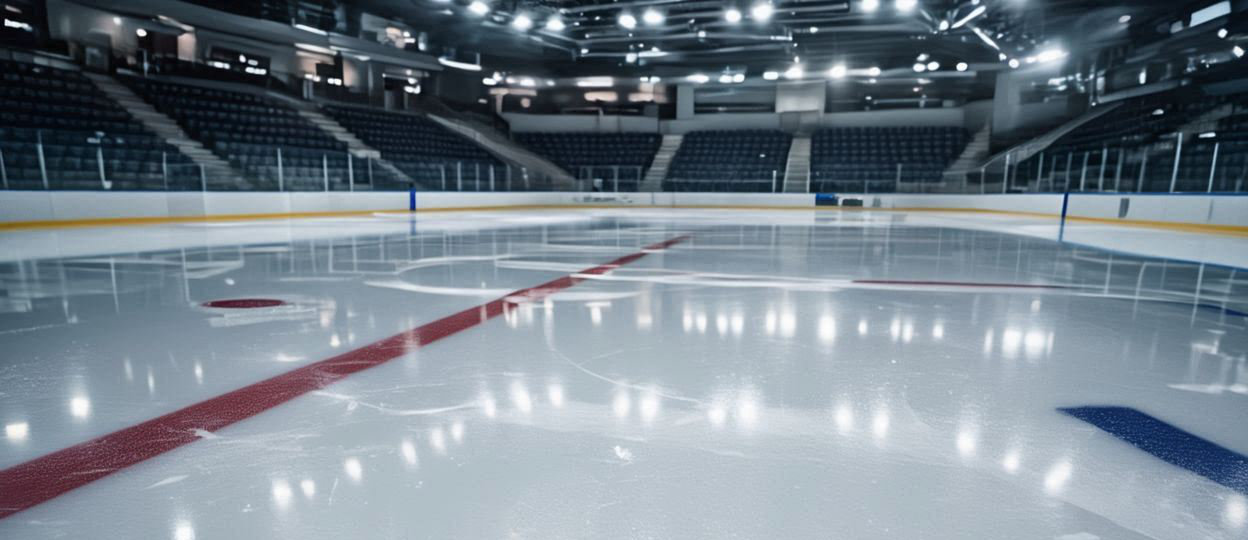
The Olympic Perspective
Don Moffatt, five-time Olympic ice master, explains: "Our main concern is pH, but our main measurement is called TDS, total dissolved solids. Too many, and the ice clouds over and blurs the lines and logos. Too few, and the sheet won't bond; it breaks apart. The sweet spot is between 75 and 125. That gives us a nice, dense sheet of ice." [5]
Key Water Quality Factors for Ice Making
According to the Canadian Water Quality Association, critical water quality parameters for ice include [8]:
Total Dissolved Solids (TDS)
High TDS levels, often from calcium, magnesium, or iron, can trap impurities in the ice. This leads to cloudy ice and weakens its surface [8].
Hardness (Ca & Mg)
Hard fill water affects how ice bonds and reacts to temperature changes. Conditioning helps keep ice consistent throughout games [8].
pH
pH influences carbonate equilibria and ice crystal formation. Stable pH is essential for consistent ice quality [2].
Dissolved Gases
Dissolved gases (oxygen and carbon dioxide) can form microbubbles, reducing strength and affecting resurfacing quality [8].
Particulates
Low particulates and dissolved gases cut down bubbles and weak spots, boosting puck bounce and reducing chipping [8].
Organic Matter
Organic carbon contributes to TDS and can affect ice clarity and bacterial growth in resurfacer systems.
A study of 55 North American ice arena managers confirmed that water quality plays a critical role in ice management, yet conflicting recommendations highlight the need for further research to determine optimal TDS levels [1][4].
Sport-Specific Ice Requirements
Different sports demand different ice characteristics—and water quality plays a role in achieving each [8]:
The International Ice Hockey Federation (IIHF) recommends maintaining TDS levels below 120 ppm, while many NHL ice-makers prefer the narrower range of 80–100 ppm for desirable ice conditions [2]. World Curling endorses the use of reverse osmosis water, which typically contains less than 10 ppm TDS [2].
Critical Distinction: Chemical Treatment vs. Vulcan Prevention
Most ice rinks manage water quality through chemical treatment or water softeners—but these approaches have significant drawbacks that affect ice quality and operational costs.
- Alters water chemistry: Removes calcium and magnesium, adds sodium
- Sodium affects ice: Changes friction and hardness characteristics
- Ongoing chemical costs: Salt, resin replacement, maintenance
- Brine discharge: Environmental concerns [7]
- Scale still forms: Softeners don't prevent scale in equipment
- Water waste: Regeneration cycles waste 20-100 gallons daily
"Cities are banning these systems due to environmental impact." [7]
- Preserves ideal TDS: Maintains 80-100 ppm target range
- No sodium added: Ice chemistry unchanged
- Zero ongoing costs: One-time investment
- Zero discharge: Environmentally friendly
- Scale prevented: Protects ice resurfacers, water heaters, pipes
- Zero water waste: No regeneration required
How It Works:
Vulcan's physical impulse technology alters the crystalline structure of calcium carbonate so it cannot bond to surfaces. Minerals stay in the water—preserving the precise TDS levels you need—but don't form scale in your equipment [6].

The Arena Operator's Choice
Chemical softeners alter your water chemistry—making it harder to achieve the precise TDS levels required for optimal ice. Vulcan preserves your target TDS while preventing scale. You get the ice you want without the chemical costs.
Real Proof: City of Kitchener Cold Water Pilot
Facility: Sportsworld Arena, Kitchener, Ontario
Duration: May 2024 – May 2025 [3]
The Challenge
Water heated up to 60°C is typically used because it gets the air out of the water for a smoother surface, both for making and resurfacing arena ice. Sportsworld Arena had consistently the highest energy intensity per square foot across municipally owned arenas in the region of Waterloo [3].
The Results
"During hockey tournaments ice may need to be resurfaced as many as 30 times in one day—with only one flood using up to 500 L of water." [3]
The Vulcan Advantage
Kitchener achieved savings through cold water deaeration. Now imagine combining that with Vulcan scale prevention:
- Protect the deaerator unit from scale
- Keep water lines at full diameter for optimal flow
- Prevent scale in ice resurfacers
- Compound energy savings year after year

Real Proof: Banff Fenlands Recreation Centre
Facility: Fenlands Recreation Centre
Location: Banff, Alberta
System: Two hockey arenas [9]
The Solution
Installation of a REALice system—an energy-saving water treatment system for ice rinks that creates a controlled vortex as water flows through it, eliminating the need to use heated water when building or resurfacing ice [9].
The Results
- 44,785 kWh/year electrical energy savings [9]
- 270 GJ/year natural gas energy savings
- 39 tonnes CO₂e/year GHG reductions
- $25,227 rebate/incentive
"This project represents one of the many ways the Town of Banff is working to reduce our overall energy consumption, which is a key strategy in addressing climate change." — Karen Sorensen, Mayor [9]
The Vulcan Connection
Banff achieved significant energy savings through cold water technology. Vulcan would protect that investment by:
- Preventing scale in the vortex system
- Keeping pipes at design diameter
- Protecting ice resurfacers from scale buildup
- Ensuring consistent water quality for optimal ice
Real Proof: UC Davis Bodega Marine Laboratory
Facility: UC Davis Bodega Marine Laboratory
Location: California
The Challenge
This leading research facility faced severe scale buildup in their water heating system, causing frequent maintenance and energy waste [10].
The Results
- Scale eliminated from water heaters
- No scale-related maintenance in 3+ years
- Energy savings validated in facility audit
Relevance to Ice Rinks
The same scale that plagued UC Davis's water heaters attacks ice rink equipment—water heaters, boilers, ice resurfacers, and pipes. Vulcan's proven technology protects them all.
Emerging Contaminants and Sustainability
Recent research highlights growing environmental concerns in ice rinks [1][4]:
Microplastics
A study found that a typical ice hockey game can produce up to 20 grams of microplastics, primarily from players' equipment and the boards. These microplastics can end up in ice resurfacing wastewater, potentially entering local water systems [4].
PFAS Concerns
PFAS (per- and polyfluoroalkyl substances) have been detected in ski area snowmelt and surrounding soils. As arenas focus on both performance and sustainability, addressing these contaminants will become increasingly important [1].
The City of Nový Bydžov in the Czech Republic is researching the use of captured rainwater as an alternative source of process water for ice rinks, potentially saving drinking water resources [6].
The Vulcan Advantage
Vulcan's chemical-free scale prevention works with any water source—municipal, treated, or rainwater. No chemicals, no discharge, no environmental footprint.
ROI Calculator: 2-Sheet Community Arena
| Without Vulcan (Reactive Maintenance) | |
| Energy penalty from scaled equipment (7%) | $8,400 |
| Ice resurfacer descaling (2x/year @ $1,500) | $3,000 |
| Water heater descaling (annually) | $1,200 |
| Boiler maintenance (scale-related) | $2,500 |
| Chemical water treatment (salt, inhibitors) | $3,600 |
| Water waste from softener regeneration | $900 |
| Total annual scale-related cost | $19,600 |
| With Vulcan (Preventive) | |
| Energy penalty eliminated | $8,400 saved |
| Ice resurfacer descaling eliminated | $3,000 saved |
| Water heater descaling eliminated | $1,200 saved |
| Boiler maintenance reduced | $2,500 saved |
| Chemical treatment eliminated | $3,600 saved |
| Water waste eliminated | $900 saved |
| Total Annual Savings | $19,600 |
The Ice Quality Value
Cloudy ice, poor glide, and inconsistent resurfacing directly affect player experience and user satisfaction. Vulcan preserves your water chemistry—so your ice stays at its best.
Get Exact Pricing for Your Arena
For precise pricing tailored to your facility specifications:
- Existing customers: Log in to your account to view model-specific pricing
- New users: Create a free account to access detailed pricing and configuration options
- Need assistance? Contact our team for an ice rink assessment
Account registration takes less than 2 minutes.
Recommended Vulcan Models for Ice Rinks
Different arena sizes require different models. Create an account for detailed specifications and pricing.
Vulcan S250 / S350
Single ice surface, community facility
Protects ice resurfacer
Preserves ideal TDS levels
Boiler and water heater protection
✓ Perfect for community arenas
Vulcan S500 / X-PRO 1
2-3 sheets, higher usage
Multiple resurfacers
Central water system
Consistent ice quality
✓ Zero maintenance, zero consumables
Vulcan X-PRO 2
Multiple sheets, elite competition
Full facility protection
Precision TDS management
Olympic-level ice quality
✓ Permanent scale prevention
Ice Rink Water Quality Checklist
- Test TDS regularly: Target 80-100 ppm for hockey [2]
- Monitor pH: Stable chemistry ensures consistent ice
- Check ice resurfacer: Inspect for scale buildup
- Evaluate water heaters: Monitor recovery rates
- Consider cold water technology: Reduce energy costs [3][9]
- Install Vulcan on main water line: Prevent scale, preserve TDS
- Document ice quality: Track glide, hardness, clarity
- Monitor energy use: Document savings
References
- Scientific Reports. (2025). Arena ice quality and perspectives on optimizing performance.
- Sports Engineering. (2026). Effect of water quality on ice hardness and skate-to-ice friction.
- CityNews Kitchener. (2026). Kitchener cold water pilot project.
- NIH. (2025). Arena ice quality and emerging challenges.
- Olympics.com. (2025). Ice master Don Moffatt explains Olympic ice.
- Vulcan Descaler. Electronic Anti-Scale System Technology.
- The Old Farmer's Almanac. Softener environmental impact.
- Canadian Water Quality Association. (2026). The Science of Ice: Winter Olympics Edition.
- Municipal Climate Change Action Centre. (2020). Banff Fenlands REALice Retrofit.
- Vulcan Descaler. UC Davis Bodega Marine Laboratory Case Study.
Questions for Your Ice Rink Water Quality Audit
- What is our current TDS level? (Target: 80-100 ppm) [2]
- Do we use a water softener? Does it add sodium?
- How often do we descale our ice resurfacer?
- Is our ice consistently clear? Any cloudiness?
- Do players complain about ice speed or glide?
- Have we considered cold water technology?
- Could scale be affecting our ice quality?
Vulcan provides the answers—and the solution.
Achieve Olympic-Quality Ice
Join leading arenas in preserving water chemistry and preventing scale—delivering better ice, lower costs, and satisfied users.
About the Author
Waslix (Vulcan Mineral Descaler) provides non-chemical, maintenance-free scale prevention for ice rinks worldwide. Our physical impulse technology preserves the precise water chemistry required for optimal ice while protecting resurfacers, boilers, and water heaters from scale damage—trusted by community arenas and professional facilities globally. Create an account for detailed model specifications and pricing.

