
LEED and Retail Water Efficiency: The Opportunity
Retail properties occupy a unique position in the green building landscape. With high visibility to consumers and significant operational footprints, malls and retail centers can achieve substantial LEED points through strategic water management - while demonstrating environmental leadership to tenants and shoppers [1].
11+
LEED points for Water Efficiency [1]
30-50%
Cooling tower water savings [2]
5-7
Year ROI on water efficiency [3]
According to the USGBC, LEED-certified buildings have diverted over 80 million tons of waste from landfills and are responsible for $1.2 billion in energy savings [1]. For retail properties, the Water Efficiency (WE) category offers significant opportunities - particularly through cooling tower optimization, which accounts for the largest water use in most commercial buildings [4].
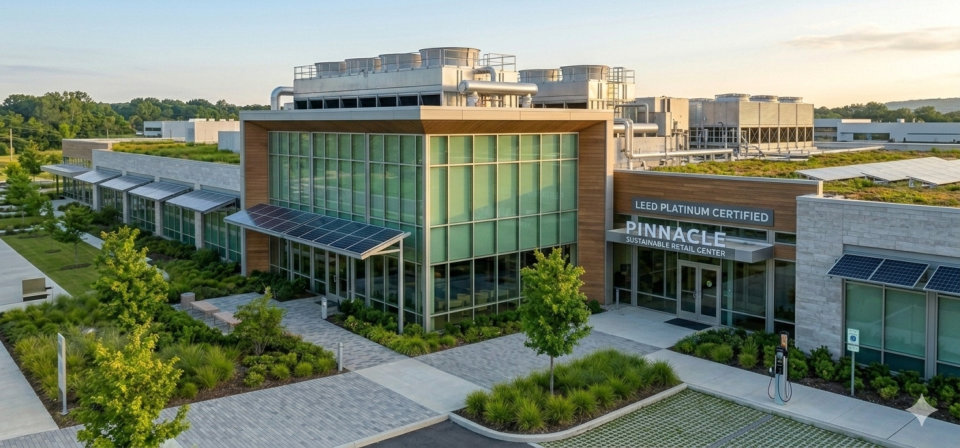
The Chemical-Free Advantage
Traditional water treatment introduces chemicals that conflict with LEED's Material & Resources and Indoor Environmental Quality goals. Chemical-free scale prevention aligns perfectly with LEED v5's emphasis on holistic sustainability.
LEED Water Efficiency Credits: What Retail Properties Need to Know
LEED v5 for Retail: New Construction and Major Renovations includes several Water Efficiency credits that cooling tower optimization can address [1]:
WE Credit: Outdoor Water Use Reduction
Points available: 1-2
Reduce outdoor water consumption through efficient landscaping. Alternative water sources (condensate, harvested rainwater) can offset cooling tower makeup [5].
WE Credit: Indoor Water Use Reduction
Points available: 1-6
Reduce indoor water consumption below baseline. Cooling towers are the largest indoor water users in most retail properties [2].
WE Credit: Cooling Tower Water Use
Points available: 1-2
Optimize cooling tower water treatment and increase cycles of concentration. Requires make-up water analysis, conductivity control, and chemical treatment optimization [4].
WE Credit: Water Metering
Points available: 1
Install permanent water meters for cooling towers, domestic water, and irrigation to enable ongoing management [4].
The WE Credit for Cooling Tower Water Use specifically requires:
- Conduct a make-up water quality analysis (hardness, alkalinity, silica, etc.)
- Install conductivity controllers to automate bleed
- Optimize cycles of concentration based on water quality
- Implement a water treatment management plan [4]
The Cooling Tower Challenge in Retail Properties
Common Obstacles
- Scale formation limiting cycles of concentration
- Chemical discharge compliance requirements
- High water and sewer costs
- Maintenance burden of chemical feed systems
- Tenant complaints about roof noise and drift
The LEED Solution Path
- Increase cycles to reduce blowdown
- Use alternative water sources
- Implement advanced controls
- Eliminate chemical treatment
- Document savings for LEED submission
How Vulcan Works: Physical Impulse Technology
Vulcan's impulse bands wrap around the pipe - no cutting, no plumbing modifications. The high copper alloy purity bands guarantee the cleanest possible frequency transfer output, maximizing the interactive frequency coverage area [8].
Treatment Zone:
Impulses radiate 9-16 feet on both ends of the impulse bands across the pipeline to make up the primary water treatment zone [8].
Scale Prevention Mechanism:
When water flows between the impulse band's primary treatment zone, the sticky structure of untreated water scale crystals are broken into smooth rod-shaped mono-crystals preventing the hard water minerals from bonding to surfaces [8].
Billions of microscopic rod-shaped descaling crystals behave like brushes, interacting with existing mineral deposits, loosening them and removing the scale with the water flow [8].

Vulcan S150 installed on main water line - zero chemicals, zero maintenance
Critical Distinction: Chemical Treatment vs. Vulcan for LEED
LEED v5 places increasing emphasis on holistic sustainability - including the environmental impact of building operations. Chemical water treatment introduces hidden costs that conflict with LEED's goals.
- Chemical discharge - Requires permits, violates zero-discharge goals [6]
- Ongoing chemical purchases - Recurring cost, supply chain dependencies
- Safety hazards - Chemical storage, handling, employee training
- Maintenance burden - Feed pumps, controllers, calibration
- Compliance documentation - Ongoing reporting requirements
- Conflicts with LEED IEQ - Chemical odors, drift concerns
"Cities are banning traditional softeners due to environmental impact" [6]
- Zero discharge - No chemicals to permit or report
- No ongoing costs - One-time installation, zero consumables
- No safety hazards - No storage, handling, or PPE required
- Zero maintenance - No moving parts, no calibration
- Simple documentation - Installation record only
- LEED-compatible - Supports all WE, IEQ, and MR credits

The LEED Perspective
Chemical treatment creates negative environmental impacts that LEED seeks to eliminate. Vulcan's physical impulse technology achieves the same operational goals - higher cycles, reduced blowdown, protected equipment - with zero chemical footprint.
Real Proof: Supermall Karawaci, Indonesia
Facility: Supermall Karawaci (SMK)
Location: Tangerang, Indonesia
Application: Cooling tower systems serving retail and cinema
The Challenge
Supermall Karawaci faced severe scaling issues in their cooling tower systems, driving up energy costs and maintenance frequency. The scale buildup was reducing heat transfer efficiency and forcing more frequent blowdown [9].
The Results
- Scale eliminated from cooling tower systems
- Energy consumption reduced by 11%
- Maintenance costs dropped immediately
- Chemical treatment eliminated [9]
LEED Impact
Supermall's results demonstrate the potential for LEED points:
- 11% energy reduction contributes to EA credits
- Water savings from higher cycles (WE credits)
- Chemical elimination supports MR credits
- Documented performance for LEED submission

Real Proof: Avril Supermarket, France
Facility: Avril Supermarket
Location: France
Application: Cooling systems, refrigeration, HVAC
The Challenge
The supermarket chain faced persistent scale buildup across multiple systems - cooling towers, refrigeration condensers, and HVAC equipment. Scale was reducing efficiency and increasing maintenance costs [10].
The Results
- Scale eliminated across all systems
- No more clogged nozzles or scale buildup
- Extended equipment life
- Reduced maintenance calls [10]
LEED Contribution
- WE Credit Cooling Tower Water Use: Higher cycles achieved without chemical treatment
- WE Credit Indoor Water Use Reduction: Less blowdown, reduced total water consumption
- EA Credit Optimize Energy Performance: Scale-free condensers maintain peak efficiency
- MR Credit Building Life-Cycle Impact Reduction: Extended equipment life reduces replacement frequency
Real Proof: IGA Extra Famille Girard, Canada
Facility: IGA Extra Famille Girard
Location: Quebec, Canada
Application: Supermarket refrigeration and HVAC systems
The Challenge
The supermarket faced chronic scale in their refrigeration condensers and HVAC systems, leading to higher energy consumption and frequent maintenance. They sought a chemical-free solution to align with sustainability goals [11].
The Results
- Scale eliminated from all systems
- Energy consumption reduced significantly
- Maintenance costs dropped
- Chemical treatment eliminated [11]
LEED Documentation Ready
Vulcan provides the documentation LEED reviewers require:
- Installation records
- Baseline vs. post-installation water use
- Energy savings calculations
- Zero-chemical verification
Alternative Water Sources for Retail LEED Points
LEED rewards the use of non-potable water sources for cooling tower makeup. Vulcan enables these sources by preventing scale regardless of water chemistry.
Condensate Recovery
Condensed water from air handlers is high-quality makeup water [4]. Vulcan ensures scale prevention even with variable water quality.
Rainwater Harvesting
Stormwater collection can offset potable demand [5]. Vulcan treats collected water regardless of hardness fluctuations.
Reclaimed Water
Municipal reclaimed water often has higher hardness. Vulcan prevents scale without chemical adjustment [6].
The Vulcan Enabler
Alternative water sources are often harder or more variable than municipal supply. Vulcan's physical impulse technology prevents scale regardless of water chemistry - making these LEED-friendly sources viable without chemical treatment.
LEED Water Efficiency Checklist for Retail
- WE Prerequisite: Conduct make-up water quality analysis (hardness, alkalinity, silica)
- WE Credit: Install conductivity controllers with automated bleed
- WE Credit: Install Vulcan on main cooling tower makeup line
- WE Credit: Increase cycles of concentration to 8-15 based on water quality
- WE Credit: Implement alternative water sources (condensate, rainwater)
- WE Credit: Install permanent water meters for cooling towers
- Documentation: Record baseline and post-installation water use
- Documentation: Verify zero-chemical operation for LEED submission
ROI Calculator: LEED Water Efficiency for Retail
| Baseline (4 cycles, chemical treatment) | |
| Annual cooling tower makeup water | 6,000,000 gallons |
| Annual chemical treatment cost | $8,500 |
| Annual water + sewer cost @ $15/kgal | $90,000 |
| Maintenance labor for chemical system | $4,500 |
| Total annual operating cost | $103,000 |
| With Vulcan (12 cycles, zero chemicals) | |
| Annual makeup water (40% reduction) | 3,600,000 gallons |
| Annual water + sewer savings | $36,000 |
| Chemical treatment elimination | $8,500 |
| Maintenance labor reduction | $4,500 |
| Energy savings (improved heat transfer) | $5,000 - $8,000 |
| Total Annual Savings | $54,000 - $57,000 |
LEED Value Add
Beyond direct savings, LEED certification adds significant value to retail properties - higher rents, increased tenant demand, and positive brand association. Water Efficiency credits are among the most cost-effective to achieve.
Get Exact Pricing for Your Retail Property
For precise pricing tailored to your cooling tower specifications:
- Existing customers: Log in to your account to view model-specific pricing
- New users: Create a free account to access detailed pricing and configuration options
- Need assistance? Contact our team for a retail property assessment
Account registration takes less than 2 minutes.
Recommended Vulcan Models for Retail Properties
Different retail sizes require different models. Create an account for detailed specifications and pricing.
Vulcan S100 / S150
Up to 500 tons cooling load
Individual store cooling
Standalone retail
Small food courts
✓ Ideal for LEED pilot projects
Vulcan S250 / S350
500-2,000 tons / multiple towers
Central plant cooling
Multiple tower systems
District cooling loops
✓ Zero chemicals, zero discharge
Vulcan X-PRO Series
2,000+ tons / mixed-use
Mixed-use developments
Large central plants
Campus-style retail
✓ Permanent scale prevention
More Retail Success Stories
Fan Mallorca
Carrefour / Shopping CenterShopping center in Palma de Mallorca eliminated scale in cooling systems, reducing energy consumption and maintenance.
Read →Beer Sheva Grand Mall
IsraelMajor shopping center resolved chronic scale issues in cooling towers, achieving significant water and energy savings.
Read →Marina Plaza
Office Building & MallMixed-use property eliminated scale in cooling towers and HVAC systems, reducing operating costs and chemical use.
Read →References
- USGBC. (2024). LEED v5 for Retail: New Construction and Major Renovations.
- U.S. Department of Energy. (2024). Water-Efficient Technology Opportunity: Advanced Cooling Tower Controls.
- USGBC. (2024). The three R's of cooling water conservation: Reduce, replace, reuse.
- Los Angeles Department of Water and Power. (2023). Cooling Towers: Saving Water Saves Money.
- Building Design+Construction. (2010). Water Performance Action Plan.
- Vulcan Descaler. Wobbling Impulse Frequency Mineral Descaling Technology.
- Control Global. (2018). Optimization of cooling towers.
- Vulcan Descaler. Physical Impulse Technology Overview.
- Vulcan Descaler. Supermall Karawaci Case Study.
- Vulcan Descaler. Avril Supermarket Case Study.
- Vulcan Descaler. IGA Extra Famille Girard Case Study.
Questions LEED Reviewers Will Ask
- "What is your baseline water use for cooling towers?"
- "What cycles of concentration have you achieved?"
- "What water treatment chemicals are used?"
- "How do you prevent scale and corrosion?"
- "Show me your water meter data for the past 12 months."
- "Have you implemented alternative water sources?"
With Vulcan, your answers are simple: zero chemicals, verified cycles, documented savings.
Earn LEED Credits with Vulcan
Join leading retail properties in achieving Water Efficiency credits while eliminating chemical treatment costs.
About the Author
Waslix (Vulcan Mineral Descaler) provides non-chemical, maintenance-free scale prevention for retail properties worldwide. Our physical impulse technology enables malls and retail centers to achieve LEED Water Efficiency credits while eliminating chemical treatment costs - proven in thousands of installations globally. Create an account for detailed model specifications and pricing.

