
What Is the Langelier Saturation Index (LSI)?
The Langelier Saturation Index is a mathematical formula used to predict whether water will dissolve calcium carbonate or deposit calcium scale. In simple terms: negative LSI means water is aggressive (corrosive), zero LSI (±0.3) means water is balanced, and positive LSI means water is scale-forming [1].
< -0.3
Corrosive / Aggressive [1]
-0.3 to +0.3
Balanced [1]
+0.3 to +0.5
Slightly Scale-Forming [1]
> +0.5
Scale-Forming [1]
Developed by Dr. Wilfred Langelier in 1936, the LSI measures the saturation level of calcium carbonate in water. Calcium carbonate is a compound that can form scale on surfaces or cause corrosion if the water is too aggressive [2]. The index is calculated using five key parameters: pH, alkalinity, calcium hardness, total dissolved solids (TDS), and temperature.
As the industry's sophistication in understanding pool water chemistry has grown, so has popular acceptance of the LSI as a tool for maintaining balance [3]. Yet there remains confusion about the Index both within the pool water testing community and among operators who may be vaguely aware it has something to do with pool chemistry [3].
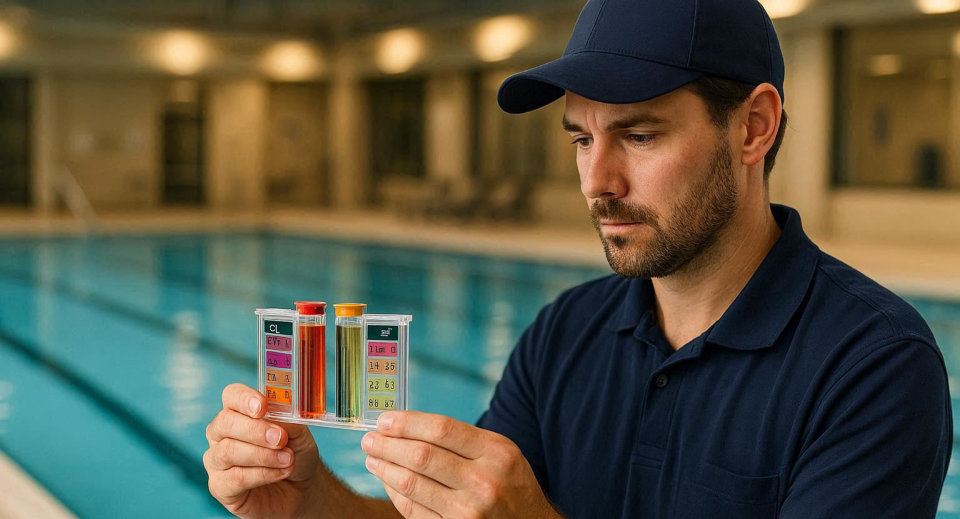
The Restaurant Health Score Analogy
"LSI is like a restaurant's health score. A score of 93 tells you things are generally fine, but you don't know exactly what's right or wrong. A score of 72 tells you something's seriously wrong, but you don't know if it's cockroaches or spoiled meat. LSI gives you that same kind of snapshot—it tells you if water is problematic, but you need to look deeper at individual parameters to know exactly what's happening." [3]
Why "In-Range" Chemistry Isn't Enough
A pool can technically be "within range" on every test strip and still destroy itself [1].
The Problem with Ranges
Traditional pool chemistry guidelines look at individual values: pH between 7.2 and 7.8, chlorine between 1-3 ppm, calcium hardness above a minimum threshold [1].
But balanced water is not about isolated numbers—it's about how those numbers interact with each other [1].
For example: pH 7.5, alkalinity 90 ppm, calcium 350 ppm. Looks fine—until temperature spikes, CYA climbs, or alkalinity becomes overstated. Suddenly, your water becomes scale-forming or corrosive without any single number appearing wrong [1].
Why LSI Matters
LSI evaluates how all chemistry factors work together [1]. This matters because:
- Water always seeks equilibrium [1]
- If calcium carbonate is missing, water will pull it from plaster, grout, and stone [4]
- If calcium carbonate is excessive, water will deposit it as scale [4]
LSI reveals the true chemical behavior of the water—not just isolated readings [1].
The LSI Formula
The familiar equation used by the pool industry is [5]:
LSI = pH + F(T) + F(TA) + F(CH) – F(TDS)
Where F stands for a "factor" based on temperature, alkalinity, calcium hardness, and TDS [5]
Temperature, total alkalinity, calcium hardness and total dissolved solids are all given a factor. The pH value is not given a factor and is used as measured at the pool [6].
When LSI is zero:
The water is balanced. Calcium carbonate scale should not form, nor should calcium carbonate be dissolved from cementitious surfaces [5].
When LSI is above zero:
The water is potentially scale-forming. The higher the number, the stronger the tendency for calcium carbonate scale to form [5].
When LSI is below zero:
The water is potentially aggressive towards calcium compounds. The lower the number, the stronger the tendency for etching to occur [5].
The Association of Pool & Spa Professionals (APSP) considers the minimum and maximum LSI for proper pool water balance to be -0.3 to +0.5. Within these parameters, water should be neither significantly aggressive nor scale-forming [5].
The Core Variables That Affect LSI
pH
pH has the strongest influence on LSI. Lower pH = more corrosive water; higher pH = more scale potential. Even a 0.2 pH shift can significantly change your LSI value [1].
Total Alkalinity (TA)
TA acts as a pH buffer. Problems with high alkalinity: encourages pH rise, increases scale potential. Problems with low alkalinity: pH becomes unstable, water can swing aggressively corrosive [1].
Calcium Hardness
Low calcium → water seeks calcium from plaster. High calcium → scale forms on surfaces and inside equipment. Calcium is structural, not optional [1].
Temperature
Temperature has a massive impact on calcium carbonate solubility. Warm water → scale forms more easily. Cold water → water becomes more aggressive [1].
Total Dissolved Solids (TDS)
As TDS rises, water behaves differently and saturation dynamics change. High TDS increases scale potential and can reduce water clarity. In salt pools, TDS can be especially high [1].
Cyanuric Acid (CYA)
High CYA inflates total alkalinity, alters carbonate chemistry, and pushes LSI toward scale formation. This is why many pools with "perfect numbers" still experience scale lines and cloudy water [1].
The Missing Piece Most Operators Ignore: Carbonate Alkalinity
When measuring total alkalinity, what really matters is carbonate alkalinity—because it's high or low carbonate levels that cause corrosion or scaling respectively [7].
Cyanuric acid and borates both increase total alkalinity but do NOT contribute to carbonate alkalinity [7].
The CYA Problem
When cyanuric acid concentration becomes particularly high, measured total alkalinity may fall within normal ranges, but the true carbonate alkalinity might be exceedingly low. This creates an extremely corrosive environment that causes etching to plaster surfaces and corroded metals [7].
Rule of thumb: subtract one-third of the cyanuric acid concentration from total alkalinity [7]:
Alkalinity corrected = Alkalinity total – 1/3 Cyanuric AcidIf you do not subtract CYA's contribution from alkalinity, your LSI result is wrong [1]. This is why modern LSI calculators like the Orenda app have become industry standards—they automatically account for CYA, borates, and true carbonate alkalinity [1].
Critical Distinction: Chemical Adjustment vs. True Prevention
Standard pool chemistry manages LSI by adding chemicals to adjust pH, alkalinity, or calcium hardness. But this reactive approach has significant limitations—and can create new problems.
- Ongoing chemical costs - pH adjusters, alkalinity buffers, calcium increasers
- Creates secondary problems - Lowering pH to balance LSI can make chlorine so active it burns up immediately [3]
- Can't remove excess calcium - Once calcium is in the water, the only way to lower it is dilution [3]
- Reactive approach - You adjust after the imbalance already exists
- Never-ending cycle - Parameters drift, you adjust, they drift again
- Can't stop scale once formed - Chemicals only prevent future scale, they don't remove existing deposits
Alicia Stephens, director of training at BioLab, describes a challenging example: lowering pH to 6.8 to balance LSI for winterizing creates water where chlorine becomes so active it can't maintain a residual [3].
- Zero ongoing chemical costs - One-time investment
- No secondary problems - pH remains in optimal range for chlorine effectiveness
- Works with any calcium level - Prevents bonding regardless of concentration
- Preventive approach - Scale never forms, no need to adjust around it
- Permanent solution - Install once, protect forever
- Removes existing scale - Gradually eliminates deposits without acid [8]
The Key Difference:
Vulcan does NOT remove minerals—it changes their crystalline structure so they won't bond to surfaces [8]. Your LSI can be slightly positive, but scale simply won't form. You maintain optimal pH for sanitizer effectiveness while preventing scale.

The Pool Operator's Math
A commercial pool spends $1,000-$3,000 annually on balancing chemicals—and still deals with scale lines, heater scaling, and plaster etching. Vulcan eliminates the scale problem while letting you maintain ideal chemistry for swimmer comfort and sanitizer effectiveness.
Real Proof: Moroccan Hammam Bathhouse
Facility: Traditional Moroccan Hammam Bathhouse
Location: Morocco
Application: Hot water system with extreme hardness
The Challenge
This traditional bathhouse faced severe scale buildup in their hot water system. The combination of high temperatures and extreme water hardness created thick scale deposits on tiles and equipment [9].
The Results
- Scale eliminated from the system
- "Water feels softer" - noticeable to customers [9]
- Chemical cleaning eliminated
Relevance to Pools
The same scale that coated this bathhouse's tiles would coat pool surfaces, heaters, and UV sleeves. If Vulcan can eliminate scale in an extreme-hardness environment, it can keep your pool scale-free regardless of LSI.

Real Proof: Supermall Karawaci, Indonesia
Facility: Supermall Karawaci (SMK)
Location: Tangerang, Indonesia
Application: Cooling towers and circulation systems
The Challenge
Severe scaling in water circulation systems was driving up energy costs and maintenance frequency—identical to the challenges faced in commercial pool operations [10].
The Results
- Scale eliminated from water systems
- Energy consumption reduced by 11% [10]
- Maintenance costs dropped immediately
Pool Parallel
The same circulation dynamics that cause scale in cooling towers also cause scale in pool systems. If Vulcan can eliminate scale in a major commercial facility, it can do the same for your pool.
Real-World LSI Examples
Example 1: Balanced
pH 7.6, alkalinity 90 ppm, CH 300 ppm, TDS 1,000 ppm, temperature 78°F, CYA 50 ppm
LSI = 0.0 (balanced) [11]
Example 2: Low pH, High Calcium
pH 7.2, alkalinity 120 ppm, CH 500 ppm, TDS 1,500 ppm, temperature 82°F, CYA 30 ppm
LSI = 0.0 (balanced despite low pH) [11]
Example 3: High pH, Low Alkalinity
pH 7.9, alkalinity 60 ppm, CH 500 ppm, temperature 60°F, TDS 3,000 ppm, CYA 30 ppm
LSI = 0.0 (balanced despite high pH) [11]
These examples show that water can be balanced—and therefore not aggressive to calcium carbonate—even when individual parameters are well outside minimum or maximum recommendations [5].
Seasonal LSI Management
Temperature has a massive impact on LSI. Many pool owners balance chemistry once and forget it—but LSI must be seasonal [1].
Winter/Cold Water
Cold water is more aggressive and can etch plaster. Many operators raise calcium and lower pH to compensate—but low pH makes chlorine ineffective [3].
Summer/Warm Water
Warm water tends toward scale formation. Scale deposits on heaters, tiles, and UV sleeves increase energy costs and reduce equipment life.
The Vulcan Advantage
Vulcan prevents scale regardless of temperature. Whether your pool is 85°F in August or 50°F in winter, scale simply cannot bond to surfaces. You maintain ideal pH for sanitizer effectiveness year-round.
ROI Calculator: Commercial Hotel Pool
| Without Vulcan (Chemical Management) | |
| pH adjustment chemicals (acid, base) | $600 |
| Alkalinity buffers | $300 |
| Calcium increaser (as needed) | $200 |
| Scale removers/chelators | $400 |
| Tile cleaning labor (scale removal) | $1,200 |
| Heater efficiency loss (8% from scale) | $400 |
| Total annual scale-related cost | $3,100 |
| With Vulcan (Preventive) | |
| Chemical adjustments optimized (no scale focus) | $800 saved |
| Scale removers eliminated | $400 saved |
| Tile cleaning labor eliminated | $1,200 saved |
| Heater efficiency restored | $400 saved |
| Total Annual Savings | $2,800 |
The Asset Protection Value
A new pool plaster finish costs $15,000-$30,000. A replacement heater costs $3,000-$5,000. Scale damage is permanent and expensive. Vulcan protects your investment.
Get Exact Pricing for Your Pool
For precise pricing tailored to your pool specifications:
- Existing customers: Log in to your account to view model-specific pricing
- New users: Create a free account to access detailed pricing and configuration options
- Need assistance? Contact our team for a pool system assessment
Account registration takes less than 2 minutes.
Recommended Vulcan Models for Pools
Different pool sizes require different models. Create an account for detailed specifications and pricing.
Vulcan S50 / S100
Up to 20,000 gallons
Prevents scale on tiles
Protects pool heater
Reduces chemical adjustments
✓ Ideal for homeowners
Vulcan S150 / S250
20,000-100,000 gallons
Eliminates scale lines
Protects UV systems
Reduces labor costs
✓ Zero maintenance, zero consumables
Vulcan X-PRO Series
100,000+ gallons / multiple pools
Multiple pool protection
Centralized solution
Long-term asset protection
✓ Permanent scale prevention
Pool LSI Maintenance Checklist
- Weekly: Test pH, chlorine, alkalinity—record readings
- Monthly: Test calcium hardness, CYA, TDS [4]
- Seasonally: Recalculate LSI with current temperature [1]
- Correct for CYA: Use carbonate alkalinity, not total alkalinity [7]
- Use LSI calculator app: Eliminate manual calculation errors [1]
- Install Vulcan on circulation line: Prevent scale regardless of LSI
- Monitor tile lines: Document absence of new scale
- Track chemical usage: Document reduction in balancing chemicals
References
- Nearby Pool Service. (2026). Understanding LSI: The Complete Guide to Balanced Pool Water.
- Palintest. (2024). Recreational Water – Langelier Water Balance Index.
- AQUA Magazine. (2024). LSI Helps Stop Scale and Etching.
- Taylor Technologies. (2025). Maintain Water Balance to Protect Your Pool and Spa.
- AQUA Magazine. (2018). Water Balance Indexes.
- Service Industry News. (2021). Calculations to figure out how…
- Service Industry News. (2021). So, for those who are…
- Vulcan Descaler. Electronic Anti-Scale System Technology.
- Vulcan Descaler. Moroccan Hammam Bathhouse Case Study.
- Vulcan Descaler. Supermall Karawaci Case Study.
- AQUA Magazine. (2015). Keeping Pool Water Balanced.
Questions for Your Pool Chemistry Audit
- What is our current LSI? When was it last calculated?
- Are we using carbonate alkalinity or total alkalinity?
- Do we account for CYA in our alkalinity readings?
- Have we seen scale lines on tiles or in the heater?
- Are we constantly fighting pH drift?
- How much do we spend annually on balancing chemicals?
- Could we eliminate scale entirely while maintaining ideal chemistry?
Vulcan provides the answers—and the solution.
Master Your Pool Chemistry
Join pool operators worldwide in understanding LSI—and eliminating scale with chemical-free prevention.
About the Author
Waslix (Vulcan Mineral Descaler) provides non-chemical, maintenance-free scale prevention for pools worldwide. Our physical impulse technology keeps pool surfaces scale-free, protects heaters and UV systems, and reduces chemical costs—trusted by residential pool owners, hotels, resorts, and commercial aquatic centers. Create an account for detailed model specifications and pricing.

