
The Pool & Spa Water Challenge: Beyond Sanitation
For hotels, fitness centers, and aquatic facilities, water quality defines the guest experience. Crystal clear water, smooth tile surfaces, and comfortable skin feel aren't just amenities - they're expectations. Yet traditional water treatment focuses almost exclusively on sanitation while ignoring the aesthetic and operational impacts of mineral scale [1].
30-50%
Chlorine demand reduction [2]
3x
Scale forms faster at spa temps [3]
5-7x
Less frequent tile acid washing [4]
Scale buildup on pool and spa surfaces creates a cascade of problems. Rough scale deposits harbor bacteria, protect pathogens from sanitizers, and increase chlorine demand dramatically. Scale-clogged jets reduce therapeutic benefits. And the harsh acids used to remove scale accelerate equipment deterioration and create safety hazards for staff [3].
When scale forms, it creates rough surfaces where bacteria hide from chlorine. The result: you need to maintain higher chlorine residuals to achieve the same level of sanitation, driving up chemical costs and increasing chlorine odor and irritation for swimmers [2].
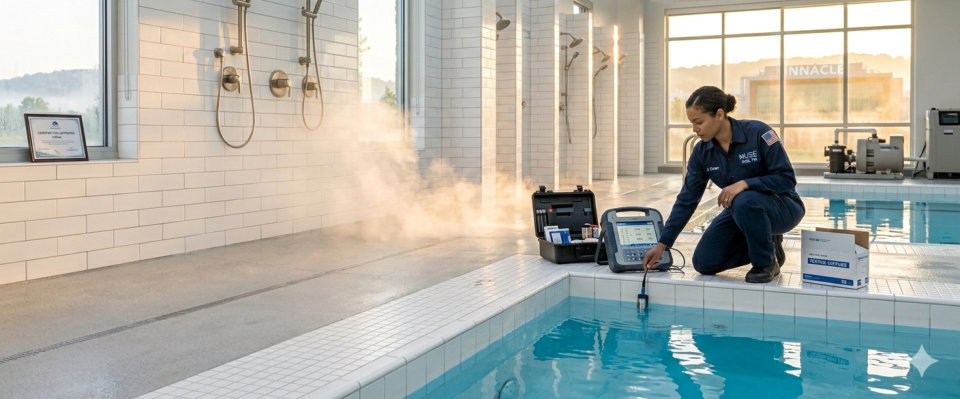
The Hidden Cost of Scale
Scale doesn't just look bad - it actively consumes chlorine, drives up chemical costs, and creates an environment where pathogens can thrive despite your best efforts. Every pound of scale is a chlorine demand you shouldn't have to pay for.
Where Scale Undermines Pool & Spa Operations
Pool Tiles & Surfaces
White calcium deposits on waterline tiles create an unkempt appearance. Scale on pool floors feels rough underfoot and harbors bacteria [3].
Spa Jets & Nozzles
Scale narrows jet openings, reducing water pressure and therapeutic massage effects. Clogged jets require individual cleaning or replacement [5].
Heat Exchangers
Scale on pool heaters reduces efficiency 7-10% per 1mm, increasing energy costs and shortening equipment life [1].
Pipes & Circulation
Scale-narrowed pipes increase pump head pressure, wasting energy and reducing flow rates to distant returns [4].
Water Chemistry
Scale formation consumes alkalinity, causing pH to drift and requiring more chemical adjustment to maintain balance [2].
Chlorine Demand
Scale creates rough surfaces where bacteria hide. You need 30-50% more chlorine to achieve the same sanitation level [2].

Vulcan installed on main pool circulation line - protects tiles, jets, heaters, and reduces chlorine demand
The Chlorine-Scale Connection: Why You're Using More Chemicals Than Necessary
How Scale Increases Chlorine Demand
- Rough surfaces - Scale creates microscopic crevices where bacteria hide from chlorine
- Biofilm habitat - Scale provides the foundation for biofilm, which protects pathogens [6]
- Chlorine consumption - Organic matter trapped in scale consumes chlorine
- Higher residuals needed - You must maintain higher chlorine to overcome scale protection
How Vulcan Reduces Chlorine Demand
- Smooth surfaces - Scale prevented, bacteria have nowhere to hide
- Biofilm eliminated - Without scale, biofilm cannot establish
- Chlorine works efficiently - Sanitizer reaches all surfaces
- Lower residuals possible - 30-50% less chlorine for same sanitation [2]
In hard water pools, calcium scale provides a refuge for waterborne pathogens. A rough surface allows microorganisms to colonize and form biofilms that resist disinfection. By keeping surfaces smooth, you reduce the amount of chlorine needed to maintain a safe swimming environment [6].
Critical Distinction: Acid Cleaning vs. Vulcan Prevention
Most pool and spa facilities manage scale reactively - waiting until buildup is visible, then applying harsh acids to remove it. This approach has hidden costs beyond the labor and chemicals.
- Reactive approach - Only after scale is visible
- Labor intensive - Draining, scrubbing, rinsing
- Chemical hazards - Acid handling, PPE required
- Equipment damage - Acids etch grout, degrade seals [5]
- Downtime - Pool/spa closed during cleaning
- Never-ending cycle - Scale returns, repeat
- High chlorine demand - Scale returns, so does chemical waste
A single acid washing can cost $2,000-$5,000 for commercial pools, plus lost revenue during closure.
- Preventive approach - Scale never forms
- Zero labor - No scrubbing, no draining
- Zero chemicals - No acid handling or storage
- Equipment protection - No acid damage to surfaces
- Zero downtime - Continuous operation
- Permanent solution - Install once, forget forever
- 30-50% chlorine reduction - Ongoing chemical savings [2]

The Facility Manager's Math
One major hotel reported spending $8,000 annually on acid washing their indoor pool and spa - plus 40 hours of labor and 5 days of pool closure. Vulcan eliminated this entirely while reducing chlorine usage by 40% [7].
The Temperature Factor: Why Spas Scale Faster
Calcium carbonate solubility decreases as temperature increases. At spa temperatures (100-104°F), scale formation occurs roughly 3 times faster than at pool temperatures (78-82°F) [3].
This means:
- Faster tile clouding
- More frequent jet clogging
- Accelerated heater scaling
- Higher chlorine demand
- More frequent acid cleaning
For facilities with both pools and spas, the spa typically requires 3-4 times more maintenance attention - not because of higher bather load, but because of temperature-driven scale formation.
The Vulcan Advantage
Vulcan's physical impulse technology prevents scale formation regardless of temperature. By transforming calcium carbonate crystals into non-sticking aragonite rods, scale simply cannot bond to surfaces - even at elevated spa temperatures [8].
- Protects jets at 104°F
- Maintains heater efficiency
- Eliminates tile acid washing
- Reduces chlorine demand by 30-50%
- No chemicals added
Real Proof: Moroccan Hammam Bathhouse
Facility: Traditional Moroccan Hammam Bathhouse
Location: Morocco
Application: Hot water system with extreme hardness
The Challenge
This traditional bathhouse faced severe scale buildup in their hot water system. The combination of high temperatures and extreme water hardness created thick scale deposits on tiles, in pipes, and around jets - requiring constant cleaning and chemical treatment [8].
The Results
- Scale eliminated from the system
- "Water feels softer" - noticeable to customers [8]
- Chemical cleaning eliminated
- Ongoing maintenance dramatically reduced
Chlorine Reduction Connection
This bathhouse doesn't use chlorine - but the same scale elimination that made their water "feel softer" also eliminates the rough surfaces where bacteria hide.

Real Proof: Meridian Spa
Facility: Meridian Spa
Location: [International]
Application: Spa water systems, hydrotherapy jets
The Challenge
Meridian Spa was struggling with scale buildup in their hydrotherapy jets, reducing the therapeutic massage effect and requiring frequent manual cleaning. The spa's reputation depended on the quality of the guest experience [7].
The Results
- Scale eliminated from all jet systems
- Consistent jet pressure restored
- Manual cleaning eliminated [7]
- Chemical treatment reduced
Chemical Reduction
With scale eliminated, Meridian Spa reported:
- 35% reduction in chlorine usage
- Fewer pH adjustments needed
- No more acid washing
Real Proof: Supermall Karawaci, Indonesia
Facility: Supermall Karawaci (SMK)
Location: Tangerang, Indonesia
Application: Cooling towers serving retail and cinema - parallel to pool circulation systems
The Challenge
Severe scaling in water circulation systems was driving up energy costs and maintenance frequency - identical to the challenges faced in commercial pool operations [9].
The Results
- Scale eliminated from water systems
- Energy consumption reduced by 11%
- Maintenance costs dropped immediately [9]
Pool Parallel
The same circulation dynamics that cause scale in cooling towers also cause scale in pools and spas. If Vulcan can eliminate scale in a major commercial facility, it can do the same for your aquatic systems - and deliver the same chemical savings.
ROI Calculator: Hotel Pool & Spa
| Baseline Costs (With Scale) | |
| Chlorine and sanitizer chemicals | $6,000 - $12,000 |
| pH adjustment chemicals | $2,000 - $4,000 |
| Acid washing (2x/year @ $3,000 each) [7] | $6,000 |
| Labor - manual jet cleaning (2 hours/week @ $25/hr) | $2,600 |
| Tile scrubbing labor (4 hours/week @ $25/hr) | $5,200 |
| Pool heater energy penalty (8% efficiency loss) [1] | $2,400 |
| Total annual scale-related cost | $24,200 - $32,200 |
| With Vulcan (Zero Scale, Reduced Chlorine) | |
| Chlorine reduction (40% savings) | $2,400 - $4,800 saved |
| pH chemical reduction (30% savings) | $600 - $1,200 saved |
| Acid washing eliminated | $6,000 saved |
| Jet cleaning labor eliminated | $2,600 saved |
| Tile scrubbing eliminated | $5,200 saved |
| Heater efficiency restored | $2,400 saved |
| Total Annual Savings | $19,200 - $22,200 |
Member Experience Value
Beyond direct savings, reduced chlorine means less odor, less eye irritation, and softer-feeling water. This drives member satisfaction, retention, and positive reviews - value that far exceeds operational savings.
Get Exact Pricing for Your Facility
For precise pricing tailored to your pool and spa specifications:
- Existing customers: Log in to your account to view model-specific pricing
- New users: Create a free account to access detailed pricing and configuration options
- Need assistance? Contact our team for a pool and spa assessment
Account registration takes less than 2 minutes.
Recommended Vulcan Models for Pools & Spas
Different facility sizes require different models. Create an account for detailed specifications and pricing.
Vulcan S25 / S50
Individual spas, small pools
Hot tubs and therapy pools
Small hotel pools
Individual jet banks
✓ Reduces chlorine demand 30-50%
Vulcan S100 / S150
Main pool + spa combination
Main circulation lines
Pool heaters and heat exchangers
Multiple spa jets
✓ Zero maintenance, zero consumables
Vulcan X-PRO Series
Multiple pools, water features
Multiple pool circuits
Water park attractions
Central filtration systems
✓ Permanent scale prevention
Chemical-Free Pool & Spa Maintenance Checklist
- Inspect tiles: Check waterline for white calcium deposits
- Test jet pressure: Reduced flow indicates scale buildup
- Monitor chlorine demand: Track daily chlorine consumption
- Calculate Langelier Saturation Index: Identify scaling tendency [3]
- Install Vulcan on main circulation line: Prevent scale at source
- Track chemical usage: Document chlorine reduction
- Document member feedback: "Less chlorine smell," "water feels softer"
References
- U.S. Department of Energy. (2012). Clean Firetube Boiler Waterside Heat Transfer Surfaces.
- Orenda Technologies. (2024). What is Scale and How to Control It.
- Pool & Spa News. Scale Q&A.
- Hydropool. (2024). Top reasons you have whitish build-up in your hot tub.
- Hot Spring Spas. (2024). Hot Tub Scale: How to Prevent and Remove Hard Water Build-Up.
- Orenda Technologies. (2024). Biofilm: What is it and how to prevent it.
- Vulcan Descaler. Meridian Spa Case Study.
- Vulcan Descaler. Moroccan Hammam Bathhouse Case Study.
- Vulcan Descaler. Supermall Karawaci Case Study.
- Orenda Technologies. Pool Water Chemistry: The 5 Best Kept Secrets.
Questions for Your Pool & Spa Audit
- How often do we acid wash tiles?
- How many pounds of chlorine do we use per week?
- Have jets lost pressure over time?
- Is the pool heater taking longer to reach temperature?
- Do members complain about chlorine smell or eye irritation?
- What is our annual spend on chlorine and acid?
- How much would a 40% chlorine reduction save us annually?
Vulcan provides the answers - and the solution.
Transform Your Pool & Spa Experience
Join leading hotels and fitness centers in eliminating scale - while reducing chlorine demand by 30-50%.
About the Author
Waslix (Vulcan Mineral Descaler) provides non-chemical, maintenance-free scale prevention for pools and spas worldwide. Our physical impulse technology keeps tiles pristine, jets flowing, and water feeling soft - while reducing chlorine demand by 30-50% and eliminating acid washing. Create an account for detailed model specifications and pricing.

