
The Critical Role of RO Membranes at Sea
For luxury yachts on extended passages, the watermaker is the single most important system for self-sufficiency. Reverse osmosis (RO) membranes convert seawater into fresh water for drinking, cooking, bathing, and laundry—but they are vulnerable to a silent enemy: mineral scale [2].
$3k-8k
Membrane replacement cost [2]
40%
Premature failure from scale [2]
15mg/L
Chemical dosing limit [2]
97.5%
Vulcan contact ratio [3]
Scaling and iron fouling of the RO membranes will reduce system performance and lead to premature membrane replacement. Precipitation of scale and deposits build up on the RO membrane, which leads to poor permeate quality, low permeate production, unscheduled downtime, increased water consumption and increased energy costs [2].
For a yacht crossing oceans, watermaker failure is not merely inconvenient—it's a safety issue. Every day without fresh water production puts crew and guests at risk and forces reliance on stored water, limiting range and flexibility.
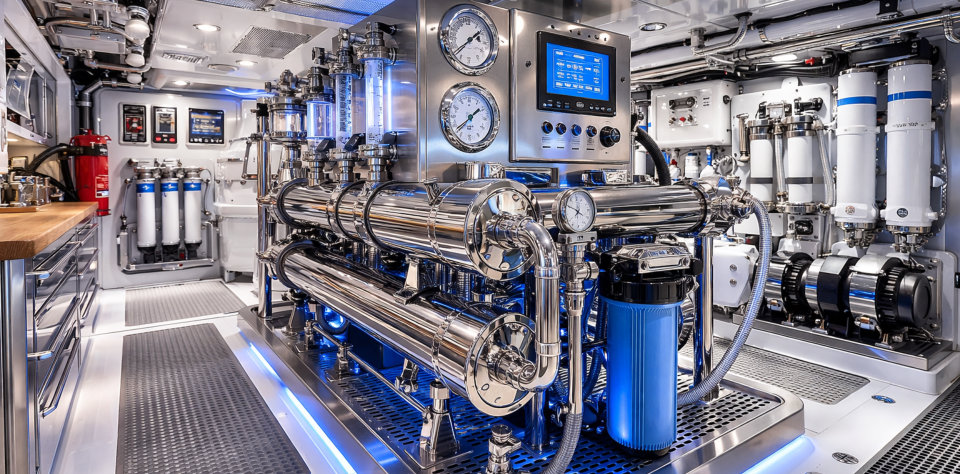
The Hidden Risk
Membrane fouling is one of the major limitations of RO technology. Inorganic fouling—commonly referred to as scaling—occurs when salts like CaCO₃, CaSO₄, BaSO₄, and SiO₂ precipitate on membrane surfaces [4]. Once scale forms, membrane performance degrades rapidly, and replacement is often the only option.
Where Scale Forms in Marine RO Systems
Membrane Surface
Scale precipitates directly on membrane surfaces, blocking pores and reducing flux. CaCO₃ and CaSO₄ are the most common culprits [4].
Feed Spacers
Scale clogs feed channels, increasing pressure drop and reducing flow across the membrane element.
Pumps & Valves
Scale on high-pressure pump internals reduces efficiency and can cause seal failures at the worst possible moment.
Prefilters
Scale particles can blind prefilters prematurely, requiring frequent changes and increasing consumables cost.
Heat Exchangers
If your system includes energy recovery or temperature control, scale on heat transfer surfaces reduces efficiency.
Tubing & Fittings
Scale-narrowed tubing reduces flow to the membrane array, starving elements of feed water.
Membrane fouling can be divided into four categories: colloidal fouling, inorganic fouling (scaling), organic fouling, and biofouling [4]. Scale is particularly insidious because it forms a crystalline structure that physically blocks membrane pores and cannot be removed by simple flushing.
Critical Distinction: Chemical Dosing vs. Vulcan Prevention
The standard approach to RO scale control involves chemical inhibitors—but these come with significant drawbacks for yacht owners and the marine environment.
- Chemical storage required - 25L drums take valuable space [2]
- Ongoing consumables cost - $500-$2,000 annually
- Chemical handling hazards - pH 10-11, requires PPE [2]
- Dosing pumps & maintenance - Another system to fail at sea
- Material compatibility issues - Not compatible with brass, Viton, polyurethane [2]
- Environmental discharge - Chemicals pumped overboard
- Limited effectiveness - Inhibitors slow scale but don't prevent it entirely
"Scaling and iron fouling of the RO membranes will reduce system performance and lead to premature membrane replacement." [2] Chemical dosing only postpones the inevitable.
- Zero chemical storage - No drums, no waste
- Zero ongoing costs - One-time investment
- No chemical handling - No PPE, no hazards
- Zero moving parts - No pumps to fail
- Works with all materials - External installation, no compatibility issues
- Environmentally friendly - No discharge, no chemicals
- Prevents scale entirely - Membranes stay clean, performance maintained
Proven in Marine Applications:
"After installing two Vulcan descaling systems on our boiler hot water pipelines and reverse osmosis system, we have made significant improvements that surpassed our initial expectations." [3]

The Yacht Owner's Math
A set of marine RO membranes costs $3,000-$8,000 to replace [2]. Chemical inhibitors add $500-$2,000 annually. Over a 5-year period, chemical treatment costs $2,500-$10,000—and you still replace membranes prematurely. Vulcan protects membranes for the life of the system with zero ongoing cost.
How Vulcan Works: Protecting RO Membranes
Vulcan's physical impulse technology uses low-frequency radio pulses transmitted through copper bands wrapped around the feed water pipe. These pulses prevent the crystallization of calcium and magnesium, which form limescale [9].
The Science of Scale Prevention:
When water flows between the impulse band's primary treatment zone, the sticky structure of untreated water scale crystals are broken into smooth rod-shaped mono-crystals preventing the hard water minerals from bonding to surfaces [3].
For RO Membranes, This Means:
- Scale-forming minerals remain in suspension rather than precipitating on membrane surfaces
- Membranes stay clean, maintaining design flux and salt rejection
- No chemical inhibitors needed
- Extended membrane life—2-3x longer between replacements
- Consistent water production, passage after passage
The high copper alloy purity Vulcan impulse copper bands guarantee the cleanest possible frequency transfer output to maximize the interactive frequency coverage area. Impulses radiate 9-16 feet on both ends of the impulse bands [3].

Vulcan installs externally on RO feed water line—protects membranes without chemicals
Real Proof: Norwegian Cruise Ship
Vessel: Norwegian Cruise Ship
Application: Ship-wide water systems including RO
The Challenge
Marine vessels face constant scaling challenges in water systems due to seawater exposure. Scale buildup affects RO membranes, reducing freshwater production and increasing maintenance [10].
The Results
- Scale eliminated from water systems
- Improved water quality throughout vessel
- Reduced maintenance frequency [10]
- Chemical treatment reduced
RO-Specific Impact
For a cruise ship producing thousands of gallons of fresh water daily, RO membrane reliability is critical. By eliminating scale, this vessel achieved:
- Consistent freshwater production
- Extended membrane life
- Reduced chemical costs
- Fewer unscheduled maintenance events
Real Proof: RO Membrane Life Extension
Facility: Commercial/Industrial RO Application
Application: Reverse osmosis system protection
The Objective
"We wanted to improve operational efficiencies, save energy and extend RO membrane lifespans." [3]
The Results
- Significant improvements beyond initial expectations
- RO membrane life extended
- Energy savings achieved [3]
The Marine Parallel
This commercial RO application proves that Vulcan extends membrane life. For yachts, this means:
- Fewer membrane replacements
- Consistent water production
- Lower operating costs
- Peace of mind on long passages
Complementary Technology: Self-Cleaning Pre-Filtration
Case Marine has introduced new self-cleaning pre-filtration technology for reverse osmosis systems. Replacing traditional sand filters, these filters have a smaller footprint, more precise filtration grade, low maintenance, a longer service life and easy waste management [8].
How It Works
The filters are rated at 30 micron (0.03 mm), designed to prevent anything larger than 30 micron from passing through. For reference, a human hair is around 50 micron [8].
The system self-regulates for seawater temperature changes and when ships go from salt water to brackish or fresh water [8].
Vulcan + Pre-Filtration
Pre-filtration removes suspended particles. Vulcan prevents dissolved minerals from precipitating as scale. Together, they provide complete protection for RO membranes—without chemicals.
RO System Sizing for Luxury Yachts
Marine watermakers are available in capacities from 150 to 1,600 gallons per day, depending on vessel size and usage requirements [5].
| Vessel Size | Typical RO Capacity | Membrane Elements | Recommended Vulcan Model |
|---|---|---|---|
| 40-60 ft | 150-300 GPD [5] | 1-2 x 2.5" x 21" | Vulcan S100 |
| 60-80 ft | 400-800 GPD [5] | 1-2 x 2.5" x 40" | Vulcan S150 |
| 80-120 ft | 1,200-1,600+ GPD [5] | 3-4 x 2.5" x 40" | Vulcan S250 / X-PRO |
Regardless of system size, Vulcan installs on the feed water line before the RO system, treating all water entering the membranes [3].
ROI Calculator: 80' Luxury Yacht
| Without Vulcan (Reactive Maintenance) | |
| Membrane replacement (every 3 years @ $4,500) | $1,500 annualized |
| Chemical inhibitor (25L drum) [2] | $800 |
| Dosing pump maintenance | $300 |
| Energy penalty from scaled membranes (8%) [3] | $600 |
| Prefilter changes (increased frequency) | $400 |
| Crew labor for chemical handling & monitoring | $1,000 |
| Total annual RO-related cost | $4,600 |
| With Vulcan (Preventive) | |
| Membrane replacement extended (6 years) | $750 saved |
| Chemical inhibitor eliminated | $800 saved |
| Dosing pump maintenance eliminated | $300 saved |
| Energy penalty eliminated | $600 saved |
| Prefilter life extended | $200 saved |
| Crew labor reallocated | $1,000 saved |
| Total Annual Savings | $3,650 |
The Water Security Value
A failed watermaker 1,000 miles from port is not a maintenance issue—it's a safety crisis. The cost of emergency water delivery, shortened passages, or ruined vacations far exceeds any equipment savings. Vulcan provides insurance against RO failure.
Get Exact Pricing for Your Vessel
For precise pricing tailored to your RO system specifications:
- Existing customers: Log in to your account to view model-specific pricing
- New users: Create a free account to access detailed pricing and configuration options
- Need assistance? Contact our team for a marine RO system assessment
Account registration takes less than 2 minutes.
Recommended Vulcan Models for Marine RO Systems
Different RO system sizes require different models. Create an account for detailed specifications and pricing.
Vulcan S100
RO systems up to 400 GPD
Protects 1-2 membrane elements
9-16 foot treatment zone [3]
Zero chemicals, zero maintenance
✓ Extends membrane life 2-3x
Vulcan S250
RO systems 400-1,200 GPD
Protects 2-4 membrane elements
Main feed water line protection
Eliminates chemical dosing
✓ Zero consumables, zero waste
Vulcan X-PRO Series
RO systems 1,200+ GPD
Multiple RO banks
Ship-wide water systems
Maximum water security
✓ Permanent scale prevention
Marine RO System Maintenance Checklist
- Daily: Monitor feed pressure, permeate flow, and TDS [5]
- Weekly: Check prefilters, inspect for visible scale
- Monthly: Calibrate TDS meter, test chemical inhibitor levels (if used)
- Quarterly: Clean prefilter housings, inspect for leaks
- Annually: Professional inspection, membrane cleaning if needed
- Install Vulcan on RO feed line: Prevent scale at source
- Eliminate chemical inhibitor: No more chemical storage or handling
- Monitor membrane performance: Track extended life
References
- Aquatech. (2025). Electrically charged membranes scale smarter.
- July Marine. (2024). NALFLEET RO Scale Control Marine Chemical.
- Vulcan Descaler. Wobbling Impulse Frequency Mineral Descaling Technology.
- Canadian Journal of Chemical Engineering. (2025). Scaling in reverse osmosis seawater desalination: Mechanism and prevention.
- Applied Membranes. Maritime Watermaker RO Systems.
- Vulcan Descaler. Residential Applications - Electronic Anti-Scale System.
- ScienceDirect. (2025). Strategies for functionalized RO membranes with improved antifouling properties.
- Cruise Industry News. (2019). Self-Cleaning Pre-Filtration for Case RO.
- Vulcan Norway. (2025). The Vulcan Technology.
- Vulcan Descaler. Norwegian Cruise Ship Case Study.
Questions for Your Marine Technician
- What is our current membrane age? When were they last replaced?
- Are we seeing permeate flow decline over time?
- What is our feed pressure compared to baseline?
- Do we use chemical scale inhibitors? How much do they cost annually?
- How much chemical storage space do they occupy?
- Have we ever experienced watermaker failure on a passage?
- What would it be worth to never replace membranes again?
Vulcan provides the answers—and the solution.
Water Security on Every Passage
Join discerning yacht owners in protecting RO membranes without chemicals—extending life, reducing costs, and ensuring fresh water wherever you cruise.
About the Author
Waslix (Vulcan Mineral Descaler) provides non-chemical, maintenance-free scale prevention for marine RO systems worldwide. Our physical impulse technology protects membranes from scale, extends membrane life 2-3x, and eliminates chemical inhibitors—trusted by yacht owners and marine technicians for water security on long passages. Create an account for detailed model specifications and pricing.

