
The Snowmaking Challenge: Every Drop Counts
For ski resorts worldwide, technical snow production has become indispensable. Rising customer expectations, adaptation to climate variability, and unfavorable natural snow conditions drive the steadily increasing reliance on snowmaking facilities [9]. Yet the process is far from perfectly efficient.
7-35%
Water loss during snowmaking [9]
21%
Average water loss [9]
50%+
Communal water use in some resorts [9]
A groundbreaking 2019 study by the WSL Institute for Snow and Avalanche Research in Switzerland conducted detailed field experiments measuring water losses during snow production. Using high-resolution terrestrial laser scanning and manual snow density sampling across 12 tests, researchers found that 7 to 35% of water consumed was lost during snowmaking, with a mean loss of 21% [9]. These losses occur through sublimation, evaporation, wind drift, and discharge of unfrozen water to the ground.
The study also revealed that water losses increase with air temperature—a critical finding for resorts operating in marginal conditions. For example, a resort using 100 million gallons of water annually could lose 21 million gallons to the atmosphere—water that never becomes skiable terrain [9].
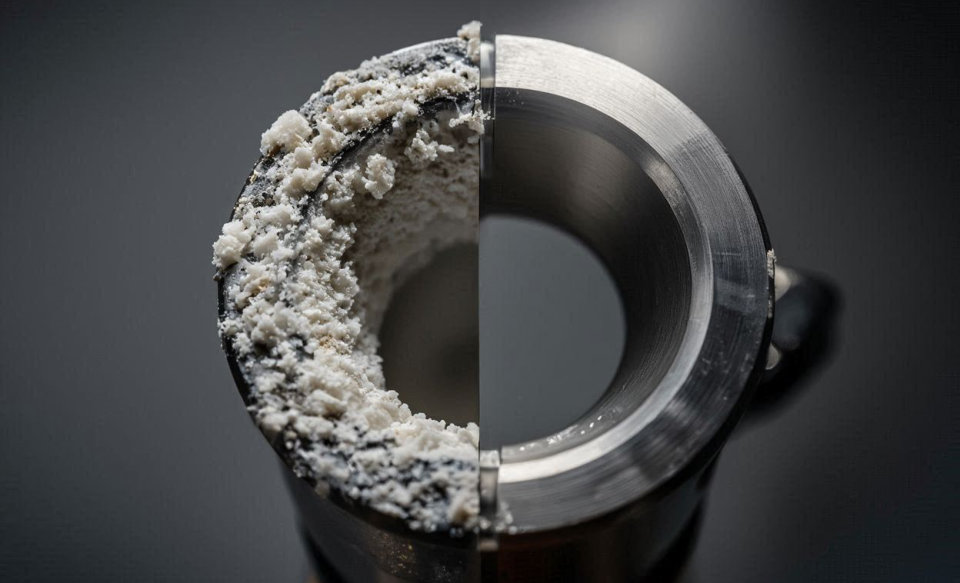
The Hidden Variable
While atmospheric conditions determine evaporation losses, water quality determines equipment efficiency. Scale-clogged nozzles reduce output, create uneven distribution, and waste water—compounding the losses you can't control.
Where Scale Attacks Your Snowmaking System
Snow Gun Nozzles
Scale clogs precision nozzles, reducing water flow and creating uneven droplet size. Poor atomization means less water freezes before reaching the ground [2].
Water Lines
Scale-narrowed pipes reduce flow and pressure. Snow guns require precise pressure for optimal performance—pressure loss means poor snow quality.
Pumps
Scale on impellers reduces pump efficiency, increasing energy consumption and reducing flow to snow guns [2].
Valves & Controls
Scale on valve seats prevents proper sealing, causing pressure fluctuations and inconsistent operation across snowmaking networks.
Water Heaters
Some systems use water heating to optimize snow production. Scale on heating elements reduces efficiency and increases energy costs [2].
Filtration Systems
Scale can blind filter media, increasing backwash frequency and reducing flow to snow guns when you need it most.
The contaminants or other substances removed or reduced by water treatment systems are not necessarily in your water, but when they are, they directly impact snowmaking efficiency [2].

Vulcan installed on main snowmaking water line—protects every snow gun, nozzle, and pump
The Science of Water Loss: What the Research Shows
Field research from the Swiss Federal Institute for Snow and Avalanche Research provides the most detailed analysis of snowmaking efficiency to date [9].
Key Findings [9]
- 7-35% water loss during snow production (mean 21%)
- Losses increase with air temperature
- Sublimation and evaporation account for significant losses
- Wind drift deposits snow outside target areas
- Unfrozen water drains to ground when atomization is poor
The Scale Connection
Poor atomization from clogged nozzles increases unfrozen water reaching the ground—directly contributing to the 7-35% loss. Scale-clogged nozzles produce larger droplets that freeze less efficiently, wasting water that never becomes skiable snow.
For a ski resort using 100 million gallons annually, 21% loss means 21 million gallons wasted—at a cost of thousands in water, energy, and lost ski terrain [9].
Critical Distinction: Reactive Descaling vs. True Prevention
Standard snowmaking maintenance involves periodic acid cleaning of nozzles, pumps, and lines. But this reactive approach has significant drawbacks—and doesn't address the root cause of efficiency loss.
- System downtime: Snowmaking halted during cleaning
- Chemical hazards: Acids require special handling and disposal
- Nozzle damage: Acid can erode precision orifices over time
- Reactive approach: Only after efficiency has already dropped
- Never-ending cycle: Scale returns, descaling repeats
- Water waste between cleanings: You pay the efficiency penalty until scale is removed
Scale reduction/control is essential, but reactive cleaning only addresses the symptom, not the cause [2].
- Zero downtime: Snowmaking never interrupted
- Zero chemicals: No acids, no disposal, no hazards
- Nozzle protection: No acid erosion, precision maintained
- Preventive approach: Scale never forms
- Permanent solution: Install once, protect forever
- Continuous savings: No efficiency loss between cleanings
How It Works:
Vulcan's physical impulse technology alters the crystalline structure of calcium carbonate so it cannot bond to surfaces. Nozzles stay clear, pumps maintain efficiency, and your snowmaking system operates at design capacity [6].

The Ski Resort Operator's Math
A mid-sized ski resort with 50 snow guns loses 21% of water to atmospheric losses [9]. Scale-clogged nozzles add another 10-15% efficiency loss. Vulcan eliminates the scale factor, saving millions of gallons and thousands in energy costs annually.
Real Proof: Big Sky Resort, Montana
Facility: Big Sky Resort
Location: Montana, USA
Innovation: First public ski area in Montana approved for recycled water snowmaking [5]
The Challenge
For more than 25 years, the Big Sky community has supported water reuse and zero direct discharge into the Gallatin River. As the community grew and summers became hotter and drier, finding sustainable water sources for snowmaking became critical [3][5].
The Solution
"Reusing water as snow conserves the fresh water that our rivers and community depend on. Instead of taking clean water from the river, water is recycled back as snow to the mountains—a win-win for the health of our rivers and the resort economy." — Kristin Gardner, Gallatin River Taskforce [5]
The Vulcan Connection
Recycled water often has higher scaling potential due to dissolved solids. Membrane bioreactors and UV treatment produce high-quality water, but scale still forms in distribution systems [8].
Vulcan would add:
- Scale prevention in snowmaking lines
- Protection for precision snow gun nozzles
- Extended life for pumps and valves
- Maximum efficiency from recycled water investment

Real Proof: WSL Institute for Snow and Avalanche Research
Institution: WSL Institute, Davos, Switzerland
Location: Rinerhorn ski resort
Study: 12 detailed snowmaking field tests [9]
The Methodology
Researchers used high-resolution terrestrial laser scanning and manual snow density sampling to measure water losses during operational snowmaking. Water inflows at the snow machine were compared to the mass of snow deposited on the ground [9].
The Results
- 7-35% water loss during snowmaking [9]
- Mean loss: 21%
- Losses increase with air temperature
- Sublimation and evaporation are major factors
The Vulcan Opportunity
The 21% average loss is from atmospheric conditions—but scale adds another layer of inefficiency. With Vulcan:
- Nozzles produce optimal droplet size for freezing
- Less unfrozen water reaches the ground
- More water becomes skiable snow
- Your 21% atmospheric loss is the baseline—scale doesn't make it worse
Water Quality and Bacterial Contamination
Research Findings [1]
A 2025 study examined bacterial contamination in technical snow from five ski resorts. Key findings:
- Numbers of culturable bacteria drop sharply during snow production
- Water storage in reservoirs prior to snowmaking reduces bacterial and antibiotic resistance gene contaminants [1]
- Freezing temperatures and UV exposure kill pathogens
- River water intake sites downstream of WWTPs are most contaminated
The Vulcan Role
While snowmaking naturally reduces bacterial loads, scale in reservoirs and distribution lines can harbor biofilm and protect bacteria. Vulcan:
- Prevents scale where bacteria hide
- Keeps reservoir surfaces smooth and clean
- Eliminates biofilm habitat in water lines
- Supports natural disinfection processes
The Future: Recycled Water Snowmaking
The U.S. Environmental Protection Agency added snowmaking as a viable reclaimed water reuse option in its 2012 Guidelines for Water Reuse [3]. Today, over a dozen ski areas across eight states and several countries use recycled water for snowmaking [6].
Benefits of Recycled Snowmaking [3][6]
- Conserves fresh water: Protects rivers and aquifers
- Recharges aquifers: Snowmelt filters into groundwater
- Extends ski season: Reliable base layer
- Zero discharge: Keeps treated water out of rivers
- Community support: Conservation groups endorse the practice
The Scale Challenge
Recycled water often contains higher dissolved solids, increasing scaling potential. Membrane bioreactors and UV treatment produce high-quality water, but scale still forms in distribution systems [8].
Vulcan prevents scale regardless of water source—making recycled water snowmaking even more viable.
The Yellowstone Club Success
The private Yellowstone Club began recycled snowmaking in 2023-24 and won the 2024 Montana Water Environment Association Beneficial Reuse Award. Big Sky Resort's public program follows this proven model [3].
ROI Calculator: Mid-Size Ski Resort
| Without Vulcan (Reactive Maintenance) | |
| Annual water use for snowmaking | 50,000,000 gallons |
| Water loss to atmosphere (21% average) [9] | 10,500,000 gallons |
| Additional loss from scale-clogged nozzles (8% estimate) | 4,000,000 gallons |
| Water cost @ $5/1,000 gallons | $20,000 |
| Energy penalty from scaled pumps (7%) [2] | $8,400 |
| Nozzle cleaning labor (50 guns x 4x/year x 1 hour @ $50/hr) | $10,000 |
| Descaling chemicals (annual) | $5,000 |
| Pump maintenance (scale-related) | $7,500 |
| Total annual scale-related cost | $50,900 |
| With Vulcan (Preventive) | |
| Scale-related water loss eliminated | $20,000 saved |
| Energy penalty eliminated | $8,400 saved |
| Nozzle cleaning labor eliminated | $10,000 saved |
| Descaling chemicals eliminated | $5,000 saved |
| Pump maintenance reduced (70%) | $5,250 saved |
| Total Annual Savings | $48,650 |
The Terrain Value
Every gallon lost to scale is snow that never lands on your slopes. With Vulcan, more water becomes skiable terrain—extending your season and improving guest experience.
Get Exact Pricing for Your Resort
For precise pricing tailored to your snowmaking specifications:
- Existing customers: Log in to your account to view model-specific pricing
- New users: Create a free account to access detailed pricing and configuration options
- Need assistance? Contact our team for a snowmaking system assessment
Account registration takes less than 2 minutes.
Recommended Vulcan Models for Snowmaking Systems
Different resort sizes and snowmaking configurations require different models. Create an account for detailed specifications and pricing.
Vulcan S250 / S350
Single reservoir, limited distribution
Protects all snow gun nozzles
Maintains pump efficiency
Reduces nozzle cleaning labor
✓ Ideal for smaller operations
Vulcan S500 / X-PRO 1
Multiple reservoirs, extensive distribution
Full snowmaking system protection
Central pump station
Maximum water efficiency
✓ Zero maintenance, zero consumables
Vulcan X-PRO 2
Multiple reservoirs, pump stations, high volume
Full mountain protection
Multiple pump stations
As protects 44M+ gallon systems [3]
✓ Permanent scale prevention
Snowmaking Efficiency Checklist
- Test water hardness: Determine scaling potential
- Monitor nozzle performance: Track output and pattern
- Calculate water efficiency: Gallons per acre of snow
- Inspect pumps and valves: Look for scale buildup
- Consider water storage: Reservoirs improve quality [1]
- Install Vulcan on main water line: Prevent scale at source
- Eliminate nozzle cleaning: No more acid treatments
- Track water savings: Document efficiency gains
References
- NIH. (2025). Impact of technical snow production on bacterial community composition.
- Pentair. Filtration for Ice Applications.
- Big Sky Resort. (2025). Montana DEQ Approves Water Conservation Program.
- ACHR News. (2001). The Water Factor in Ice Machines.
- Billings Gazette. (2025). Big Sky first public ski area using wastewater for snowmaking.
- Teton Gravity Research. (2025). Big Sky Recycled Snowmaking.
- lee.net. (2025). Spanish Peaks recycled snowmaking proposal.
- Frontiers in Earth Science. (2019). Water Losses During Technical Snow Production.
- Vulcan Descaler. Electronic Anti-Scale System Technology.
Questions for Your Snowmaking Efficiency Audit
- What is our current water hardness?
- How many snow guns do we operate? How many nozzles each?
- How often do we clean nozzles? How many labor hours?
- Have we noticed uneven snow distribution from clogged nozzles?
- What is our water consumption per acre of snow produced?
- Are we using recycled water? What is its scaling potential?
- Could scale be adding to our 21% water loss?
Vulcan provides the answers—and the solution.
Maximize Every Drop of Water
Join leading ski resorts in eliminating scale-driven efficiency losses—turning more water into skiable terrain, reducing maintenance, and protecting your investment.
About the Author
Waslix (Vulcan Mineral Descaler) provides non-chemical, maintenance-free scale prevention for snowmaking systems worldwide. Our physical impulse technology keeps snow gun nozzles clear, pumps efficient, and water flowing where it belongs—onto your slopes. Trusted by ski resorts and mountain operators globally. Create an account for detailed model specifications and pricing.

