
The High Cost of Water Spots
When a customer pays for a wash, they expect a spot-free finish. Water spots aren't just cosmetic—they signal poor quality, erode customer trust, and drive away repeat business [9].
99%
TDS removal needed for spot-free [5]
#1
Customer complaint [9]
50%
May not return after bad experience
Water spots are created when water evaporates and leaves behind dissolved solids. The offending spots are usually created when water evaporates leaving behind a solid residue. The resulting residues or spots are cosmetically unappealing and may interfere with the function of the part itself. Furthermore, the spots are often difficult to remove even by manual means once they have formed [1].
The worst cases for water spotting are hydrophobic surfaces on which water forms large beads or droplets. Of course, the larger the droplets, the more water volume they will contain. The more volume, the more solids the water will contain with the result that evaporation of a large drop of water is more likely to leave sufficient residue to appear as a spot than the evaporation of a smaller drop even if it has the same concentration of solids [1].
From the beginning, operators at many exterior tunnel washes knew they had a problem. No matter how good a job they did washing cars and trying to blow off the water, cars that emerged would have some drops remaining that didn't blow off. And what might happen to be in those drops was the problem [9].
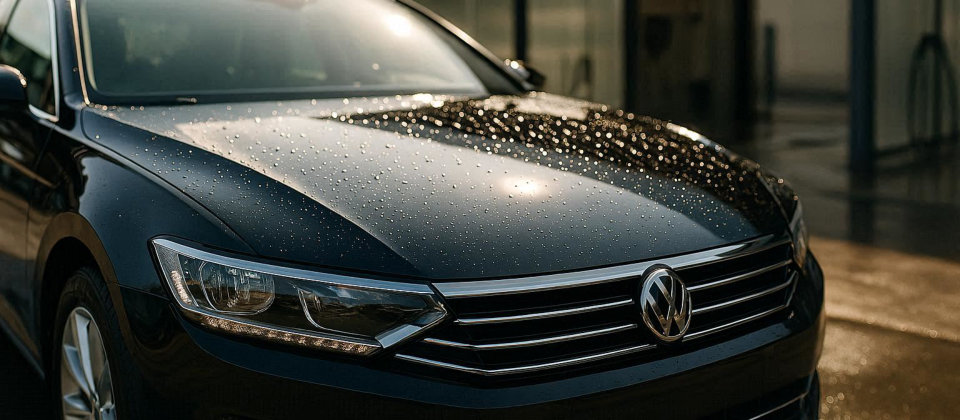
The Customer Perspective
Absolutely pure water was fine, but most water supplied from mains or wells contains dissolved salts. When such drops evaporate on an unwiped car, spotting occurs. This spotting might be negligible, or it could be horrendous enough to make customers scream, depending upon the total dissolved solids (TDS) in the rinse water—and also depending upon the color of the car, black being the worst offender for showing up those tiny white spots [9].
Understanding Spot-Free Technology: RO and DI
The common way to prevent drying spots is to use water with very low solids content for the final rinse(s) prior to drying. Water with a resistivity in excess of 1 megOhm is usually adequate to prevent spots [1].
RO systems filter out dissolved minerals, producing pure water (permeate) that results in a spot-free rinse. An RO System ensures that the rinse water quality is consistently high, irrespective of the incoming water's condition, by removing up to 99% of dissolved solids and impurities [5].
Key components: Membranes, pumps, pre-filters, storage tank [2]
DI systems use resin cartridges to strip out dissolved mineral ions like calcium, magnesium, and iron at a molecular level, producing highly purified rinse water [10].
Key components: DI resin tanks, pre-filtration
DI resin life: Varies based on water hardness and usage—typically several months [10]
It wasn't until the mid sixties that RO and DI appeared in enough car washes to make it possible to find out how successful these systems could be in turning out spot-free cars from exterior tunnels on an economical basis [9].
At first, most operators would charge something extra for such spot-free rinse as an extra service. When they kept track of sales and customer reactions, it was quickly discovered that—far from complaining—customers would ask for it regardless of the extra cost. They could see the big difference in the way their cars were spot-free [9].

Vulcan installed on RO feed line—protects membranes from scale, extends their life
The Hidden Threat: Scale in RO Systems
How Scale Attacks RO Systems
Municipal water contains a variety of dissolved minerals, such as calcium, magnesium, and sodium, which contribute to water hardness [5]. These minerals precipitate on membrane surfaces, causing:
- Reduced permeate production
- Higher operating pressure
- Increased energy consumption
- Premature membrane failure
Critical warning: Failure to properly pre-treat the water may result in reduced membrane life and premature membrane failure and is not covered under the limited warranty [5].
The Role of Pre-Treatment
Modern RO systems require proper pre-treatment to protect membranes [5]:
- Sediment filtration: Removes particles
- Carbon filtration: Removes chlorine
- Water softening: Reduces hardness
- Vulcan: Prevents scale without chemicals
Scale prevention is essential—once membranes are fouled, they cannot be cleaned and must be replaced [5].
Critical Distinction: Reactive Solutions vs. True Prevention
Most spot-free rinse issues are addressed reactively—after customers complain, after membranes fail, after resin is exhausted. But the root cause is often scale that could have been prevented.
- Extended membrane life: 2-3x longer
- Reduced resin consumption: Less frequent replacement
- Consistent spot-free quality: No complaints
- Preventive approach: Scale never forms
- Zero chemicals: No drying agents needed
- Zero consumables: No salt, no disposal
How It Works:
Vulcan's physical impulse technology alters the crystalline structure of calcium carbonate so it cannot bond to surfaces. RO membranes stay clean, DI resins last longer, and spot-free water stays spot-free [6].

The Operator's Math
A car wash with two RO membrane sets replacing every 3 years spends $1,000-$4,000 annually on membranes. Add DI resin, chemicals, and labor—and you're looking at $5,000-$10,000 per year in spot-free system costs. Vulcan protects this investment while delivering consistent results.
Spot-Free Rinse Troubleshooting Flowchart
Problem: Water Spots on Vehicles
Step 1: Check TDS of Spot-Free Rinse
- Use a TDS meter to measure dissolved solids
- Target: < 10-20 ppm for spot-free results [2]
- High TDS indicates RO/DI system issue
Step 2: If TDS is High, Check RO System [5]
- Membrane age? (3-5 year typical life)
- Feed water pressure? (60-80 psi ideal)
- Temperature? (colder = lower production) [5]
- Pre-filters clean? Change quarterly
Step 3: Check for Scale on Membranes
- Increased pressure drop across membranes
- Reduced permeate flow
- Visible scale on membrane elements (if inspectable)
- Vulcan solution: Install on feed line to prevent future scale
Problem: No Spot-Free Flow
Electrical Checks [3]
- Check SFR tank low level float switch
- Check SFR system fuse
- Test contactor coil voltage (24V when bay active)
- Check incoming/outgoing voltage through contactor
- Verify motor starter operation
Mechanical Checks [3]
- Air locked pump? Discharge hose to test
- Bad contactor or starter motor
- Wiring issues
- Fluid obstruction (scale buildup in lines)
Pump-Specific Checks
- Spot-free pump separate from main pump [3]
- Check for power at pump motor
- Inspect for scale on pump internals
Real Proof: RO Membrane Protection
Application: Commercial RO Systems
Challenge: Scale formation on membranes reduces performance and leads to premature replacement [5]
The Problem
Without proper pre-treatment, scale forms on membrane surfaces, causing reduced permeate production, higher operating pressure, and premature failure. Membrane replacement is costly and disrupts operations [5].
The Solution
- Vulcan installed on RO feed line prevents scale formation
- Membranes stay clean, maintain design performance
- Extended membrane life—2-3x longer
- Consistent spot-free water quality
The Spot-Free Connection
Clean membranes = consistent TDS rejection = reliable spot-free rinse. Vulcan ensures your RO system delivers what it promises—every time.

Real Proof: Avril Supermarket, France
Facility: Avril Supermarket
Location: France
Application: Multiple water systems including nozzles
The Challenge
Persistent scale buildup was clogging nozzles and affecting equipment performance—directly analogous to car wash spot-free nozzle and RO system fouling [7].
The Results
- "No more clogged nozzles" [7]
- Scale eliminated across all systems
- Reduced maintenance calls
Direct Translation to Car Wash
"No more clogged nozzles" means:
- Consistent spot-free rinse flow
- Even coverage across vehicle
- No scale on RO membranes
- Extended DI resin life
TDS Monitoring: Your Early Warning System
When to Take Action
| Permeate TDS | Action |
|---|---|
| < 20 ppm | Normal operation |
| 20-50 ppm | Monitor closely, check pre-treatment |
| 50-100 ppm | Investigate—possible scale or membrane damage |
| > 100 ppm | Immediate action—customers will see spots |
The Role of Drying Agents
In some cases, visible water spots can be prevented through the use of "rinse aids" which serve to modify the surface tension of water to provide that "sheeting action" for which that "other blue liquid" you put in your home dishwasher is well known [1].
Pros and Cons [6]
- Pro: Helps water sheet off surfaces
- Pro: Can improve dryer performance
- Con: Leaves chemical film behind
- Con: Can cause spots if not properly rinsed
- Con: Adds ongoing chemical cost
Best Practices [6]
- Use ceramic drying agents for best results
- Very small amounts—more isn't better
- Test different injection points
- Consider spot-free rinse after drying agent
- Monitor for residue buildup
There is a difference between a surface without spots and a surface without chemical residues [1]. True spot-free rinse leaves nothing behind.
ROI Calculator: Car Wash with RO System
| Without Vulcan (Reactive Maintenance) | |
| RO membrane replacement (4 membranes @ $300 each, every 3 years) | $400 annualized |
| DI resin replacement (2x/year @ $500) [10] | $1,000 |
| Pre-filter replacements (quarterly @ $50) | $200 |
| Drying agent chemicals (annual) | $1,200 |
| Customer refunds/complaints (lost revenue) | $2,000 |
| Labor for troubleshooting/repairs | $800 |
| Total annual spot-free system cost | $5,600 |
| With Vulcan (Preventive) | |
| RO membrane life extended (6 years) | $200 saved |
| DI resin life extended (1x/year replacement) | $500 saved |
| Pre-filter life extended | $100 saved |
| Drying agent reduced (50% less) | $600 saved |
| Customer complaints eliminated | $2,000 saved |
| Troubleshooting labor eliminated | $800 saved |
| Total Annual Savings | $4,200 |
The Customer Retention Value
A single lost customer costs $500+ in lifetime value. Preventing spot complaints keeps customers coming back—and bringing referrals. The value of spot-free reputation far exceeds direct savings.
Get Exact Pricing for Your Car Wash
For precise pricing tailored to your spot-free system specifications:
- Existing customers: Log in to your account to view model-specific pricing
- New users: Create a free account to access detailed pricing and configuration options
- Need assistance? Contact our team for a car wash system assessment
Account registration takes less than 2 minutes.
Recommended Vulcan Models for Spot-Free Systems
Different car wash sizes and RO system capacities require different models. Create an account for detailed specifications and pricing.
Vulcan S100 / S150
Small RO systems, 1-2 bays
Protects RO membranes
Extends DI resin life
Consistent spot-free quality
✓ Ideal for smaller operations
Vulcan S250 / S350
Mid-size RO systems
Multiple membrane protection
Pre-feed to DI systems
Reduced chemical costs
✓ Zero maintenance, zero consumables
Vulcan X-PRO Series
Large RO systems, multiple bays
Full system protection
Maximum membrane life
Consistent customer satisfaction
✓ Permanent scale prevention
Spot-Free System Maintenance Checklist
- Daily: Check TDS of spot-free rinse (target <20 ppm) [2]
- Weekly: Inspect pre-filters, check system pressure
- Monthly: Replace sediment filters, record TDS trends
- Quarterly: Inspect RO membranes for scale, check DI resin color
- Annually: Professional system inspection, membrane cleaning if needed
- Install Vulcan on RO feed line: Prevent scale at source
- Extend membrane life: 2-3x longer between replacements
- Document customer feedback: Track satisfaction scores
References
- Blackstone-NEY. (2011). What is "Spot Free" All About?
- Applied Membranes. (2026). Car Wash and Spotless Rinse Systems.
- Car Wash Forum. (2024). Rotary Selector Problem / Diagnosis.
- innovateIT. (2023). Reverse Osmosis System Overview.
- innovateIT. (2023). RO System Specifications and Pre-Treatment Requirements.
- Car Wash Forum. (2025). Proper Touchless Drying Agent Usage.
- Vulcan Descaler. Avril Supermarket Case Study.
- International Boat Industry. (2025). The case for pure water onboard.
- Car Wash Magazine. (2015). Clean Departures with Spot-Free Rinse.
- APEC Water. (2026). Spot-Free Car Wash Water Filter System.
Questions for Your Spot-Free System Audit
- What is our current spot-free rinse TDS reading?
- When was the last time we replaced RO membranes?
- How often do we replace DI resin? What does it cost?
- Do we get customer complaints about water spots?
- Have we noticed any pressure drop in the spot-free system?
- Is scale visible on any system components?
- What would 50% longer membrane life save us annually?
Vulcan provides the answers—and the solution.
Every Car, Spot-Free, Every Time
Join car wash operators nationwide in eliminating spot-related complaints—protecting your RO system, extending membrane life, and delivering the spot-free finish customers expect.
About the Author
Waslix (Vulcan Mineral Descaler) provides non-chemical, maintenance-free scale prevention for car wash spot-free systems worldwide. Our physical impulse technology protects RO membranes from scale, extends DI resin life, and ensures consistent spot-free quality—trusted by self-serve bays, automatic washes, and fleet operations globally. Create an account for detailed model specifications and pricing.

