
The High Cost of Imperfect Warewashing
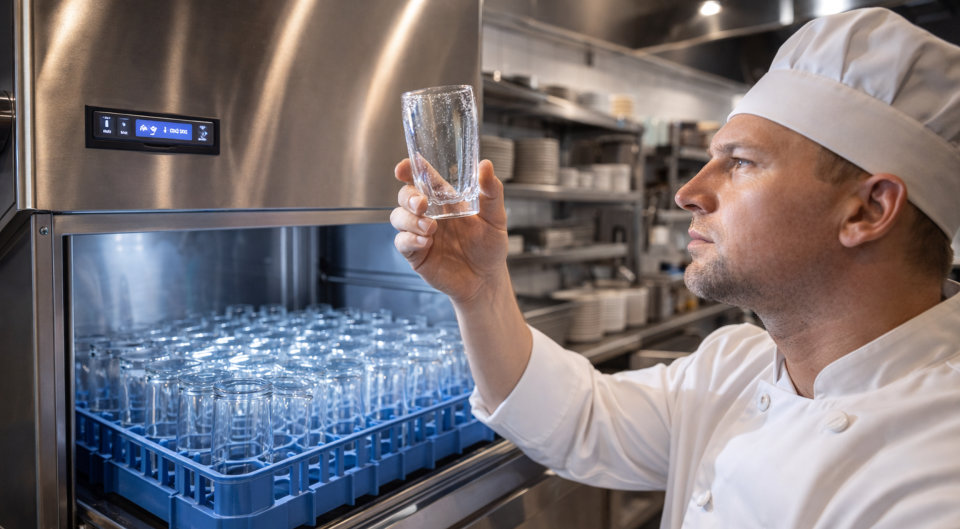
In the restaurant industry, perception is reality. A single spotted glass served to a customer can undo hours of perfect service. Cloudy glassware suggests poor hygiene, and in the age of social media, one photo can damage a reputation built over years [1].
30-50%
Detergent waste from scale [2]
20%
Energy loss per 1mm scale [3]
$500-1k
Annual chemical savings [2]
#3
Most common health violation [4]
Commercial dishwashers are workhorses of the kitchen, running cycle after cycle, day after day. They're expected to deliver spotless results with every load—but they face an invisible enemy: mineral scale. Scale buildup on heating elements, spray arms, and interior surfaces silently undermines every aspect of warewashing performance [1].
According to a survey of over 500 food service establishments, warewashing equipment accounts for approximately 40% of total water usage in a typical restaurant. Inefficient machines can waste thousands of gallons annually—along with the energy to heat that water and the chemicals to treat it [2].
The Health Code Reality
Improperly sanitized dishes are a direct path to health code violations. The FDA Food Code requires that all food-contact surfaces be properly cleaned and sanitized. Scale buildup can prevent sanitizers from reaching bacteria, leading to failed inspections [4].
Where Scale Undermines Your Commercial Dishwasher
Heating Elements
Scale acts as insulation, reducing heat transfer. The machine works harder to reach sanitizing temperatures, wasting energy and extending cycle times [3].
Spray Arms
Scale clogs spray arm nozzles, reducing water pressure and creating uneven coverage. Dishes come out dirty or with food residue [1].
Wash Tanks
Scale on tank walls and baffles creates rough surfaces where soil and bacteria accumulate, recontaminating wash water [2].
Rinse Lines
Scale-narrowed rinse lines reduce flow, preventing proper final rinse coverage. Glassware emerges spotted and streaked [5].
Detergent Dispensers
Scale can clog detergent lines and sensors, causing under- or over-dosing of chemicals—wasting money and compromising cleaning [2].
Temperature Sensors
Scale on sensors causes false readings, leading to inadequate sanitizing temperatures or excessive energy use [3].
According to the NSF, warewashing equipment must be maintained in accordance with manufacturer specifications to ensure proper sanitization. Scale buildup is one of the leading causes of equipment malfunction and failed health inspections [4].
The Chemistry of Spotting: Why Scale Makes Glassware Look Dirty
What Causes Glassware Spotting?
When water evaporates from glassware, any dissolved minerals remain behind as visible deposits. In hard water areas, these mineral spots are a constant battle [5].
The problem is compounded by:
- Inadequate rinse: Scale-narrowed rinse arms reduce water volume
- Improper drying: Scale-insulated heating elements fail to reach drying temperatures
- Chemical imbalance: Detergent sensors fooled by scale give incorrect dosing
- Water sheeting failure: Rinse aids cannot overcome mineral-laden water
Even with perfect chemical dosing, hard water will spot glassware. The only solution is to address the minerals themselves.
How Vulcan Prevents Spotting
Vulcan doesn't remove minerals—it changes their crystalline structure so they won't bond to surfaces [6].
For glassware, this means:
- Minerals stay in suspension during rinse cycle
- Water sheets off cleanly, leaving no spots
- Glass dries crystal clear
- No chemical aftertaste or residue
The result is glassware that looks professionally polished—every time, without chemical rinse aids.

Critical Distinction: Chemical Additives vs. True Prevention
Most restaurants attack spotting with more chemicals—extra rinse aid, stronger detergents, anti-spotting agents. But these address symptoms, not the root cause.
- Ongoing chemical costs - Detergent, rinse aid, deliming agents [2]
- Chemical storage - Drums take up valuable kitchen space
- Dosing system maintenance - Pumps, sensors, calibration
- Chemical handling hazards - Worker safety, spill risks
- Environmental impact - Chemical discharge into wastewater
- Masking, not solving - Extra chemicals mask spotting but don't remove minerals
- Equipment damage - Acids in deliming agents corrode components over time
The average restaurant spends $500-$1,500 annually on warewashing chemicals alone [2].
- Zero chemical costs - One-time investment, no ongoing purchases
- Zero storage - No drums, no space required
- Zero maintenance - No pumps, no sensors, no calibration
- Zero chemical hazards - No PPE, no spill risk
- Environmentally friendly - No chemical discharge
- Root cause solution - Prevents minerals from bonding
- Equipment protection - No acid damage, extended life
The Key Difference:
Vulcan does NOT add chemicals—it physically alters mineral crystal formation so scale cannot bond. Your water chemistry remains unchanged, but minerals stay suspended and rinse away cleanly [6].
The Restaurant Owner's Math
A mid-sized restaurant spends $800 annually on warewashing chemicals, $300 on deliming chemicals, and $200 on rinse aids—$1,300 total. Vulcan eliminates these costs entirely while delivering better results.
Sanitizing Effectiveness: The Hidden Food Safety Risk
Commercial dishwashers sanitize by maintaining a specific temperature for a specific duration—typically 180°F for high-temperature machines or chemical sanitizers for low-temperature units [4].
How Scale Compromises Sanitizing:
- Temperature loss: Scale on heating elements prevents water from reaching required sanitizing temperatures
- Incomplete coverage: Scale-clogged spray arms miss areas of dishware
- Chemical interference: Scale can neutralize or bind with sanitizing chemicals
- Bacteria harborage: Scale creates rough surfaces where bacteria survive sanitizing cycles [4]
The FDA Food Code requires that all food-contact surfaces be properly cleaned and sanitized. Failure to achieve proper sanitization is a critical violation that can result in immediate closure [4].
Temperature Requirements
| Machine Type | Final Rinse Temp |
|---|---|
| High-temp stationary rack | 165°F (74°C) |
| High-temp conveyor | 180°F (82°C) |
| Chemical sanitizing | 120-140°F + chemicals [4] |
Scale-insulated heaters often fail to reach these temperatures, creating a critical health risk.
Real Proof: Avril Supermarket, France
Facility: Avril Supermarket
Location: France
Application: Multiple water systems including warewashing
The Challenge
The supermarket faced persistent scale buildup across multiple systems. Scale was clogging nozzles and affecting equipment performance [7].
The Results
- "No more clogged nozzles" or scale buildup [7]
- Scale eliminated from all systems
- Reduced maintenance calls
Direct Translation to Warewashing
"No more clogged nozzles" means:
- Clean spray arms with full water pressure
- Consistent rinse coverage
- No mineral spots on glassware
- Zero deliming required
This case proves Vulcan delivers scale-free operation in food service environments.
Real Proof: Indonesian Food Processing Plant
Facility: Food Processing Plant (Delicatessen)
Location: Indonesia
Application: Boilers, heat exchanger, sterilizers
The Challenge
The facility faced severe scaling issues across multiple systems. They sought a chemical-free solution that would make old scale manageable and prevent future deposits [8].
The Results
- 0.5mm scale cleared within 2 months [8]
- 15-year scale buildup disappeared within 3 months
- Chemical treatment eliminated
Relevance to Warewashing
If Vulcan can remove 15 years of scale from industrial equipment, it can certainly keep your dishwasher scale-free. The same technology protects heating elements, spray arms, and rinse lines.

Real Proof: Salles Frères, French Food Confectioner
Facility: Salles Frères
Location: France
Application: Food confectionery processing equipment
The Challenge
This French food confectioner faced scale buildup on processing equipment, affecting product quality and requiring frequent cleaning cycles [9].
The Results
- Improved product quality consistency [9]
- Scale eliminated from processing equipment
- Reduced cleaning frequency
- Chemical cleaning reduced
The Quality Connection
For restaurants, glassware quality is as important as food quality. Spotless presentation signals attention to detail. With Vulcan, consistency becomes automatic.
ROI Calculator: Mid-Size Restaurant
| Without Vulcan (Reactive Chemical Treatment) | |
| Detergent (commercial grade) [2] | $600 |
| Rinse aid | $200 |
| Sanitizer chemicals | $300 |
| Deliming/descaling chemicals (4x/year @ $75) | $300 |
| Extra energy cost (20% from scale) [3] | $400 |
| Extra water from extended cycles | $200 |
| Repairs/service calls (annualized) | $300 |
| Labor for deliming (8 hours @ $20/hr) | $160 |
| Total annual warewashing cost | $2,460 |
| With Vulcan (Preventive) | |
| Detergent reduction (30% less needed) [2] | $180 saved |
| Rinse aid elimination (not needed) | $200 saved |
| Sanitizer optimized (works more effectively) | $100 saved |
| Deliming chemicals eliminated | $300 saved |
| Energy savings (20% efficiency gain) | $400 saved |
| Water savings | $200 saved |
| Repair/service call reduction | $300 saved |
| Deliming labor eliminated | $160 saved |
| Total Annual Savings | $1,840 |
The Reputation Value
A single customer who notices spotted glassware may never return. Regular customers who appreciate sparkling clean presentation become loyal advocates. The value of pristine presentation is immeasurable.
Get Exact Pricing for Your Restaurant
For precise pricing tailored to your warewashing equipment specifications:
- Existing customers: Log in to your account to view model-specific pricing
- New users: Create a free account to access detailed pricing and configuration options
- Need assistance? Contact our team for a kitchen equipment assessment
Account registration takes less than 2 minutes.
Recommended Vulcan Models for Commercial Kitchens
Different kitchen sizes require different models. Create an account for detailed specifications and pricing.
Vulcan S50 / S100
Undercounter or small door machine
Protects heating elements
Eliminates glassware spotting
Reduces detergent use
✓ Ideal for single dishwasher
Vulcan S150 / S250
Conveyor or flight machine
Full machine protection
High-volume operation
Consistent sanitizing temps
✓ Zero maintenance, zero consumables
Vulcan X-PRO Series
Multiple machines, central water system
Whole-kitchen protection
Dishwashers + glasswashers
Complete compliance assurance
✓ Permanent scale prevention
Chemical-Free Warewashing Efficiency Checklist
- Daily: Inspect spray arms for clogs, check rinse temperature [1]
- Weekly: Clean spray arms and nozzles, inspect for scale buildup
- Monthly: Remove and soak spray arms in deliming solution (if scale present)
- Quarterly: Professional inspection, heater element check
- Install Vulcan on main water line: Prevent scale at source
- Eliminate deliming: No more acid treatments
- Reduce detergent: Adjust dosing down as surfaces stay clean
- Monitor glassware: Document spotless results
References
- Foodservice Equipment & Supplies. (2025). Cleaning & Maintaining Warewashing Equipment.
- Ecolab. (2025). Warewashing Chemical Cost Analysis.
- Rinnai UK. (2025). Limescale protection in commercial heating systems.
- U.S. Food and Drug Administration. (2022). FDA Food Code Section 4-601.11.
- Hobart. (2025). Commercial Warewashing Best Practices.
- Vulcan Descaler. Electronic Anti-Scale System - Technology Overview.
- Vulcan Descaler. Avril Supermarket Case Study.
- Vulcan Indonesia. (2024). Food Processing Plant Installation Case Study.
- Vulcan Descaler. Salles Frères Food Confectioner Case Study.
- NSF International. (2025). Commercial Dishwasher Sanitization Standards.
Questions for Your Kitchen Efficiency Audit
- Are we seeing spots or film on glassware after washing?
- How much do we spend monthly on detergent and rinse aid?
- How often do we deliming our dishwasher? How long does it take?
- Does our dishwasher reach proper sanitizing temperatures?
- Have we ever had a health inspection citation related to warewashing?
- Are spray arms clogged with mineral deposits?
- What would a 30% reduction in detergent costs save us annually?
Vulcan provides the answers—and the solution.
Spotless Glassware, Lower Costs, Zero Chemicals
Join thousands of restaurants in eliminating warewashing chemicals—while achieving better results and passing every inspection.
About the Author
Waslix (Vulcan Mineral Descaler) provides non-chemical, maintenance-free scale prevention for commercial kitchens worldwide. Our physical impulse technology keeps dishwashers scale-free, eliminates glassware spotting, reduces detergent use by 30%, and ensures proper sanitization—trusted by restaurants, hotels, and food service operators globally. Create an account for detailed model specifications and pricing.

