
The High-Stakes Reality of Laundromat Water Heating
When a water heater fails in a laundromat, it's not just an inconvenience—it's a business crisis. A real-world HVAC technician recounts: "I went to a laundromat today... found the rear dry back fireside plate warped and heat stressed to the point of me shutting off the unit off — told the manager the situation — had him sign a ticket stating the unit was un-safe for operations. I went back to check on the boiler... the manager had turned it back on — CO pouring out." [1]
$8,500
Annual savings potential for laundromats [2]
12%
Efficiency loss from 1.6mm scale [4]
#1
Cause of tankless failure [10]
Commercial water heaters are the workhorses of any laundromat operation. With massive daily hot water demands—often 2,650 gallons per day or more [3]—these systems operate under constant stress. And in hard water areas, they face an invisible enemy: mineral scale.
Industry studies show that energy usage increases by 7% with every 1mm of scale build-up [4]. For a laundromat spending $40,000 annually on energy, that's $2,800 wasted per millimeter of scale. At 4mm, you're looking at over $11,000 in annual energy waste—money that could be pure profit [4][5].
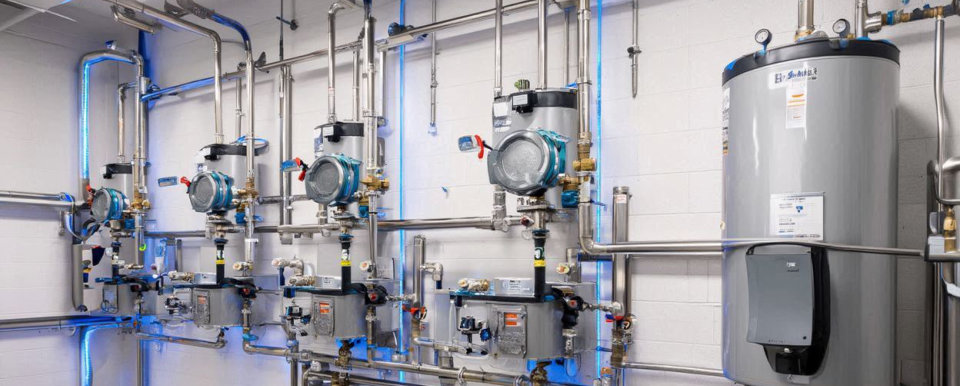
The Safety Reality
Scale doesn't just waste money—it creates dangerous conditions. As the HVAC technician discovered, heat-stressed, scaled components can lead to carbon monoxide leaks and catastrophic failure [1]. Prevention isn't optional; it's a safety imperative.
Where Scale Attacks Your Laundromat Water Heaters
Heat Exchangers
Scale impedes heat transfer efficiency, forcing the system to input more energy to maintain performance. 1.6mm of scale reduces efficiency by 12% [4].
Small Tubes in Tankless Units
Tankless heaters have smaller tubes than traditional heaters, making them more susceptible to clogging. Both types need deliming regularly [8].
Burner Assemblies
Scale and sediment can affect burner operation, leading to incomplete combustion and carbon monoxide risks—as seen in the laundromat near-disaster [1].
Circulation Pumps
Scale can seize pump impellers or clog internal passages, causing flow failures during peak demand periods.
Temperature Sensors
Scale on sensors causes false readings, leading to overheating or underheating—both costly and potentially dangerous.
Storage Tanks
Scale buildup at the bottom of storage tanks reduces effective capacity and insulates heating elements, wasting energy [4].
The lime and mineral buildup inside the heater acts as an insulation which reduces the transfer of heat from the flame to the water. Over time, water heaters will require more and more firing time to maintain temperature levels [8].

Vulcan installed on main water heater feed line—protects all units simultaneously
The Quantifiable Cost of Scale in Laundromats
Rinnai's comprehensive study of commercial hot water systems reveals the dramatic impact of scale over time [4][5]:
Energy Loss Per mm of Scale
- 1mm scale = 7% energy increase
- 2mm scale = 14% energy increase
- 3mm scale = 21% energy increase
- 4mm scale = 28% energy increase
For a laundromat with $40,000 annual energy costs, 4mm of scale wastes $11,200 per year [4].
10-Year Operating Cost Impact
Based on hotel case studies scaled to laundromat demand [4]:
- 1mm scale = $3,200+ per year additional cost
- 4mm scale = $12,800+ per year additional cost
- 10-year cumulative loss with 4mm scale = $86,000+
A properly sized water heater isn't just about having enough hot water—it's about having it at the lowest possible cost [2]. For laundromats, where water heating represents a massive operational expense, scale prevention delivers direct bottom-line impact.
Real-World Proof: The Bowles Laundry Case Study
Facility: Bowles Laundry
Demand: 2,650 gallons per day
The Situation
The Bowles Laundry installed a heat reclamation system (Therm-Katcher) to improve efficiency. The system cost $4,500 installed, with a tax credit of $1,125 leaving an effective cost of $3,375 [3].
The Results
- Average annual savings: $1,644 [3]
- Payback period: 2.1 years
- Contribution ranged from 29% to 52% of water heating load
The Vulcan Advantage
Bowles Laundry achieved 2.1-year payback through heat recovery. Now imagine combining that with scale prevention:
- Heat recovery + scale prevention = compounded savings
- Scale-free heat exchangers maximize heat transfer
- No descaling chemicals or labor
- Extended equipment life beyond design
With Vulcan, the payback period shrinks even further.

Critical Distinction: Reactive Descaling vs. True Prevention
Most laundromat owners accept annual descaling as unavoidable. For tankless water heaters, the recommendation is to hire a professional to descale annually—which adds about $250 per year to operating costs per unit [10]. But descaling is reactive, not preventive.
- Annual descaling cost: $250 per unit [10]
- System downtime: Hours of lost operation
- Chemical hazards: Acid handling, PPE, disposal
- Reactive approach: Only after efficiency has already dropped
- Never-ending cycle: Scale returns, descaling repeats
- Energy waste between cleanings: You pay the penalty until scale is removed
- Warranty risk: Hard water can void warranties [10]
"Scale accumulation in a unit still reduces the flow of hot water—meaning it'll need increasingly greater amounts of energy to deliver the same performance." [10]
- Zero annual descaling cost: One-time investment [6]
- Zero downtime: Units always operational
- Zero chemicals: No acids, no PPE, no disposal
- Preventive approach: Scale never forms
- Permanent solution: Install once, protect forever
- Continuous savings: No energy waste between cleanings
- Warranty protection: Preserves equipment eligibility [9]
How It Works:
Vulcan's physical impulse technology alters the crystalline structure of calcium carbonate so it cannot bond to surfaces. Minerals form non-adhering aragonite crystals that simply wash through, keeping heat exchangers clean and efficient [6].

The Laundromat Owner's Math
A laundromat with 6 tankless water heaters spends $1,500 annually on descaling labor and chemicals—plus the 7% energy penalty between cleanings. Over 10 years, that's $15,000 in descaling costs alone. Vulcan eliminates this entirely while protecting your equipment investment.
Tankless vs. Traditional: Scale Considerations for Laundromats
Many laundromats are switching to tankless water heaters for their space savings and energy efficiency. But there are important scale considerations [8]:
Benefits of Tankless for Laundromats
- Cost often less than traditional storage tank systems [8]
- Easy to add additional heaters if volume increases
- Space required is significantly less—mount on wall [8]
- No huge storage tank constantly bleeding off heat
- Ease of replacement—lift off bracket, install new [8]
- Redundancy—if one fails, others continue operating
The Scale Challenge
- Smaller tubes inside tankless heaters leads to the need to delime every year or so [8]
- Scale acts as insulation, reducing heat transfer
- Scale is the #1 cause of failure in tankless models [10]
- Hard water can void standard warranties [10]
"All water heaters develop lime buildup in the interior of their pipes... The lime and mineral buildup inside the heater acts as an insulation which reduces the transfer of heat from the flame to the water." [8]
Monitoring Scale: The Exhaust Temperature Method
Experienced laundromat operators have a clever way to monitor scale buildup [8]:
"The best way to discover how quickly to determine when you should delime any water heater is to drill a small hole in the exhaust vent and insert a meat thermometer when you first install your heating system. The temperature recorded will increase as more and more minerals are laid down inside your pipes. This is a terrible waste of energy as the heat is going out the exhaust and not being transferred to the water." [8]
How It Works:
- Record baseline exhaust temperature with new, clean unit
- Monitor periodically as scale accumulates
- Rising exhaust temp = scale insulating heat exchanger
- Schedule descaling when temp exceeds threshold
This removes the guesswork out of heater maintenance [8].
With Vulcan
Exhaust temperature never rises—because scale never forms. Your units operate at design efficiency indefinitely, and you never need to drill test holes or monitor for scale progression.
Warranty Implications: Hard Water and Coverage
The Hard Reality
Most industry-standard warranties for tankless water heaters are rendered void in the presence of hard water [10]. Scale damage is considered a maintenance issue, not a manufacturing defect.
Failure to properly pre-treat water may result in reduced equipment life and premature failure and is not covered under the limited warranty [5].
The Vulcan Advantage
Some manufacturers offer extended warranty options when using approved scale prevention. For example, Navien offers an additional year of labor warranty when installing their tankless units with an approved scale prevention system [9].
Vulcan provides the documentation needed to demonstrate proper water treatment—protecting your warranty coverage.
ROI Calculator: 6-Unit Tankless Laundromat
| Without Vulcan (Reactive Maintenance) | |
| Annual descaling labor (6 units x $250 each) [10] | $1,500 |
| Descaling chemicals/acids | $300 |
| Energy penalty from scale (7% average) [4] | $2,800 |
| Downtime (6 units x 2 hours @ $200/hr lost revenue) | $2,400 |
| Premature replacement (annualized cost) | $1,500 |
| Total annual scale-related cost | $8,500 |
| With Vulcan (Preventive) | |
| Descaling labor eliminated | $1,500 saved |
| Descaling chemicals eliminated | $300 saved |
| Energy penalty eliminated | $2,800 saved |
| Downtime eliminated | $2,400 saved |
| Extended equipment life | $1,500 saved |
| Total Annual Savings | $8,500 |
The Safety Value
The laundromat technician's story of carbon monoxide danger shows the ultimate cost of scale-related failure. Vulcan provides insurance against catastrophic equipment failure and safety risks [1].
Get Exact Pricing for Your Laundromat
For precise pricing tailored to your water heater specifications:
- Existing customers: Log in to your account to view model-specific pricing
- New users: Create a free account to access detailed pricing and configuration options
- Need assistance? Contact our team for a laundromat assessment
Account registration takes less than 2 minutes.
Recommended Vulcan Models for Laundromat Water Heaters
Different laundromat sizes and water heater configurations require different models. Create an account for detailed specifications and pricing.
Vulcan S150 / S250
2-4 tankless units or 1 traditional boiler
Protects heat exchangers
Eliminates annual descaling
Maintains rated efficiency
✓ Ideal for smaller operations
Vulcan S350 / S500
4-8 tankless units or multiple boilers
Multiple unit protection
Central hot water system
Maximum energy savings
✓ Zero maintenance, zero consumables
Vulcan X-PRO Series
8+ tankless units / central boiler plant
Full facility protection
As installed at Bowles: protects 2,650 GPD demand [3]
Maximum uptime assurance
✓ Permanent scale prevention
Laundromat Water Heater Protection Checklist
- Test water hardness: Determine scaling potential
- Calculate peak demand: Size system properly [2]
- Monitor exhaust temperature: Track baseline vs. current [8]
- Inspect heat exchangers: Look for visible scale
- Calculate descaling costs: Chemicals + labor + downtime
- Install Vulcan on main water line: Prevent scale at source
- Eliminate descaling: No more acid flushing
- Track energy savings: Document reduced gas consumption
- Maintain warranty records: Document scale prevention
References
- HVAC-Talk. (2004). Laundromat Boiler Safety Incident.
- North West Plumbing. (2025). Commercial Water Heater Guide.
- UNT Digital Library. (2018). Bowles Laundry Case Study.
- Rinnai UK. (2025). Limescale Protection Commercial Systems.
- Heating & Ventilating. (2025). Scale Protection Savings.
- Vulcan Descaler. Electronic Anti-Scale System Technology.
- Larsen, L. (2024). Should Laundromats Install Tankless Heaters?
- Navien. (2025). PeakFlow Scale Prevention System.
- Popular Mechanics. (2025). Tankless Water Heater Scale Prevention.
Questions for Your Laundromat Water Heater Audit
- What is our current water hardness (gpg)?
- How many tankless units do we have? What is their age?
- What is our annual descaling cost? (chemicals + labor + downtime)
- Have we measured exhaust temperature to detect scale buildup? [8]
- Have we ever experienced a water heater failure during operation?
- What is our current energy cost per month for water heating?
- Would eliminating annual descaling and 7% energy waste be valuable?
Vulcan provides the answers—and the solution.
Protect Your Water Heaters, Protect Your Business
Join laundromat owners nationwide in eliminating scale-related water heater failures—no descaling, no downtime, no safety risks.
About the Author
Waslix (Vulcan Mineral Descaler) provides non-chemical, maintenance-free scale prevention for laundromat water heaters worldwide. Our physical impulse technology keeps heat exchangers clean, eliminates annual descaling, and prevents catastrophic failures—trusted by laundromat owners and operators globally. Create an account for detailed model specifications and pricing.

