
The Silent Pump Killer: Why Mineral Scale Is Your Biggest Threat
If you have ever noticed your pressure washer losing that crisp, "like-new" punch, you are likely witnessing the physics of mineral precipitation in real-time. In hard water regions, every gallon of water pushed through your pump carries microscopic dissolved solids—primarily calcium and magnesium [1].
10-15%
Pressure drop from incipient scale [1]
2-3x
Faster failure from softeners [1]
$2-5k
Commercial pump replacement [4]
Under the high-heat and high-velocity conditions found inside a hydraulic pump, these minerals don't just pass through; they undergo a phase change, transitioning from a dissolved state into a solid, stony layer known as calcium carbonate (CaCO₃). This scale accumulates at critical "nucleation points"—specific areas where water velocity changes abruptly, such as check valve seats and unloader assemblies [1].
We often see operators mistake a gradual 10–15% pressure drop for "pump fatigue" or motor wear. However, the culprit is almost always scale accumulation. When scale builds up on valve seats, it prevents valves from sealing perfectly, causing internal leaks that bleed off pressure before it ever reaches your spray nozzles [1].
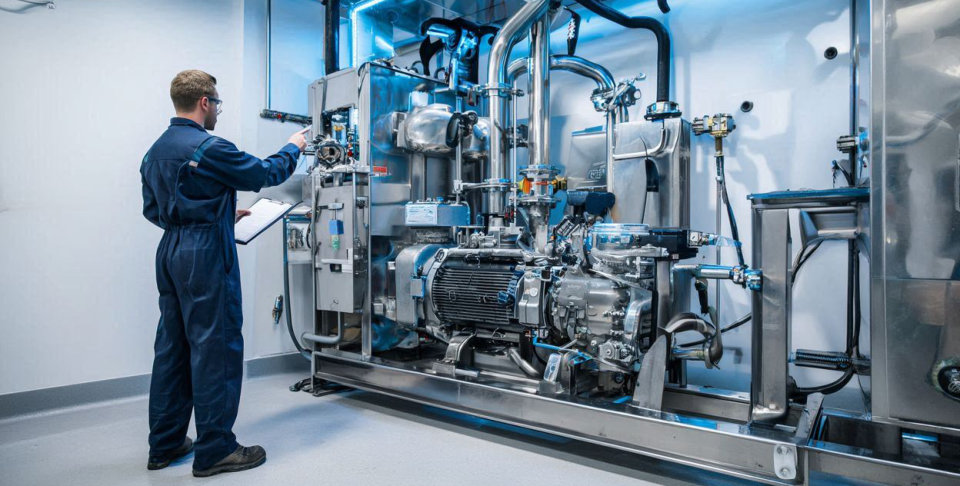
Understanding the Scaling Mechanism: Where Scale Attacks Your Pump
Scale does not form uniformly across the entire pump. Instead, it follows a predictable pattern of accumulation based on "nucleation points"—microscopic imperfections or sharp turns in the hydraulic pathway where mineral crystals can grab hold [1].
Check Valves
These small, spring-loaded components ensure water flows in only one direction. Even a paper-thin layer of scale on the valve seat prevents a tight seal. This leads to "pulsation," where pressure fluctuates rapidly [1].
Unloader Assemblies
The unloader diverts water into bypass when you release the trigger. Because it experiences high friction and rapid pressure shifts, it is often the first site of complete seizure [1].
Internal Sensors
Mineral buildup can insulate thermal or pressure sensors, leading to "false readings" that might cause the motor to shut down prematurely [1].
The Three-Stage Progression of Scale-Related Failure [1]:
- Stage 1 (Incipient): 10–15% pressure drop; often unnoticed by operators
- Stage 2 (Intermediate): Flow pulsation and audible "hunting" from the motor as valves fail to seat
- Stage 3 (Critical): Complete valve seizure or unloader failure, requiring component replacement

Vulcan installed on main water line—protects pumps, valves, and unloaders
The Temperature Factor: Why Hot Water Accelerates Scale
It is a common technical "gotcha" that scale formation is not linear; it is exponential relative to temperature. If you are using a hot water pressure washer or feeding from a hot water tap, water temperatures above 140°F (60°C) accelerate scale formation dramatically. The heat provides the activation energy needed for calcium ions to bond more tightly to metal surfaces [1].
Water Hardness Categories [1]
| Hardness | Grains per Gallon | Flush Frequency |
|---|---|---|
| Soft | 0-3 | Annual |
| Moderate | 3-7 | Every 6 months |
| Hard | 7-10 | Quarterly |
| Very Hard | 10+ | Bi-monthly |
Critical Distinction: Chemical Descaling vs. True Prevention
Most car wash operators address scale reactively—waiting until pressure drops, then flushing with acids. This approach has significant drawbacks, including seal damage and downtime.
- System downtime - Pumps offline for flushing
- Chemical hazards - Acid handling, PPE required
- Seal damage risk - Acids can swell or embrittle rubber seals [1]
- Never use vinegar >5% - Concentrated vinegar attacks elastomers [1]
- Reactive approach - Only after pressure has already dropped
- Never-ending cycle - Scale returns, descaling repeats
- Critical flush step - Must neutralize thoroughly to prevent ongoing corrosion [1]
Citric acid is gentler than vinegar, but both are reactive—they remove scale after it has already damaged your system [1].
- Zero downtime - Pumps always operational
- Zero chemicals - No acids, no PPE, no storage
- Seal protection - No chemical attack on elastomers
- Preventive approach - Scale never forms
- Permanent solution - Install once, protect forever
- No flushing required - Water chemistry unchanged
- Zero waste - No chemical discharge
How It Works:
Vulcan's physical impulse technology alters the crystalline structure of calcium carbonate so it cannot bond to surfaces. Rather than forming hard "calcite" scale that sticks to valves, minerals form non-adhering "aragonite" powder that simply washes through [1][8].

The Car Wash Operator's Math
A commercial car wash with 4 high-pressure pumps spends 8 hours quarterly on descaling at $75/hour labor = $2,400 annually—plus chemical costs and lost revenue during maintenance. Vulcan eliminates this entirely while extending pump life.
The Softener Paradox: Why "Soft" Water Can Destroy Your Pumps Faster
This is perhaps the most counter-intuitive insight in hydraulic maintenance: Sodium-based water softeners can actually be more damaging to your pump than hard water [1].
The Problem
Conventional wisdom suggests that removing calcium solves the problem. However, most residential softeners replace calcium ions with sodium ions. This creates "ionically active" water with much higher electrical conductivity [1].
In the multi-metal environment of a pump (where stainless steel valves meet brass or aluminum housings), this high conductivity creates "galvanic cells." Instead of scale buildup, you get electrochemical corrosion.
This "aggressive" water preferentially attacks valve seats and seals, causing catastrophic failures that are often 2–3 times faster than gradual scale accumulation [1].
The Vulcan Solution
Vulcan does not add sodium or alter water chemistry. It simply prevents scale from bonding to surfaces while preserving the natural mineral balance [8].
For car wash pumps, this means:
- No galvanic corrosion from softened water
- No scale buildup on valve seats
- No chemical handling or storage
- Pumps operate at design pressure indefinitely
If you have a whole-house softener, consider installing Vulcan on the pump supply line for unsoftened bypass water.
Real Proof: Car Wash Pump Protection
Application: High-pressure pump systems
Challenge: Scale buildup on valve seats causing pressure loss and pulsation [1]
The Mechanism
Scale accumulates at "nucleation points"—check valve seats and unloader assemblies. Even a paper-thin layer prevents valves from seating perfectly, causing internal leaks that bleed off pressure [1].
The Solution
- Vulcan prevents scale formation at the molecular level
- Valves seat perfectly, maintaining design pressure
- Unloaders function reliably without seizure
- No chemical descaling required
Direct Translation to Car Wash Pumps
The same scale that plagues industrial pumps destroys car wash pumps daily. Vulcan's proven technology keeps check valves clear, unloaders functional, and pressure consistent.

Real Proof: Avril Supermarket, France
Facility: Avril Supermarket
Location: France
Application: Multiple water systems including nozzles
The Challenge
Persistent scale buildup was clogging nozzles and affecting equipment performance—directly analogous to car wash pump valve and nozzle fouling [7].
The Results
- "No more clogged nozzles" [7]
- Scale eliminated across all systems
- Reduced maintenance calls
Direct Translation to Car Wash
"No more clogged nozzles" means:
- Clean check valves that seat perfectly
- Clear unloader passages
- Consistent spray pressure
- No pressure drop from internal leaks
Pump Maintenance Best Practices
Daily [4]
- Visual inspection for leaks or unusual noise
- Check pressure gauges for normal readings
- Clean inlet filters and screens
Weekly
- Check oil levels and condition
- Inspect hoses for cracks or wear
- Test trigger gun and wand
Monthly
- Change oil (every 300-500 hours) [4]
- Inspect seals and O-rings
- Check valve operation
Quarterly
- Descale with citric acid if scale present (without Vulcan)
- Inspect unloader valve
- Check belt tension and alignment
With Vulcan
- Eliminate descaling step entirely
- Focus on routine oil changes and inspection
- Track pressure consistency (no degradation)
- Extended intervals between rebuilds
"The goal is to dissolve minerals without etching the metal or rotting rubber O-rings and seals. If seals are already showing signs of cracking, chemical descaling may exacerbate existing leaks." [1]
ROI Calculator: 4-Bay Commercial Car Wash
| Without Vulcan (Reactive Maintenance) | |
| Pump replacement (1 pump @ $3,000 every 3 years) [2][4] | $1,000 annualized |
| Valve/unloader rebuilds (2x/year @ $200/rebuild) | $400 |
| Descaling chemicals (4 pumps x 4x/year @ $25) | $400 |
| Labor for descaling (4 pumps x 4x/year x 1 hr @ $50/hr) | $800 |
| Downtime lost revenue (4x/year x $500/hour) | $2,000 |
| Energy penalty (5% from scale-induced friction) [1] | $600 |
| Total annual scale-related cost | $5,200 |
| With Vulcan (Preventive) | |
| Pump replacement deferred (6-year life) | $500 saved |
| Valve/unloader rebuilds eliminated | $400 saved |
| Descaling chemicals eliminated | $400 saved |
| Descaling labor eliminated | $800 saved |
| Downtime eliminated | $2,000 saved |
| Energy penalty eliminated | $600 saved |
| Total Annual Savings | $4,700 |
The Softener Risk
If you use softened water, your pumps face corrosion 2-3x faster than scale formation. Vulcan prevents scale without introducing sodium—protecting pumps from both threats [1].
Get Exact Pricing for Your Car Wash
For precise pricing tailored to your pump specifications:
- Existing customers: Log in to your account to view model-specific pricing
- New users: Create a free account to access detailed pricing and configuration options
- Need assistance? Contact our team for a car wash pump assessment
Account registration takes less than 2 minutes.
Recommended Vulcan Models for Car Wash Operations
Different facility sizes and pump configurations require different models. Create an account for detailed specifications and pricing.
Vulcan S100
1-2 high-pressure pumps
Protects check valves and unloaders
Maintains consistent pressure
Eliminates descaling downtime
✓ Ideal for smaller operations
Vulcan S250 / S350
4-8 pumps / tunnel systems
Multiple pump protection
Central water supply
Extended equipment life
✓ Zero maintenance, zero consumables
Vulcan X-PRO Series
Multiple pumps / high volume
Full facility protection
Booster pumps and softeners
Maximum uptime assurance
✓ Permanent scale prevention
Car Wash Pump Protection Checklist
- Test water hardness: Determine your risk level (0-10+ gpg) [1]
- Monitor pressure gauges: Track baseline vs. current readings
- Inspect check valves: Look for signs of scale or leakage
- Check unloader operation: Ensure smooth bypass cycling
- Evaluate softener impact: Are you using softened water? Consider bypass
- Install Vulcan on main water line: Prevent scale at source
- Eliminate descaling: No more acid flushing
- Track pump life: Document extended intervals between rebuilds
References
- Fanttik. (2026). Hard Water Defense: Preventing Mineral Scale in Pump Valves.
- Chinahbv. (2025). 降低部件间的摩擦 - Car Wash Pump Life Expectancy.
- 太平洋汽车. (2024). 洗车水泵压力不足的原因.
- Riggers Pumps. (2024). How to Maintain Commercial Car Wash Pumps.
- 汽车之家. (2024). 洗车水泵压力不足的原因是什么?
- 太平洋汽车. (2025). 洗车机水泵的使用寿命大概多久?
- Vulcan Descaler. Avril Supermarket Case Study.
- Vulcan Descaler. Electronic Anti-Scale System Technology.
Questions for Your Pump System Audit
- What is our current water hardness (gpg)?
- Have we noticed any pressure drop over time?
- Do our pumps pulsate or "hunt" at the unloader?
- How often do we descale? How many labor hours?
- Do we use softened water? Have we seen corrosion?
- What is our average pump life before rebuild?
- Could we eliminate descaling and double pump life?
Vulcan provides the answers—and the solution.
Protect Your Pumps, Protect Your Profit
Join car wash operators nationwide in eliminating scale-related pump failures—no chemicals, no downtime, no softener paradox.
About the Author
Waslix (Vulcan Mineral Descaler) provides non-chemical, maintenance-free scale prevention for car wash pumps worldwide. Our physical impulse technology keeps check valves clear, unloaders functional, and pressure consistent—trusted by self-serve bays, automatic washes, and fleet operations globally. Create an account for detailed model specifications and pricing.

