
The Pursuit of Perfect Water
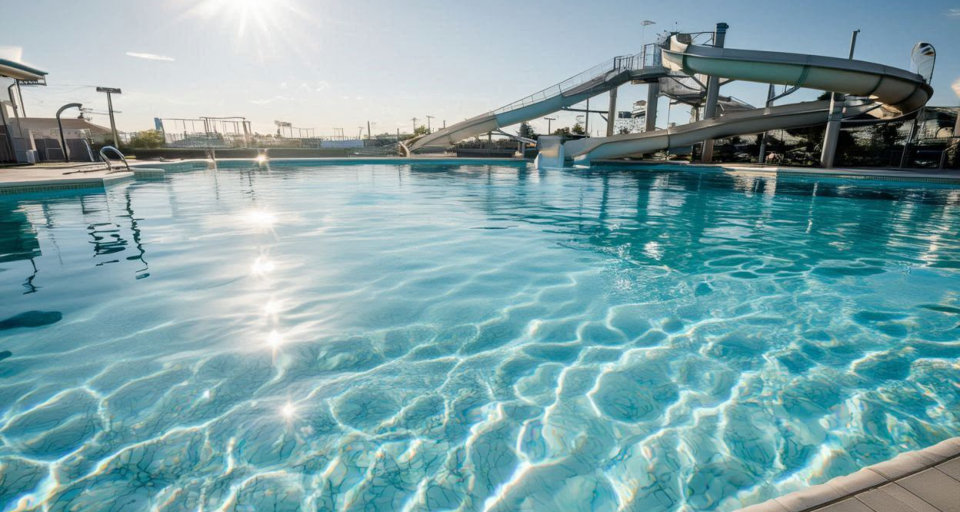
When water is perfectly balanced, it's almost invisible—crystal clear, odorless, and gentle on eyes and skin. But achieving that balance is one of the most complex challenges in water park operations [2][7].
7.2-7.8
Ideal pH range [1]
80-120 ppm
Calcium hardness range [7]
80-100 ppm
Total alkalinity range [1]
Water chemistry in commercial pools and water parks is a delicate balancing act. Every parameter interacts with every other. pH affects chlorine effectiveness. Alkalinity buffers pH. Calcium hardness affects both scaling and corrosion. And all of it is influenced by temperature, bather load, and makeup water quality [2].
The goal of water balance is to maintain water that is neither corrosive nor scale-forming. This is measured by the Langelier Saturation Index (LSI)—a calculation that considers pH, temperature, calcium hardness, total alkalinity, and total dissolved solids [1].
The Sweet Spot
The Association of Pool & Spa Professionals (APSP) considers the minimum and maximum LSI for proper pool water balance to be -0.3 to +0.5. Within these parameters, water should be neither significantly aggressive nor scale-forming [1].
The Chemistry of Balanced Water
Understanding the five key parameters that determine water balance [1][7]:
pH
The most important factor. Low pH (below 7.2) causes corrosion and eye irritation. High pH (above 7.8) reduces chlorine effectiveness and promotes scale formation [1].
Total Alkalinity (TA)
TA buffers pH, preventing rapid swings. Low TA causes pH bounce. High TA leads to pH creep and scale formation. Target: 80-100 ppm [1].
Calcium Hardness
Calcium is structural—it prevents water from becoming aggressive. Low calcium corrodes plaster and equipment. High calcium causes scale. Target: 80-120 ppm for indoor pools, 200-400 ppm for outdoor [7].
Temperature
Warmer water increases LSI. Water parks operate at higher temperatures, increasing scaling risk. Each degree matters [1].
Total Dissolved Solids (TDS)
As TDS rises, water behaves differently. High TDS increases scale potential and reduces water clarity [2].
Cyanuric Acid (CYA)
CYA stabilizes chlorine but also affects alkalinity calculations. High CYA (above 100 ppm) requires different LSI adjustments [2].
The LSI Formula [1]
LSI = pH + Temperature Factor + Calcium Hardness Factor + Alkalinity Factor – TDS Factor
Modern LSI calculators account for CYA and borates, providing accurate carbonate alkalinity values.
The Scale-Chemistry Connection: Why Scale Disrupts Balance
How Scale Destabilizes Chemistry
- Scale formation consumes alkalinity, causing pH to drift
- Scale on sensors causes false readings—you adjust based on wrong data
- Scale in heat exchangers changes temperature, affecting LSI
- Scale particles cloud water, increasing chemical demand
- Scale hides bacteria, requiring higher chlorine residuals [2]
How Vulcan Helps
By preventing scale formation, Vulcan:
- Preserves alkalinity—no consumption by scale
- Keeps sensors clean—accurate readings, accurate adjustments
- Maintains heat transfer—stable temperatures, stable LSI
- Eliminates scale particles—clearer water
- Removes biofilm habitat—lower chlorine demand [6]
Critical Distinction: Chemical Adjustment vs. True Prevention
Most water parks manage chemistry by adding chemicals to correct imbalances. But if scale is forming, you're always playing catch-up—and using more chemicals than necessary.
- pH adjusters: Acid to lower pH, soda ash to raise it
- Alkalinity buffers: Sodium bicarbonate, etc.
- Calcium increaser: For low calcium
- Scale inhibitors: Sequestering agents [3]
- Never-ending cycle: Scale forms, chemistry drifts, you adjust
- Can't fix root cause: You treat symptoms, not the problem
Scale inhibitors are not scale preventers—they temporarily bind minerals but don't stop formation [3].
- Zero pH drift: No scale to consume alkalinity
- Stable alkalinity: No chemical adjustments needed
- Calcium preserved: Healthy levels maintained
- Zero inhibitors needed: Scale never forms
- Permanent solution: Install once, protect forever
- Root cause solved: No scale = stable chemistry
How It Works:
Vulcan's physical impulse technology alters the crystalline structure of calcium carbonate so it cannot bond to surfaces. Water chemistry remains stable, sensors stay accurate, and chemical usage drops [6].

The Operator's Math
A water park spending $50,000 annually on water chemistry chemicals can reduce usage by 30-50% with stable, scale-free water. That's $15,000-$25,000 in direct savings—every year.
Real Proof: Moroccan Hammam Bathhouse
Facility: Traditional Moroccan Hammam Bathhouse
Location: Morocco
Application: Hot water system with extreme hardness
The Challenge
This traditional bathhouse faced severe scale buildup in their hot water system. The combination of high temperatures and extreme water hardness created thick scale deposits, making water feel harsh and requiring constant chemical cleaning [7].
The Results
- Scale eliminated from the system
- "Water feels softer" - noticeable to customers [7]
- Chemical cleaning eliminated
"Water Feels Softer"
This feedback from customers is the ultimate validation of water quality. When scale is eliminated, water retains its natural softness—improving the guest experience while reducing chemical usage.

Real Proof: UC Davis Bodega Marine Laboratory
Facility: UC Davis Bodega Marine Laboratory
Location: California
Application: Water heating systems
The Challenge
This leading research facility faced severe scale buildup in their domestic water heating system, causing frequent maintenance and energy waste. They sought a solution aligned with their environmental mission [8].
The Results
- Scale eliminated from water heaters
- No scale-related maintenance in 3+ years
- Energy savings validated in facility audit
Water Quality Impact
By eliminating scale, UC Davis achieved stable water chemistry, reduced chemical usage, and consistent performance—the same benefits water parks need.
Real Proof: Supermall Karawaci, Indonesia
Facility: Supermall Karawaci (SMK)
Location: Tangerang, Indonesia
Application: Cooling towers and circulation systems
The Challenge
Severe scaling in water circulation systems was driving up energy costs and maintenance frequency—identical to challenges in water park operations [9].
The Results
- Scale eliminated from water systems
- Energy consumption reduced by 11% [9]
- Maintenance costs dropped immediately
Water Park Parallel
The same circulation dynamics that cause scale in cooling towers also cause scale in water park systems. Eliminating scale means stable chemistry, less chemical adjustment, and better water quality.
Practical Water Quality Management
Daily Tasks [4]
- Test free chlorine and pH (multiple times daily)
- Record results in logbook
- Adjust chemical feed as needed
- Visual check for clarity, color, floating debris
Weekly Tasks
- Test total alkalinity, calcium hardness, cyanuric acid
- Check and calibrate sensors
- Inspect pool surfaces for scale
ROI Calculator: Water Park with 1 Million Gallons
| Without Vulcan (Reactive Chemistry) | |
| pH adjustment chemicals (acid/soda ash) | $12,000 |
| Alkalinity buffers | $6,000 |
| Calcium hardness adjusters | $4,000 |
| Scale inhibitors/sequestering agents [3] | $8,000 |
| Extra chlorine due to scale interference (15%) | $9,000 |
| Labor for chemical adjustments (4 hours/day @ $40/hr) | $58,400 |
| Total annual chemistry-related cost | $97,400 |
| With Vulcan (Stable Chemistry) | |
| pH adjustment chemicals (50% reduction) | $6,000 saved |
| Alkalinity buffers (50% reduction) | $3,000 saved |
| Calcium adjusters (80% reduction) | $3,200 saved |
| Scale inhibitors eliminated | $8,000 saved |
| Chlorine optimization | $9,000 saved |
| Labor reduction (2 hours/day) | $29,200 saved |
| Total Annual Savings | $58,400 |
The Guest Experience Value
Perfectly balanced water means no red eyes, no chlorine smell, no dry skin. Guests notice—and they return. The value of repeat business far exceeds chemical savings.
Get Exact Pricing for Your Water Park
For precise pricing tailored to your facility specifications:
- Existing customers: Log in to your account to view model-specific pricing
- New users: Create a free account to access detailed pricing and configuration options
- Need assistance? Contact our team for a water chemistry assessment
Account registration takes less than 2 minutes.
Recommended Vulcan Models for Water Parks
Different water park sizes and configurations require different models. Create an account for detailed specifications and pricing.
Vulcan S250 / S350
Up to 500,000 gallons
Stabilizes water chemistry
Reduces chemical usage 30-50%
Protects sensors and equipment
✓ Ideal for hotel water parks
Vulcan S500 / X-PRO 1
500,000 - 1.5M gallons
Multiple pool circuits
Central water treatment
Consistent water quality
✓ Zero maintenance, zero consumables
Vulcan X-PRO 2
1.5M+ gallons / multiple buildings
Full facility protection
Advanced chemistry stability
Maximum guest experience
✓ Permanent scale prevention
Water Quality Optimization Checklist
- Test water hardness: Determine baseline
- Calculate LSI monthly: Use modern calculator accounting for CYA [2]
- Check sensors for scale: Clean or calibrate as needed
- Review chemical logs: Track usage per month
- Inspect pool surfaces: Look for scale or etching
- Install Vulcan on main circulation line: Prevent scale at source
- Monitor chemical usage: Document reduction
- Survey guest experience: Track feedback on water quality
References
- AQUA Magazine. (2015). Keeping Pool Water Balanced.
- Orenda Technologies. (2019). 7 Factors That Affect LSI.
- Pool & Spa News. Scale Q&A.
- NSW Health. (2023). Public Pool Water Quality.
- NSW Health. (2023). Public Spa Pool Water Quality.
- Vulcan Descaler. Electronic Anti-Scale System Technology.
- Vulcan Descaler. Moroccan Hammam Bathhouse Case Study.
- Vulcan Descaler. UC Davis Bodega Marine Laboratory Case Study.
- Vulcan Descaler. Supermall Karawaci Case Study.
Questions for Your Water Chemistry Audit
- What is our current LSI? How often do we calculate it?
- How much do we spend monthly on pH adjusters?
- Do we use scale inhibitors? What do they cost?
- Are our sensors reading accurately? Any scale buildup?
- Do guests complain about eye irritation or chlorine smell?
- Have we noticed any scale on pool surfaces?
- What would 40% lower chemical costs save us annually?
Vulcan provides the answers—and the solution.
Perfect Water, Less Chemicals
Join leading water parks in achieving optimal water chemistry—stable, balanced, and gentle on guests. Less chemical usage, lower costs, better experience.
About the Author
Waslix (Vulcan Mineral Descaler) provides non-chemical, maintenance-free scale prevention for water parks worldwide. Our physical impulse technology stabilizes water chemistry, reduces chemical usage by 30-50%, and delivers the crystal-clear, gentle water guests expect. Create an account for detailed model specifications and pricing.

