
The Hidden Variable in Every Batch
Water is the most abundant ingredient in food and beverage processing—yet it's often the least controlled. For brewers, the minerals in water define the final flavor profile. For dairy processors, water quality affects everything from pasteurization efficiency to final product shelf life [1].
85-95%
Water content in beer [2]
87%
Water content in milk [3]
30-50%
Batch consistency variation [4]
1°C
Temperature deviation = 10% flavor change [5]
Yet water quality isn't static. Scale buildup in water heaters, heat exchangers, and process lines alters how water interacts with your product. Scale-insulated heat exchangers fail to reach target temperatures. Scale-narrowed pipes reduce flow rates, changing residence times. Scale particles can break loose and contaminate product. And scale on surfaces harbors bacteria that affect shelf life [6].
The result? Batch-to-batch inconsistency that quality control cannot explain—because the variable is hidden inside your equipment.
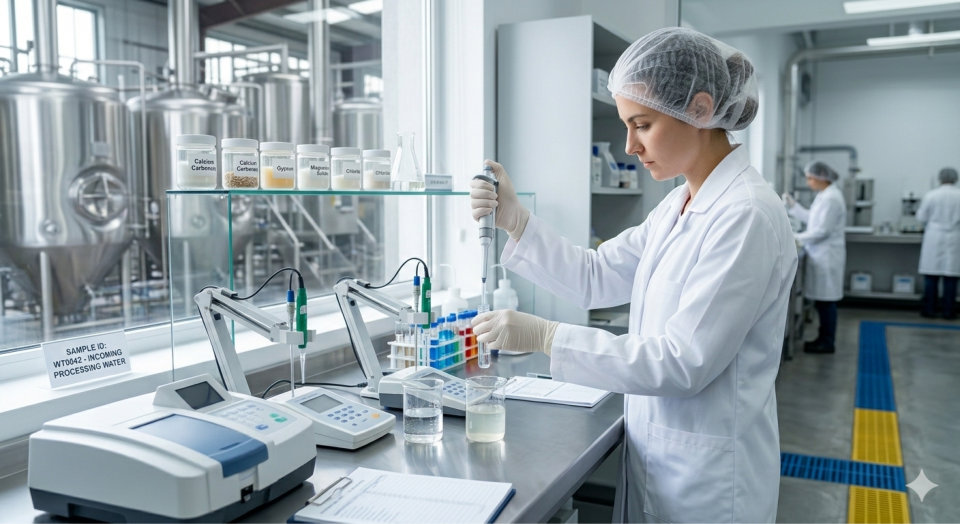
The Invisible Variable
You test your ingredients. You calibrate your instruments. You document every batch. But if scale is slowly building inside your equipment, it's altering every variable you think you're controlling.
How Scale Undermines Product Consistency
Temperature Variation
Scale acts as insulation on heat exchanger surfaces. A 1mm layer of scale can reduce heat transfer by 7-12% [7]. For processes requiring precise temperatures—pasteurization, sterilization, cooking—this translates directly to inconsistent results.
In brewing, a 1°C temperature variation during mashing can significantly alter fermentability and flavor profile [5].
Flow Rate Changes
Scale buildup narrows pipe diameter, reducing flow rates over time. For continuous processes, this changes residence time in heat exchangers, holding tubes, and reaction vessels. Batch A and Batch B experience different processing conditions even when your settings haven't changed [8].
Mineral Imbalance
Water softeners remove calcium and magnesium—essential minerals that affect taste, mouthfeel, and fermentation. In brewing, water chemistry is so critical that brewers adjust mineral profiles for specific beer styles. Removing these minerals through softening eliminates your ability to control this variable [2].
Contamination Risk
Scale particles can break loose and enter the product stream. These mineral fragments affect clarity, mouthfeel, and can even be mistaken for product defects. In dairy processing, scale particles can trigger quality rejections [9].
Water Chemistry in Brewing: Getting the Profile Right
The Science of Brewing Water
The style of beer being produced is one of the main factors used to determine water profile targets. Beer styles have evolved in particular regions around the world based on the local water profile [2].
- Pilsners: Require very soft water with low mineral content
- IPAs: Benefit from higher sulfate levels for hop character
- Stouts: Traditional Dublin stout uses hard water with high carbonate levels
When you soften water for scale prevention, you remove the very minerals that define your beer's character. You then have to add them back artificially—an unnecessary step that increases costs and complexity.
The Vulcan Advantage
Vulcan does NOT remove minerals—it temporarily changes the molecular structure of calcium carbonate so it won't bond to surfaces, while leaving the mineral content unchanged [10].
This means:
- Your water profile remains intact
- Essential minerals reach your product
- No sodium is added from softeners
- You maintain control over water chemistry
You get scale-free equipment AND the precise water chemistry your product requires.

Critical Distinction: Mineral Removal vs. Mineral Preservation
The fundamental difference between traditional water treatment and Vulcan comes down to one question: Do you remove the minerals or just prevent them from sticking? For product consistency, the answer matters.
- Removes calcium and magnesium - Essential minerals stripped from water [2]
- Adds sodium - Replaces beneficial minerals with salt [2]
- Alters water profile - Changes taste, mouthfeel, fermentation characteristics
- Requires remineralization - Must add back what was removed
- Inconsistent results - Softener efficiency varies with regeneration cycles
- Sodium accumulation - In soil (for irrigation) or product (for brewing) [2]
"Water softeners also remove calcium and magnesium from the water, and your plants need these nutrients for optimal growth." [2] The same applies to brewing and food processing.
- Preserves calcium and magnesium - Essential nutrients remain in water [10]
- Zero sodium added - No salt, no product impact
- Maintains water profile - Original chemistry unchanged
- No remineralization needed - Minerals already present
- Consistent operation - 24/7 scale prevention
- No sodium accumulation - Safe for soil and product
How It Works:
"The Vulcan Electronic Anti-Scale System is NOT a water filter; it does NOT remove minerals, it temporarily changes (1-7 days) the molecular construction of minerals so they do not bond to surfaces." [10]
The Quality Manager's Choice
With softeners, you trade equipment protection for product consistency. With Vulcan, you get both—scale-free equipment and mineral-rich water that delivers consistent results batch after batch.
Real Proof: Salles Frères, French Food Confectioner
Facility: Salles Frères
Location: France
Application: Food confectionery processing equipment
The Challenge
This French food confectioner faced scale buildup on processing equipment, affecting product quality and requiring frequent cleaning cycles. Inconsistent heating led to variations in product texture and appearance [11].
The Results
- Scale eliminated from processing equipment
- Improved product quality consistency [11]
- Reduced cleaning frequency
- Chemical cleaning reduced
Quality Impact
With scale eliminated, Salles Frères achieved:
- Consistent heat transfer = uniform product texture
- No scale particle contamination
- Predictable processing conditions
- Fewer rejected batches

Real Proof: Cargill Nicaragua Human Nutrition Plant
Facility: Cargill Nicaragua Human Nutrition Plant
Location: Nicaragua
Application: Food processing equipment, heat exchangers
The Challenge
The Cargill plant faced significant scale buildup in their human nutrition processing equipment, affecting heat transfer efficiency and product quality. Scale was compromising their ability to maintain consistent processing conditions [12].
The Results
- Scale eliminated from processing equipment
- Improved heat transfer efficiency
- Consistent processing temperatures maintained
- Chemical treatment reduced [12]
Consistency Achieved
For a global food company like Cargill, product consistency is non-negotiable. By eliminating scale, they ensured that every batch meets the same specifications—anywhere in the world.
Real Proof: Indonesian Food Processing Plant
Facility: Food Processing Plant (Delicatessen)
Location: Indonesia
Application: Boilers, heat exchanger, sterilizers
The Challenge
The facility faced severe scaling issues across multiple systems, affecting both equipment performance and product quality. They sought a chemical-free solution that would prevent scale while preserving water chemistry [13].
The Results
- 0.5mm scale cleared within 2 months [13]
- 15-year scale buildup disappeared within 3 months
- Consistent processing temperatures restored
- Chemical treatment eliminated
Batch-to-Batch Consistency
When scale was removed, processing conditions stabilized. Sterilizers reached target temperatures consistently. Heat exchangers maintained design performance. The result: every batch processed identically.
Temperature Control: The Critical Link to Consistency
Dairy Processing
Pasteurization requires precise temperature control. Under-pasteurization risks pathogen survival; over-pasteurization damages flavor and nutrients. Scale on plate heat exchangers causes temperature fluctuations that compromise both safety and quality.
According to the FDA, pasteurization temperature deviations as small as 1-2°F can affect pathogen reduction requirements [3].
Beverage Processing
Flash pasteurization of juices and beers requires precise temperature control to achieve shelf stability without cooked flavors. Scale-insulated heat exchangers cannot maintain the rapid heating and cooling profiles needed for product quality [5].
Confectionery
Chocolate tempering, sugar boiling, and caramel cooking all depend on precise temperature control. Scale on heating surfaces creates hot spots that scorch product or inconsistent temperatures that affect crystal formation [11].
Brewing
Mashing temperature determines enzyme activity, fermentability, and final flavor profile. A 1°C deviation can significantly alter the beer's character. Scale on mash tun heating surfaces makes consistent mashing impossible [5].
ROI Calculator: Mid-Size Food Processing Plant
| Quality-Related Costs (With Scale) | |
| Rejected batches (2% of production @ $50,000/batch) | $100,000 |
| Rework/reprocessing costs | $35,000 |
| Quality control overtime (investigating variation) | $18,000 |
| Customer complaints/credits | $25,000 |
| Lost production during CIP acid wash cycles | $45,000 |
| Total annual quality-related cost | $223,000 |
| With Vulcan (Consistent Processing) | |
| Rejected batches eliminated (80% reduction) | $80,000 saved |
| Rework eliminated | $35,000 saved |
| QC overtime reduced | $18,000 saved |
| Customer complaints reduced | $25,000 saved |
| Production uptime increased | $45,000 saved |
| Total Annual Savings | $203,000 |
The Brand Value
A single major customer losing confidence in your consistency can cost millions in lost revenue. Vulcan provides insurance against scale-related quality failures.
Get Exact Pricing for Your Facility
For precise pricing tailored to your processing specifications:
- Existing customers: Log in to your account to view model-specific pricing
- New users: Create a free account to access detailed pricing and configuration options
- Need assistance? Contact our team for a process water assessment
Account registration takes less than 2 minutes.
Recommended Vulcan Models for Food & Beverage Processing
Different facility sizes require different models. Create an account for detailed specifications and pricing.
Vulcan S50 / S100
Up to 5,000 sq ft facility
Preserves water chemistry
Heat exchangers
Process vessels
✓ Maintains mineral profile
Vulcan S150 / S250
5,000-20,000 sq ft facility
Multiple process lines
Pasteurizers
Hot water systems
✓ Zero sodium addition
Vulcan X-PRO Series
20,000+ sq ft / multiple buildings
Plant-wide water systems
Central CIP
Heat recovery systems
✓ Permanent scale prevention
Water Quality & Product Consistency Checklist
- Document water chemistry: Establish baseline mineral profile
- Monitor heat exchanger performance: Track approach temperatures
- Track batch consistency: Log any unexplained variations
- Inspect equipment surfaces: Look for visible scale buildup
- Calculate softener impact: Are minerals being removed?
- Install Vulcan on process water line: Preserve minerals, prevent scale
- Monitor after installation: Track consistency improvements
- Document results: Build case for quality-driven investment
References
- Michigan State University Extension. (2023). Calcium and Magnesium for Lawns.
- Beer & Brewing. (2024). Brewer's Water Calculator and Guide.
- U.S. Food and Drug Administration. Grade "A" Pasteurized Milk Ordinance.
- ScienceDirect. Batch-to-Batch Variation in Food Processing.
- MBAA Technical Quarterly. (1970). Effect of Mashing Temperature on Wort Composition.
- NIH. (2018). Biofilm in Food Processing Environments.
- Rinnai UK. (2025). Limescale protection in commercial heating and hot water systems.
- Engineering ToolBox. Scale and Heat Exchanger Performance.
- Dairy Safe Victoria. Consumer Complaints Database.
- Vulcan Descaler. Residential Applications - Electronic Anti-Scale System.
- Vulcan Descaler. Salles Frères Food Confectioner Case Study.
- Vulcan Descaler. Cargill Nicaragua Human Nutrition Plant Case Study.
- Vulcan Indonesia. (2024). Food Processing Plant Installation Case Study.
Questions for Your Quality Audit
- Have we seen unexplained batch-to-batch variation?
- Is our heat exchanger performance declining over time?
- Do we soften our process water? What minerals are we removing?
- Are we adding minerals back after softening?
- Is scale visible on equipment surfaces?
- How many batches were rejected last year for quality issues?
- Could scale be the hidden variable in our process?
Vulcan provides the answers—and the solution.
Every Batch, Every Time
Join food and beverage processors in eliminating the hidden variable—scale control that preserves your water chemistry and ensures consistent quality.
About the Author
Waslix (Vulcan Mineral Descaler) provides non-chemical, maintenance-free scale prevention for food and beverage processors worldwide. Unlike softeners that remove essential minerals, Vulcan preserves your water chemistry while preventing scale—ensuring consistent quality batch after batch. Create an account for detailed model specifications and pricing.

