
The Critical Nature of Therapy Pools in Retirement Communities
Hydrotherapy is one of the most valuable treatment modalities for elderly residents. The buoyancy of water reduces joint stress, while warmth soothes muscles and improves circulation. For many residents, therapy pool sessions are essential to maintaining mobility and quality of life [5].
Therapy pools operate under unique conditions that make them particularly vulnerable to scale problems. Warmer temperatures accelerate scale formation. Higher bather loads from therapy sessions introduce more contaminants. And vulnerable residents require impeccable water quality to prevent infections [5][9].
According to the CDC and state health departments, therapy pools must meet strict water quality standards. pH must be maintained between 7.2 and 7.8, disinfectant levels carefully controlled, and chemical balance documented daily [1][6]. Yet scale silently undermines every one of these requirements.
The Resident Safety Connection
For elderly residents with compromised immune systems, water quality is not just a compliance issue—it's a patient safety issue. Scale harbors bacteria, protects pathogens from disinfectants, and creates conditions where infections thrive [5].
Regulatory Requirements for Therapy Pools
Therapy pools are subject to strict regulations that differ from standard swimming pools. Key requirements include [1][6]:
The record of pool operations shall be kept at the facility and shall be available for inspection by anyone upon request [1]. Failure to maintain proper records can result in citations, fines, and even facility closure [3].
Case Study: Cawley Physical Therapy [3]
A Pennsylvania rehabilitation facility was cited for failing to maintain their therapy pool changing room according to facility policy. The inspection found "light-brown colored residue" on walls and "dark grayish/brown colored residue" in floor grout. The facility's plan of correction included "installation of an electric floor drain to enable proper drainage cleaning and sanitizing of the changing room" and resurfacing walls and benches to "minimize and mitigate the risk for bacteria growth uncleanliness or infection."
Where Scale Attacks Your Therapy Pool System
Heat Exchangers
Scale insulates heat transfer surfaces, reducing heating efficiency and increasing energy costs. For every 1mm of scale, energy consumption increases 7-12% [4].
Pool Surfaces
Scale on tiles and grout creates rough surfaces that trap bacteria and biofilm. Rough surfaces harbor pathogens even when chemical levels are correct [5].
Sensors & Probes
Scale on ORP and pH sensors causes false readings. Automated dosing systems then add incorrect amounts of chemicals, leading to water quality problems [4].
Circulation Lines
Scale-narrowed pipes reduce flow, increasing turnover time. If your system cannot achieve 4-hour turnover, you risk citations [1].
Pumps
Scale on impellers and volutes reduces pump efficiency, increasing energy costs and risking premature failure.
Filtration Systems
Scale can blind filter media, reducing filtration efficiency and increasing backwash frequency [10].

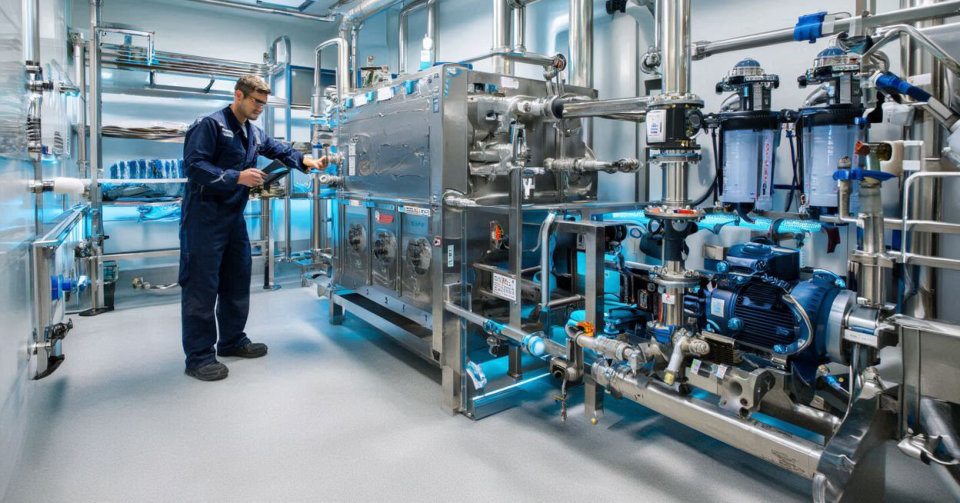
Vulcan installed on therapy pool circulation line—protects heat exchangers, pumps, and pool surfaces
The Scale-Biofilm-Infection Connection
How Scale Creates Infection Risk
- Scale provides surface area for biofilm attachment [5]
- Biofilm protects pathogens from disinfectants
- Bacteria (Pseudomonas, E. coli) thrive in scaled areas [5]
- Scale particles can break loose and cloud water
- Rough surfaces trap organic matter, feeding bacteria
A high combined chlorine might indicate inadequate disinfection or build-up of organic matters. Combined chlorine is also an irritant to skin and mucous membrane such as eyes and lungs [8].
How Vulcan Protects Residents
- Eliminates scale—removes biofilm foundation
- Smooth surfaces—bacteria have nowhere to hide
- Disinfectants work—no protection for pathogens
- Clear water—no scale particles
- Lower chemical demand—sanitizers focus on contaminants, not scale
During a Canadian health inspection, a therapy pool was cited for "dirt found on the basin floor" with the observation that "dirt could harbour pathogens and organic materials that could infect patrons. Dirt materials might also cause minor injuries like skin abrasion especially to the feets" [8]. Scale creates the same risks—rough surfaces that can abrade sensitive elderly skin and harbor pathogens.
Critical Distinction: Chemical-Dependent Systems vs. True Prevention
Modern therapy pools often rely on automated chemical dosing systems to maintain water quality. But these systems assume clean equipment—scale undermines everything.
- Automated dosing: $5,000-$15,000 system cost [4]
- Ongoing chemical costs: $3,000-$8,000 annually
- Sensor calibration/maintenance: Monthly requirement
- Scale on sensors: Causes false readings, incorrect dosing [4]
- Never-ending cycle: Scale affects dosing, you adjust chemicals, scale returns
- Reactive approach: You add chemicals to compensate for scale problems
"Scale on ORP and pH sensors causes false readings. Automated dosing systems then add incorrect amounts of chemicals, leading to water quality problems" [4].
- Zero sensor scaling: Sensors stay clean, readings accurate
- Chemical reduction: 20-30% less chemical usage [4]
- No sensor drift: Automated dosing works as designed
- Permanent solution: Install once, protect forever
- Preventive approach: Scale never forms, problems prevented
- Protects automation investment: Ensures your dosing system works
How It Works:
Vulcan's physical impulse technology alters the crystalline structure of calcium carbonate so it cannot bond to surfaces. Sensors stay clean, dosing remains accurate, and water chemistry stays stable [6].

The Facility Manager's Math
A therapy pool with automated dosing spends $5,000 annually on chemicals and $2,000 on sensor maintenance. Scale causes 20% chemical waste = $1,000 lost. Vulcan eliminates this waste while protecting your $10,000+ automation investment.
Real Proof: CHSLD Long-Term Care Centres, Quebec
Facility: CHSLD Long-Term Care Centres (12 facilities)
Location: Quebec, Canada
Application: Domestic hot water systems (parallel to therapy pools)
The Challenge
This network of public long-term care facilities faced chronic scale in domestic hot water systems, requiring 8-10 water heater replacements annually across 12 facilities. Inconsistent hot water temperatures posed scalding risks and compromised infection control protocols [8].
The Results
- Zero water heater failures in 2 years post-installation [8]
- Consistent hot water temperatures achieved
- Projected 5-year savings of $150,000+ across facilities
- Reliable thermal disinfection maintained
Relevance to Therapy Pools
The same scale that plagued these facilities' water heaters attacks therapy pool heat exchangers, sensors, and surfaces. If Vulcan can eliminate water heater failures across 12 long-term care facilities, it can protect your therapy pool equipment.

Real Proof: UC Davis Bodega Marine Laboratory
Facility: UC Davis Bodega Marine Laboratory
Location: California
Application: Water heating systems
The Challenge
This leading research facility faced severe scale buildup in their water heating system, causing frequent maintenance and energy waste [9].
The Results
- Scale eliminated from water heaters
- No scale-related maintenance in 3+ years
- Energy savings validated in facility audit
Water Quality Impact
By eliminating scale, UC Davis achieved stable water chemistry and consistent performance—the same benefits therapy pools need for resident safety.
Risk Management in Therapy Pools
Risk management planning for employees and owners providing therapy services in the aquatic environment is preventive medicine. Being familiar with regulations, codes, operations, maintenance, contraindications, and appropriate personal safety in and around the therapy pool is essential for a safe environment for both patients and staff [9].
Key Hazards [5]
- Drowning
- Heat exhaustion
- Slips and falls
- Infection
- Skin irritation
- Legionella and other pathogens
Required Controls [5]
- Pool water temperature ≤ 35.5°C
- Maximum relative humidity 55%
- Treatment duration limited to 30 minutes
- Staff limited to 1.5 hours in session
- pH maintained 7.2-7.8
- Regular microbiological testing
Good water quality helps prevent the build up of Ps. Aeruginosa, Cryptosporidium, and Escherichia coli, aided by regular microbiological testing of the water and advice and monitoring by a Consultant microbiologist [5].
ROI Calculator: Retirement Community Therapy Pool
| Without Vulcan (Reactive Maintenance) | |
| Heat exchanger descaling (2x/year) | $3,200 |
| pH adjustment chemicals (excess from scale interference) | $2,400 |
| Sensor cleaning/replacement (scale-damaged) | $1,800 |
| Tile/grout cleaning (scale removal) | $2,500 |
| Energy penalty from scaled heat exchanger (8%) [4] | $1,600 |
| Water quality testing/labor (excessive due to instability) | $2,200 |
| Total annual scale-related cost | $13,700 |
| With Vulcan (Preventive) | |
| Heat exchanger descaling eliminated | $3,200 saved |
| Chemical optimization (25% reduction) | $600 saved |
| Sensor maintenance eliminated | $1,800 saved |
| Tile/grout cleaning reduced (70%) | $1,750 saved |
| Energy penalty eliminated | $1,600 saved |
| Water quality labor optimized | $1,000 saved |
| Total Annual Savings | $9,950 |
The Compliance Value
A single health inspection citation for water quality violations can cost $5,000-$15,000 in fines, legal fees, and required corrective actions [3]. Vulcan helps ensure your therapy pool remains compliant.
Get Exact Pricing for Your Facility
For precise pricing tailored to your therapy pool specifications:
- Existing customers: Log in to your account to view model-specific pricing
- New users: Create a free account to access detailed pricing and configuration options
- Need assistance? Contact our team for a therapy pool assessment
Account registration takes less than 2 minutes.
Recommended Vulcan Models for Therapy Pools
Different therapy pool sizes and configurations require different models. Create an account for detailed specifications and pricing.
Vulcan S250 / S350
Up to 10,000 gallons
Protects heat exchangers
Maintains sensor accuracy
Reduces chemical usage 20-30%
✓ Ideal for small facilities
Vulcan S500 / X-PRO 1
10,000-25,000 gallons
Full circulation protection
Automated dosing compatibility
Maximum resident safety
✓ Zero maintenance, zero consumables
Vulcan X-PRO 2
25,000+ gallons / multiple pools
Multiple pool protection
Central equipment protection
Comprehensive compliance
✓ Permanent scale prevention
Therapy Pool Maintenance Checklist
- Daily (3x): Test disinfectant levels and pH, record results [1]
- Daily: Record flowmeter reading, temperature [1]
- Daily: Clean and disinfect changing areas [3]
- Weekly: Test cyanuric acid (if used—banned in therapy pools in some states) [6]
- Weekly: Take water samples for bacteriological screening [5]
- Monthly: Calculate saturation index, test calcium hardness [1]
- Install Vulcan on circulation line: Prevent scale at source
- Maintain records: Keep logs for minimum 3 years [6]
References
- Code of Colorado Regulations. (2025). Swimming Pool and Spa/Hot Tub Operation.
- Illinois Administrative Code. (2013). Wading Pools, Spray Pools and Therapy Pools.
- Pennsylvania Department of Health. (2021). Cawley Physical Therapy Inspection Results.
- Solenis. (2026). Smart Pool & Spa Solutions for Hospitality.
- Physiopedia. (2025). Hydrotherapy Risk Management.
- Texas Administrative Code. (2024). Water Quality at Pools and Spas.
- Health & Fitness Association. (2022). Best Practice Guidelines for Aquatics, Pools, & Hydrotherapy.
- Northern Health Authority. (2024). Chetwynd and District Leisure Pool Hot Tub Inspection.
- Moschetti M, et al. (1994). Aquatics: risk management strategies for the therapy pool. J Back Musculoskelet Rehabil.
- Health & Fitness Association. (2020). Proper Pool Maintenance Key to a Safe Reopening.
- Vulcan Descaler. CHSLD Long-Term Care Centres Case Study.
- Vulcan Descaler. UC Davis Bodega Marine Laboratory Case Study.
Questions for Your Therapy Pool Audit
- What is our current LSI? When was it last calculated?
- How often do we descale our heat exchanger?
- Are our automated sensors reading accurately? Any scale buildup?
- Do we have a preventive maintenance program for pool equipment?
- Have residents ever complained about water quality or skin irritation?
- Is our therapy pool achieving required 4-hour turnover? [1]
- What would 20-30% lower chemical costs save us annually?
Vulcan provides the answers—and the solution.
Safe, Compliant, Efficient Therapy Pools
Join retirement communities and rehabilitation facilities nationwide in eliminating scale—protecting vulnerable residents, ensuring compliance, and reducing operating costs.
About the Author
Waslix (Vulcan Mineral Descaler) provides non-chemical, maintenance-free scale prevention for therapy pools in retirement communities and rehabilitation facilities worldwide. Our physical impulse technology protects heat exchangers, keeps sensors accurate, and ensures water quality meets the highest standards for vulnerable residents. Trusted by long-term care facilities, hospitals, and rehabilitation centers globally. Create an account for detailed model specifications and pricing.

