
The Steam System Imperative in Manufacturing
Steam is an indispensable means of delivering energy in the manufacturing sector. In 2006, U.S. manufacturers used about 4,762 trillion Btu of steam energy, representing approximately 40% of the total energy used in industrial process applications [1].
40%
of industrial energy
used for steam [1]
5%
Fuel increase from
scale in firetube boilers [2]
$72K
Annual fuel loss
1/32" scale, 450K Btu boiler [3]
2-5%
Energy savings from
blowdown control [4]
While there are many different ways to improve steam system energy consumption, energy performance in steam systems is most effectively optimized when a systems approach that analyzes both the supply and demand sides of the system and how they interact, is used [1]. The prevention of scale formation in boilers can result in substantial energy savings [2].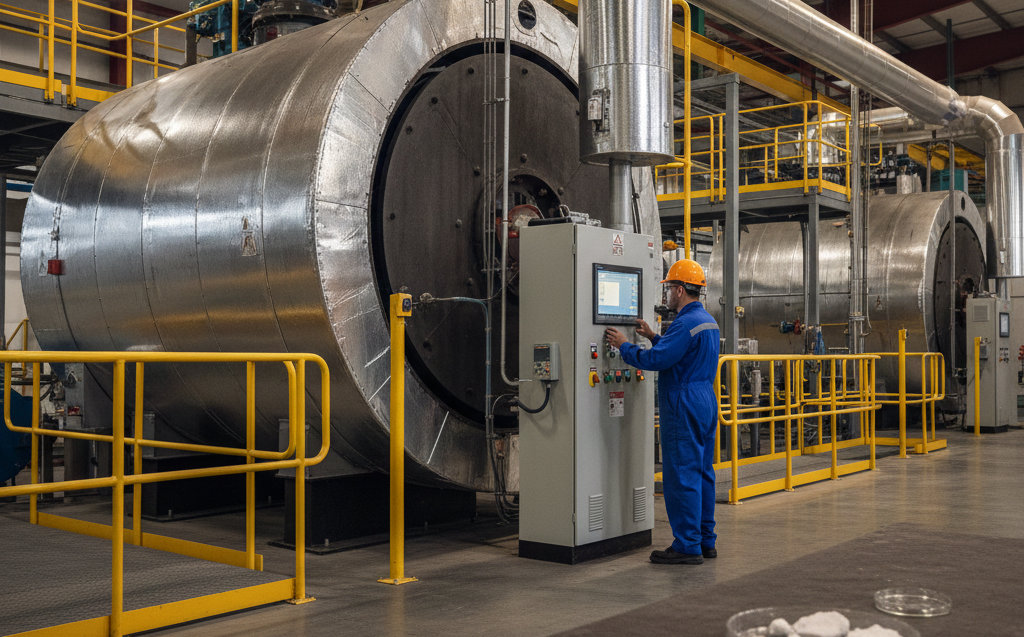
DOE Best Practices for Steam Systems
The U.S. Department of Energy's Advanced Manufacturing Office has published comprehensive guidelines for steam system efficiency. Key recommendations include [1][2]:
- Inspect and repair steam traps
- Insulate steam distribution and condensate return lines
- Install condensing economizers
- Use feedwater economizers for waste heat recovery
- Minimize boiler blowdown
- Recover heat from boiler blowdown
- Improve boiler combustion efficiency
- Prevent scale formation (focus of this guide)
DOE Steam Tip Sheet #7: Clean Firetube Boiler Waterside Heat Transfer Surfaces [2]
"Scale creates a problem because it typically possesses a thermal conductivity an order of magnitude less than the corresponding value for bare steel. Even thin layers of scale serve as an effective insulator and retard heat transfer. The result is overheating of boiler tube metal, tube failures, and loss of energy efficiency."
The Science of Scale Formation in Boilers
How Scale Forms
Scale deposits occur when calcium, magnesium, and silica, commonly found in most water supplies, react to form a continuous layer of material on the waterside of the boiler heat exchange tubes [2].
As water evaporates in the boiler, the minerals in the water don't turn into steam; they are left behind to form scale inside the equipment [3]. On some equipment, the scale buildup can be inches thick [3].
Why Scale Is So Damaging
Scale typically possesses a thermal conductivity an order of magnitude less than bare steel [2]. Even thin layers of scale serve as an effective insulator and retard heat transfer [2].
The boiler then has to burn more fuel to transfer heat through the insulating scale layer [3].
| Scale Thickness | Energy Loss (Firetube Boiler) [2] | Annual Fuel Cost Impact (450,000 Btu boiler) [3] |
|---|---|---|
| 1/32 inch (0.8 mm) | 2% fuel loss | $72,000 |
| 1/16 inch (1.6 mm) | 3% fuel loss | $108,000 |
| 1/8 inch (3.2 mm) | 5% fuel loss | $180,000 |
*Based on 8,000 hour runtime and $3.00/MMBtu fuel cost. Your savings will vary with fuel prices and operating hours.
DOE-Recommended Methods vs. Vulcan: A Critical Comparison
The DOE recommends three primary methods to prevent scale formation [2]:
Pretreating boiler makeup water using water softeners, demineralizers, and reverse osmosis to remove scale-forming minerals [2].
Removes minerals but requires ongoing media replacement, regeneration chemicals, and produces waste discharge.
Injecting chemicals into the boiler feedwater [2].
Requires continuous chemical purchases, monitoring, and feed systems. Chemicals manage scale but don't eliminate root cause.
Unlike the DOE's three traditional methods—all of which require ongoing inputs, maintenance, or energy—Vulcan's physical impulse technology prevents scale formation at the molecular level with zero consumables.
- No softeners - No salt, no regeneration, no brine discharge
- No chemicals - No oxygen scavengers, scale inhibitors, or condensate treatments
- No blowdown increase - Maintain higher cycles of concentration naturally
- Zero ongoing costs - Install once, protect forever
The DOE acknowledges:
"The best way to deal with scale is not to let it form in the first place." [2]
Real Proof: FAMU/FSU College of Engineering
Facility: FAMU/FSU College of Engineering
Location: Florida, United States
Application: Twin cooling towers (CT-1 and CT-2) on 10-inch diameter line
The Challenge
The maintenance for these cooling towers previously involved continuous injection of descaling chemical cleansers. The use of these cleansers was discontinued over a year prior to the installation of the Vulcan. In that time, the cooling tower flutes became encrusted with both scale and biofilm. Throughout the observation period, there were no cleaning procedures in place besides the treatment provided by the Vulcan [5].
Observations Over Time
- July 16: Vulcan S250 installed
- August 1: Green biofilm began receding
- August 9: Biofilm further reduced, scale separating in coin-sized flakes
- August 20: Biofilm almost completely disappeared; scale coverage reduced by over 60%
Technical Observations
The Vulcan does not change water quality beyond its effect on its propensity to cause scale buildup [5].
pH, conductivity, dissolved oxygen, and turbidity remained constant.
During electrophoresis, a small amount of H₂O₂ is liberated, which passivates metal surfaces [5].
This passivation reduces rust and corrosion inside pipes and on surfaces.
Real Proof: Indonesian Food Processing Plant
Facility: Food Processing Plant (Delicatessen)
Location: Indonesia
Application: Boilers, heat exchanger, sterilizers
The Challenge
The food processing facility was experiencing severe scaling issues across multiple systems. They sought to replace traditional water softeners with a chemical-free solution that would make old scale manageable and prevent future deposits [6].
The Vulcan Solution
- 1 x Vulcan 3000 for the boilers
- 1 x Vulcan 3000 for the heat exchanger
- 1 x Vulcan 5000 for 2 sterilizers system
The Results
🔥 Boiler:
A non-stop running boiler, covered in 0.5mm scale, cleared within 2 months of using Vulcan [6].
💧 Pipes and Sterilizers:
15 years of scale buildup disappeared within 3 months of Vulcan use [6].
"Using electrocoagulation, it transforms the molecular structure of water particles, making scale easy to clean and preventing future deposits."
Chemical Treatment: The Traditional Approach
Facility: Large industrial manufacturer in Gulf region
Boilers: Two low-pressure firetube boilers
Challenge: Softener system outages causing hardness fluctuations, increased scaling risk
The Chemical Solution:
- Bespoke CURE Chemical blend combining oxygen scavenger, scale inhibitor, and condensate treatment
- Twice-weekly monitoring and service reports
- Ongoing chemical purchases and maintenance
Results:
- >3 years without unplanned maintenance
- Zero unplanned downtime
- Up to 5% fuel efficiency improvement
✓ Gradiant achieved excellent results—but at what ongoing cost?
| Factor | Chemical Treatment | Vulcan |
|---|---|---|
| Chemical purchases | Ongoing | Zero |
| Monitoring frequency | Twice weekly | None required |
| Service reports | Ongoing | None required |
| Softener dependency | Required | Eliminated |
| Chemical handling risk | Yes | No |
Both approaches can prevent scale. Only Vulcan does so with zero ongoing costs, zero labor, and zero chemical risk.
Boiler Blowdown: A Critical Control Point
Blowdown is necessary to remove concentrated solids from the boiler, but excessive blowdown wastes water and energy [4].
EPA Recommendations [4]
- Install automated chemical feed systems to monitor conductivity, control blowdown, and add chemicals based on make-up water flow
- These systems minimize water and chemical use while protecting against scale buildup and corrosion
- Switching to automatic control can reduce boiler energy use by 2 to 5% and reduce blowdown by as much as 20%
The Vulcan Advantage
By preventing scale formation, Vulcan allows boilers to operate at higher cycles of concentration naturally—reducing blowdown frequency and volume without chemical additives.
Less blowdown = less water waste
Less blowdown = less energy loss
No chemical feed system required
Heat Exchanger Scale: The Canary in the Coal Mine
Plate heat exchangers are another common piece of equipment that can suffer from scaling [3].
Alfa Laval Study [3]:
A study looked at scale buildup on heat exchanger plates operating for one week with untreated tap water. After just one week, the plates were literally covered in hard scale. Imagine the level of scale after two weeks or even one month. It would not take long for the scale to totally stop the flow of water and ruin the equipment.
Consequences of Heat Exchanger Scale:
- Loss of heat transfer efficiency
- Increased pressure drop requiring more pump energy
- Premature equipment failure
- Higher utility bills and more frequent pump repairs [3]
Manufacturer Recommendations:
Armstrong Limited suggests: "Cleaning of fouled plate heat exchanger by back flushing will remove most of the soft debris... The solution used for back flushing shall be weak acids with concentration less than 5%; one example is citric acid." [3]
Vulcan eliminates the need for acid cleaning entirely.
DOE Top Ten Energy Efficiency Measures for Steam Systems [1]
- Inspect and repair steam traps
- Insulate steam distribution and condensate return lines
- Install a condensing economizer
- Use feedwater economizers for waste heat recovery
- Minimize boiler blowdown
- Recover heat from boiler blowdown
- Replace pressure-reducing valves with backpressure turbogenerators
- Use low-grade waste steam to power absorption chillers
- Upgrade boilers with energy-efficient burners
- Improve boiler's combustion efficiency
The 11th Measure: Scale Prevention
Every one of the DOE's ten measures assumes the boiler is operating without scale. Scale undermines every efficiency improvement—making scale prevention the foundation of all other efforts.
The ROI of Boiler Scale Prevention
| Baseline fuel consumption: 450,000 Btu/hr × 8,000 hrs = 3,600 MMBtu/year | |
| Fuel cost: $3.00/MMBtu | |
| Annual fuel cost baseline | $10,800,000 |
| 1/32" scale (2% fuel loss) [2][3] | $216,000 lost |
| 1/16" scale (3% fuel loss) [2] | $324,000 lost |
| 1/8" scale (5% fuel loss) [2] | $540,000 lost |
| Vulcan eliminates this loss permanently | $216K - $540K saved |
Chemical Treatment Costs
Typical chemical treatment programs for a boiler this size cost $15,000-$30,000 annually—and they don't eliminate scale, they merely manage it. Vulcan eliminates both the fuel loss AND the chemical costs.
Get Exact Pricing for Your Boiler
For precise pricing tailored to your boiler specifications:
- Existing customers: Log in to your account to view model-specific pricing
- New users: Create a free account to access detailed pricing and configuration options
- Need assistance? Contact our team for a boiler system assessment
Account registration takes less than 2 minutes.
Recommended Vulcan Models for Manufacturing Boilers
Different boiler sizes and configurations require different models. Create an account for detailed specifications and pricing.
Vulcan S25 / S50
Up to 100 BoHP
Package boilers
Small industrial processes
Heat exchangers
Vulcan S100 / S150
100-500 BoHP
Firetube boilers
Watertube boilers
Multiple boiler plants
Vulcan X-PRO Series
500+ BoHP / Central plants
Central utility plants
Large industrial complexes
District steam systems
References
- U.S. Department of Energy. Steam System Overview and Best Practices.
- U.S. Department of Energy. (2012). Clean Firetube Boiler Waterside Heat Transfer Surfaces, Energy Tips: STEAM, Steam Tip Sheet #7 (Fact Sheet). DOE/GO-102012-3597.
- Goodway. (2018). Heat Exchanger and Boiler Maintenance: Chemical Descaling.
- U.S. Environmental Protection Agency. (2012). WaterSense at Work: Boiler and Steam Systems.
- Vulcan Descaler. FAMU/FSU College of Engineering Case Study.
- Vulcan Indonesia. (2024). Food Processing Plant Installation Case Study.
- Gradiant. (2024). CURE Chemicals – Industrial Boiler Best Practices.
Boiler Scale Prevention Checklist (Based on DOE Guidelines)
- Test makeup water hardness weekly
- Inspect boiler tubes for scale during annual outage
- Monitor stack temperature (elevated temps indicate scale) [2]
- Track fuel consumption vs. steam production
- Implement scale prevention on feedwater line
- Optimize blowdown frequency based on conductivity [4]
- Document all maintenance for DOE compliance tracking
With Vulcan, scale prevention is documented and verified—one less variable in your efficiency program.
Implement DOE Best Practices with Vulcan
Join manufacturers worldwide in eliminating scale, reducing fuel costs, and achieving permanent steam system efficiency.
About the Author
Waslix (Vulcan Mineral Descaler) provides non-chemical, maintenance-free scale prevention for manufacturing boilers worldwide. Our technology helps industrial facilities follow DOE best practices while eliminating chemical treatment costs and compliance burdens. As proven at food processing plants and engineering facilities, Vulcan delivers permanent scale prevention without ongoing expenses. Create an account for detailed model specifications and pricing.

