
The Condenser Performance Imperative
In fossil power plants, the steam surface condenser is critical to overall cycle efficiency. Even slight fouling can result in significant heat rate deterioration and unit output losses [1].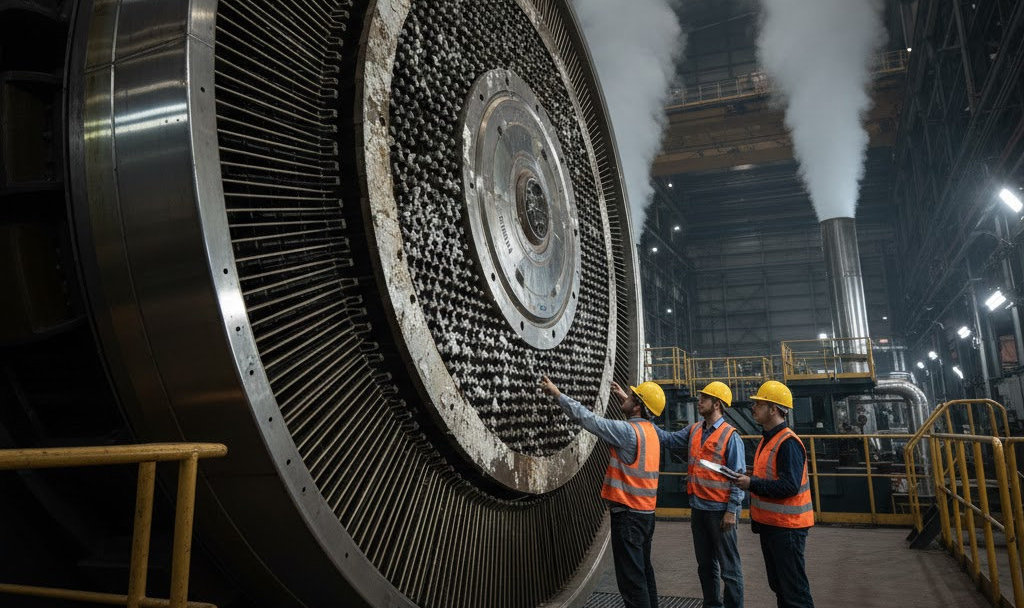
25,000
Outages in 4 years
due to condenser tube failures [2]
2-4%
Heat rate penalty
from 1mm scale [1]
20%
of U.S. generating units
use online cleaning systems [3]
$500K+
Annual fuel savings
from optimized cleaning [4]
The Electric Power Research Institute (EPRI) has developed comprehensive guidelines for the operation and maintenance of steam surface condensers, intended to assist plant engineers, operators, and maintenance personnel in improving availability and performance [5]. Tubeside cleanliness is crucial to condenser and heat exchanger performance, service life, and maintenance requirements.
The Scale Connection
Mineral scale is a primary contributor to condenser fouling. Unlike biofouling or sediment, scale chemically bonds to tube surfaces, requiring mechanical or chemical removal—and continuously reforms without preventive measures.
EPRI Guidelines for Steam Surface Condensers
EPRI's "Recommended Practices for Operating and Maintaining Steam Surface Condensers" (EPRI-CS-5235) provides a comprehensive framework including [5]:
Theory of Operation
Fundamental principles of steam condensation, heat transfer, and the factors affecting condenser performance.
Typical Problems
Identification of common issues including fouling, scaling, corrosion, air in-leakage, and tube failures.
Performance Monitoring
Techniques for measuring cleanliness factor, heat transfer coefficient, and approach temperature.
Lay-up Procedures
Methods to protect condensers during outages, including scale prevention during idle periods.
Cleaning Methods
Both online and offline cleaning techniques, including mechanical and chemical approaches.
Corrective Actions
Tube plugging, replacement, corrosion countermeasures, and corrosion monitoring.
Types of Condenser Fouling
Mineral Scale
Calcium carbonate, calcium sulfate, silica. Chemically bonded, requires mechanical or chemical removal.
Sediment
Silt, sand, and suspended solids settling in low-flow areas.
Corrosion Products
Iron oxide, copper oxide deposits from tube corrosion.
Critical Insight
EPRI's microbiofouling control handbook notes that scale creates surface roughness that accelerates biofilm attachment—making biological fouling more severe in the presence of mineral deposits [6].
Online vs. Offline Cleaning Methods
| Method | Description | Advantages | Limitations |
|---|---|---|---|
| Sponge Ball Cleaning | Sponge balls circulated through tubes during operation [1] | Continuous, no outage required, prevents buildup | Less effective on hard scale, balls wear |
| Brush Systems | Brushes periodically passed through tubes | Effective on soft deposits, automated | Can scratch tubes, requires reversal mechanisms |
| Chemical Cleaning | Acid or chelant circulation [7] | Removes hard scale, reaches all surfaces | Outage required, chemical disposal, corrosion risk |
| High-Pressure Water | Hydroblasting at 10,000+ psi | Effective on most deposits, no chemicals | Outage required, labor intensive, tube damage risk |
| Mechanical Reaming | Cutting tools through tubes | Removes toughest scale | Slow, tube damage risk, outage required |
EPRI research indicates that approximately 20% of all generating units in the United States employ online mechanical condenser cleaning systems to control fouling and improve cycle efficiency [3].
Real Proof: TU Electric Martin Lake Plant
Facility: Martin Lake Generating Station
Location: Texas, United States
Application: Condenser tube biofouling control
The Challenge
For many years, condenser biofouling had been difficult to prevent and control at TU Electric's Martin Lake Plant. The plant sought to maintain condenser cleanliness while eliminating the use of chlorine for biofouling control [8].
The Solution & Results
- Innovative online mechanical tube cleaning system installed April 1992
- Operated as a tube cleaning service—no capital investment required
- System installed while units operating at base load
- Chlorine use eliminated for biofouling control
- Effectiveness verified by EPRI Plant Monitoring Workstation
"The system was installed while the units were operating at base load. The results of the on-line cleaning effectiveness were determined by the EPRI Plant Monitoring Workstation, installed test grade instrumentation, and on-line video borescope tube inspections."
- TU Electric
Martin Lake Plant [8]
Optimizing Cleaning Schedules: The EPRI Approach
EPRI has developed methodologies to optimize condenser cleaning schedules by balancing cleaning costs against fuel costs from fouling-induced efficiency loss [4].
The Optimization Equation
An optimization program automatically computes a cleaning schedule that minimizes the combined cost of:
- Cleaning operations (labor, chemicals, materials, outage costs)
- Increased fuel consumption caused by condenser fouling
The fouling measurements from each system are used in the optimization program to determine optimal cleaning frequency [4].
Sensitivity Analysis
The optimization routine evaluates:
- Sensitivity of optimal cleaning schedules to fouling rate
- Cost impact ($) of non-optimal cleaning
- Accuracy requirements for different monitoring techniques
Lower accuracy is acceptable if the resulting cleaning schedule matches that from higher-accuracy methods [4].
Case Study: Northport Generating Station
Long Island Lighting Company's Northport Station developed a PC-based program monitoring condenser and sponge ball cleaning system real-time data, providing operators with unit-specific cleaning recommendations to optimize both condenser and cleaning system performance [9].
Real Proof: Beihai Thermal Power Plant, China

Beihai Thermal Power Plant — Scale eliminated, heat transfer restored
Facility: Beihai Thermal Power Plant
Location: China
Application: Heat pump station condenser system
The Challenge
The Beihai Thermal Power Plant heat pump station faced significant scale accumulation in their condenser system, reducing heat transfer efficiency and increasing backpressure—directly impacting turbine output and overall plant heat rate [10].
The Results
- Scale eliminated from condenser tubes
- Heat transfer restored to design specifications
- Backpressure reduced to optimal levels
- Chemical cleaning eliminated
Real Proof: Huaneng Power International
Facility: Huaneng Power International
Location: China
Application: Power generation condenser system
The Challenge
Huaneng Power International, one of China's largest power generators, struggled with persistent scale formation in condenser systems across multiple units. Scale accumulation forced more frequent offline cleaning, increased maintenance costs, and degraded heat rate [11].
The Results
- Condenser cleanliness factor maintained above 95%
- Online cleaning frequency reduced by 60%
- Chemical treatment reduced
- Heat rate improvement of approximately 1.8%
"The Vulcan system has maintained our condenser cleanliness consistently, reducing our need for chemical cleaning and improving overall unit heat rate."
- Plant Operations Manager
Huaneng Power International [11]
Preventing Condenser Tube Failures
According to ASME research, generating companies lose hundreds of millions of dollars annually to problems related to condenser and heat exchanger fouling, corrosion, and tube leaks [2].
Failure Statistics
- The EPRI Condenser Tube Failure Control Program disclosed that condenser tube failures contributed to almost 25,000 outages nationwide during a recent four-year period [2]
- Tube failures continue to be one of the most pressing issues related to plant output and availability
Prevention Strategy
- Effective tube cleaning: Ideally remove all deposits, leaving only the cleanest metal surface [2]
- Multi-frequency eddy current testing: Establish overall tube integrity after cleaning
- Plugging: Recommended for tubes with poor integrity
- Tracer gas leak detection: Sulfur hexafluoride and helium for rapid leak location
The Vulcan Advantage
By preventing scale formation, Vulcan eliminates the need for aggressive mechanical or chemical cleaning that can damage tube surfaces. Clean tubes mean reliable eddy current testing results and extended tube life.
Condenser Performance Monitoring
EPRI's research compared three condenser performance monitoring techniques within the context of optimizing cleaning schedules [4]:
Novel Online System
Electromagnetic flowmeter and RTD mounted in a compact waterproof cylinder for continuous, localized measurement.
Overall Online System
Plant-wide monitoring using existing instrumentation to track overall condenser performance.
Routine Plant Tests
Periodic manual testing following established procedures.
The study found that lower accuracy is acceptable if the resulting cleaning schedule matches that from higher-accuracy methods—but all methods require baseline cleanliness to be effective [4].
Real Proof: UHV Yinan Power Converter Station

UHV Yinan Power Converter Station — Scale prevention in critical cooling systems
Facility: Ultra-High Voltage (UHV) Yinan Power Converter Station
Location: China
Application: Cooling water systems for power conversion equipment
The Challenge
This critical UHV converter station required absolute reliability of cooling systems. Scale formation threatened heat transfer efficiency and could lead to unplanned outages with significant grid stability impacts [12].
The Results
- Zero scale-related cooling system issues
- Reliable heat transfer maintained continuously
- No unplanned outages from cooling system fouling
- Chemical treatment eliminated
Recommended Vulcan Models for Power Plants
Different plant sizes and cooling configurations require different models. Create an account for detailed specifications and pricing.
Vulcan S100 / S150
50-100 MW plants
Individual condenser circuits
Heat exchangers
Cooling tower loops
Vulcan S250 / S350
100-500 MW plants
Main condenser systems
Auxiliary cooling systems
Heat rejection loops
Vulcan X-PRO Series
500MW+ / multiple units
Multiple condenser banks
Circulating water systems
Plant-wide scale control
The ROI of Condenser Cleanliness
| Fuel savings (2% heat rate improvement @ $3/MMBtu) | $525,000 |
| Reduced chemical cleaning costs | $75,000 - $150,000 |
| Extended tube life (reduced corrosion/erosion) | $50,000 - $100,000 |
| Reduced outage days (1 day @ $500,000/day replacement power) | $500,000 |
| Lower maintenance labor | $40,000 - $80,000 |
| Total Annual Savings | $1.19M - $1.36M |
The Hidden Cost: Unplanned Outages
With nearly 25,000 condenser-related outages in a four-year period [2], the cost of unplanned downtime far exceeds routine maintenance. One avoided outage pays for plant-wide scale prevention many times over.
Get Exact Pricing for Your Plant
For precise pricing tailored to your power plant specifications:
- Existing customers: Log in to your account to view model-specific pricing
- New users: Create a free account to access detailed pricing and configuration options
- Need assistance? Contact our team for a power plant assessment
Account registration takes less than 2 minutes.
References
- IAEA. (1996). Using condenser performance measurements to optimize condenser cleaning. EPRI-TR-106529.
- Fayard, E.H. & Fischer, G. (2009). Preventing Condenser Tube Failures Through Effective Cleaning and Nondestructive Testing. ASME Power Conference.
- Aschoff, A.F. (1987). Performance of mechanical systems for condenser cleaning: Final report. EPRI.
- EPRI. (1996). Using condenser performance measurements to optimize condenser cleaning. Proceedings: 1996 heat rate improvement conference.
- EPRI. (1987). Recommended practices for operating and maintaining steam surface condensers: Final report. EPRI-CS-5235.
- EPRI. (1993). Condenser microbiofouling control handbook. EPRI-TR-102507.
- Shields, K. (1995). Choices related to chemical cleaning of fossil plant equipment. EPRI-TR-104502.
- TU Electric. (1995). A new approach to on-line mechanical condenser tube cleaning. EPRI-TR-104241-V3.
- Schaub, E. & Renfftlen, R. (1996). Development of a condenser cleaning system optimization program. EPRI-TR-106781.
- Vulcan Descaler. Beihai Thermal Power Plant Heat Pump Station Case Study.
- Vulcan Descaler. Huaneng Power International Case Study.
- Vulcan Descaler. UHV Yinan Power Converter Station ROI Feedback.
Questions for Your Condenser Maintenance Program
- "What is our current condenser cleanliness factor?"
- "How does our current heat rate compare to design?"
- "What is the dominant fouling mechanism—scale, biofouling, or sediment?"
- "Are we cleaning on an optimized schedule based on fouling rate?"
- "What is the cost per outage day for our plant?"
- "Have we implemented scale prevention to reduce cleaning frequency?"
With Vulcan, you maintain design cleanliness continuously—eliminating the scale that drives frequent cleaning and performance degradation.
Optimize Your Condenser Performance
Follow EPRI best practices with proven scale prevention technology. Eliminate the root cause of fouling and protect your heat rate.
About the Author
Waslix (Vulcan Mineral Descaler) provides non-chemical, maintenance-free scale prevention for power generation worldwide. Our technology helps fossil plants maintain condenser cleanliness, optimize heat rate, and reduce tube failures by eliminating scale at its source. Create an account for detailed model specifications and pricing.

