
The Cooling Tower Water Chemistry Challenge
Cooling towers are the unsung heroes behind many industrial processes, quietly keeping things cool while fighting a battle against scaling, mineral buildup, and excessive water usage [2]. Proper water chemistry management is essential to protect assets, prevent microbial proliferation, and safeguard public health [1].
26%
Water savings with optimized treatment [2]
50%
Maintenance reduction [2]
4-6
Optimal cycles of concentration [4]
$28K
Annual savings from optimized cycles [6]
The Central Harlem Legionnaires' disease outbreak—which sickened over 100 individuals and claimed seven lives—traced back to contaminated cooling towers, underscoring the critical importance of effective water treatment and monitoring [1]. Balancing cycles of concentration, scale prevention, and environmental compliance requires a comprehensive approach integrating physical and chemical treatment methods.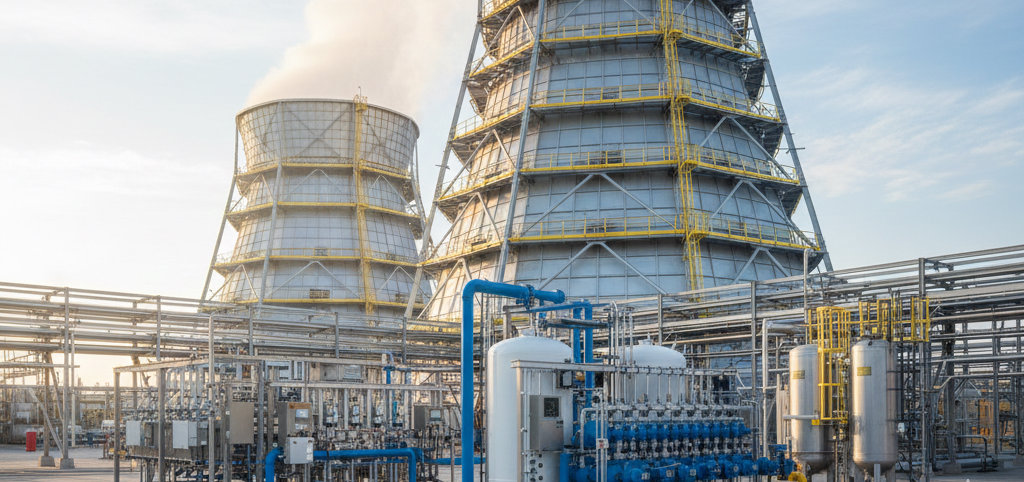
Regulatory Reality
Under 40 CFR 423.16, cooling tower blowdown must meet strict discharge limits for priority pollutants, including total chromium below 0.2 mg/L and total zinc below 1.0 mg/L [5]. Additionally, 40 CFR Part 63 Subpart Q prohibits the use of chromium-based water treatment chemicals in industrial process cooling towers [8].
Understanding Cycles of Concentration
Cycles of concentration (COC) is a fundamental concept in cooling tower operation. When water evaporates in a cooling tower, only pure H₂O is driven off, leaving dissolved solids behind. The ratio of salt concentration in the tower to the amount found in the makeup water is referred to as cycles of concentration [6].
The Optimal Range
The savings effected by a recirculating system compared to a once-through system are maximized at about four to six cycles of concentration. Below this range, treatment costs become prohibitive. At high cycles (e.g., eight to 10), the additional water savings generally are not commensurate with the increased difficulty of effective treatment [4].
Water Savings Potential
Figure 1 in the ChemTreat guide shows that after six or seven cycles of concentration, the water savings potential is small compared to the increase in circulating water contaminant concentrations [7]. The sweet spot balances water conservation with manageable chemistry.
Why Scale is the Enemy of Efficiency
The Consequences of Scaling
- Reduced heat transfer - Scale acts as insulation, reducing cooling efficiency
- Increased energy costs - Systems work harder to maintain temperatures
- Flow restrictions - Scale narrows pipes, causing pressure drops of 20-30 psi [2]
- Equipment damage - Premature failure of heat exchangers and components
- Increased maintenance - Costly outages for cleaning or repairs [6]
How Scale Forms
As cycles of concentration increase, dissolved minerals like calcium carbonate and magnesium silicate exceed their solubility thresholds and precipitate onto heat exchange surfaces [6].
Scale formation is accelerated by:
- High hardness in makeup water
- Elevated pH and alkalinity
- High temperatures on heat transfer surfaces
- Biofilm that provides attachment points [2]
Real Proof: GenGard Implementation at Canadian Steel Mill
Facility: Integrated Steel Mill
Location: Canada
Application: Secondary non-contact cooling tower
The Challenge
The cooling tower required high acid and excessive blowdown to prevent deposition caused by calcium and phosphate. The plant was feeding acid to depress pH but still had to reduce cycles of concentration to only two. This mode of operation generated excessive blowdown and sent treatment chemicals to the drain [6].
The Solution & Results
- GenGard technology implemented with stress-tolerant polymer and alkaline enhanced chemistry
- Cycles increased from 2 to 4 without acid addition
- 250 million liters of water saved annually (50% reduction)
- Eliminated $5,000 annual acid cost
- Total savings: $28,000 per year
- Eliminated environment, health & safety risks associated with acid use
"The increased cycles reduced the amount of water and chemicals being consumed. Total savings equate to $28,000 per year and eliminate the environment, health & safety risk associated with the use of acid."
- Veolia Water Technologies
[6]
Methods to Increase Cycles of Concentration
Makeup Water Softening
Ion-exchange softeners replace scale-forming calcium and magnesium ions with sodium. Soft water allows cooling towers to operate at higher cycles of concentration, resulting in less frequent blowdown [1].
Note: 100% softened water can be corrosive, so partial softening or blending is often employed [1][7].
Acid Feed
Acid feed for pH control can enhance corrosion inhibitor performance and control calcium carbonate scaling. Benefits include operating at lower alkaline pH, reducing corrosion inhibitor requirements, and increasing cycles [7].
Requires careful handling to prevent concrete basin damage [7].
Side-Stream Filtration
Removes suspended solids by filtering 3-10% of recirculating water, resulting in better heat transfer, reduced maintenance, and improved chemical efficiency [1].
Cascading Towers
Pair of cooling towers placed in series—the second uses the first tower's blowdown as makeup, reducing overall water usage while treatment chemicals carry over [7].
Environmental Compliance: Federal Regulations
Cooling tower blowdown discharged to POTW must meet:
| Pollutant | Maximum (mg/L) |
|---|---|
| Chromium, total | 0.2 |
| Zinc, total | 1.0 |
| 126 Priority Pollutants in added chemicals | No detectable amount |
No owner or operator of an IPCT shall use chromium-based water treatment chemicals in any affected cooling tower.
Compliance demonstrations:
- Water sample analysis (hexavalent chromium ≤ 0.5 ppm) OR
- Records of chemical purchases showing no chromium products
Effective: September 8, 1994 for existing towers [8]
ASHRAE Standard 188 Requirements
Facilities must maintain a Water Management Program with routine monitoring including makeup water (hardness, alkalinity, conductivity, pH), basin water (temperature, pH, conductivity, ORP), weekly dipslide testing for bacteria, and quarterly Legionella sampling [1].
Monitoring Strategies for Optimal Control
| Parameter | Location | Frequency | Control Limit |
|---|---|---|---|
| Total Hardness | Makeup Water | Routine | Varies by system |
| Alkalinity | Makeup Water | Routine | Varies by system |
| Conductivity/TDS | Makeup & Basin | Continuous/Routine | Set by cycles target |
| pH | Basin Water | Continuous | 6.8-7.2 (for orthophosphate) [7] |
| Temperature | Basin Water | Continuous | Per design |
| ORP | Basin Water | Continuous | 650-750 mV [1] |
| Total Bacteria | Basin Water | Weekly | Dipslide testing [1] |
| Legionella | Basin Water | Quarterly minimum | <1 CFU/mL [1] |
Real Proof: NREL-Validated AOP Technology
Study: National Renewable Energy Laboratory (NREL)
Client: General Services Administration (GSA) / U.S. Department of Energy
Technology: Hydroxyl-Based AOP
Validation Results
- 26% water savings (estimated 23-30%)
- 50% maintenance reduction
- Met GSA water standards without additional chemicals
- 2-year payback based on GSA average water costs
"Hydroxyl-Based AOP can push COC to higher levels, using less water, reducing blowdown, and limiting harsh chemicals—leading to a smaller environmental footprint."
- Clear Comfort
[2]
Alternative Water Sources for Sustainable Cooling
Condensate Recovery
Collecting condensation from air handlers provides high-quality makeup water with little treatment required—simple and cost-effective [10].
The Vulcan Advantage: Chemical-Free Scale Prevention
Vulcan's physical impulse technology addresses cooling tower scaling at its source—without chemicals, acid, or softening chemicals that create disposal challenges.
- Prevents scale formation on all heat transfer surfaces
- Destroys biofilm that anchors scale [2]
- Zero chemical handling or storage
- No discharge compliance issues
- Zero maintenance, no consumables
- External installation - no downtime
By eliminating scale, Vulcan allows cooling towers to operate at higher cycles of concentration safely—reducing blowdown, conserving water, and lowering chemical treatment costs while maintaining environmental compliance.
Compliance Ready
No chromium, no zinc, no priority pollutants—just clean, scale-free operation that meets 40 CFR 423.16 and Part 63 Subpart Q requirements.
Recommended Vulcan Models for Cooling Towers
Different cooling tower sizes require different models. Create an account for detailed specifications and pricing.
Vulcan S100 / S150
Up to 500 tons
Individual cooling towers
Small industrial processes
Commercial HVAC
Vulcan S250 / S350
500-2,000 tons
Industrial process cooling
Multiple tower systems
District cooling
Vulcan X-PRO Series
2,000+ tons / multiple towers
Power plant cooling
Large industrial complexes
Central utility plants
The ROI of Optimized Cooling Tower Chemistry
| Water savings (from increased cycles - 26% reduction) [2] | $12,000 - $18,000 |
| Chemical treatment reduction (acid, biocides, inhibitors) | $8,000 - $15,000 |
| Maintenance labor savings (50% reduction) [2] | $5,000 - $10,000 |
| Energy savings (improved heat transfer) | $4,000 - $8,000 |
| Extended equipment life (reduced scale corrosion) | $3,000 - $6,000 |
| Total Annual Savings | $32,000 - $57,000 |
The Compliance Cost
One environmental violation for cooling tower discharge exceeding chromium or zinc limits can cost $50,000+ in fines plus mandated system upgrades. Chemical-free scale prevention eliminates this risk entirely.
Get Exact Pricing for Your Cooling Tower
For precise pricing tailored to your cooling tower specifications:
- Existing customers: Log in to your account to view model-specific pricing
- New users: Create a free account to access detailed pricing and configuration options
- Need assistance? Contact our team for a cooling tower assessment
Account registration takes less than 2 minutes.
References
- RL Deppmann. (2025). 5 Effective Cooling Tower Treatment and Monitoring Strategies.
- Clear Comfort. (2024). Supercharge Your Cooling Towers with AOP: Higher Cycles of Concentration & Less Scaling.
- Veolia Water Technologies. GenGard Improves Cooling Tower Efficiency & Reduces Operating Costs at a Steel Mill.
- Materials Performance Magazine. (2025). Open Recirculated Cooling Water Systems.
- 40 CFR 423.16 – Pretreatment standards for existing sources (PSES).
- ChemTreat. (2022). Three Practices for Sustainable Cooling.
- 40 CFR Part 63 Subpart Q – National Emission Standards for Hazardous Air Pollutants for Industrial Process Cooling Towers.
- Los Angeles Department of Water and Power. (2023). Cooling Towers: Saving Water Saves Money.
Cooling Tower Water Management Checklist
- Establish water management team per ASHRAE 188
- Document current cycles of concentration and target range
- Verify no chromium-based treatment chemicals are used [8]
- Monitor blowdown for compliance with 40 CFR 423.16 limits [5]
- Implement scale prevention to maintain heat transfer efficiency
- Conduct weekly dipslide testing for total bacteria [1]
- Perform quarterly Legionella sampling [1]
- Document all monitoring and corrective actions
With Vulcan, scale prevention is documented and verified—one less variable in your compliance program.
Optimize Your Cooling Tower Chemistry
Balance cycles of concentration, prevent scale, and meet environmental compliance—all without chemicals or discharge concerns.
About the Author
Waslix (Vulcan Mineral Descaler) provides non-chemical, maintenance-free scale prevention for cooling towers worldwide. Our technology helps industrial facilities optimize cycles of concentration, reduce blowdown, and meet environmental compliance without hazardous chemicals. Create an account for detailed model specifications and pricing.

