
The Lean-Water Connection: Why Efficiency Demands Scale Control
Manufacturing facilities consume millions of gallons of water daily. Water scarcity now ranks among top business concerns for manufacturers worldwide, particularly in sectors like food and beverage production [1]. The opportunity is substantial: according to the EPA, manufacturing firms have successfully reduced water usage by 27-30% through targeted lean practices [1].
27-30%
Water reduction through lean [1]
20%
of global freshwater used by manufacturing [1]
24.1%
Production increase with lean-water integration [8]
Lean thinking promotes the elimination of all forms of waste, including excessive water consumption [1]. Yet one of the most persistent and overlooked forms of waste in manufacturing water systems is mineral scale accumulation. Scale silently undermines every lean initiative—increasing energy use, driving unplanned downtime, and wasting water through inefficient processes.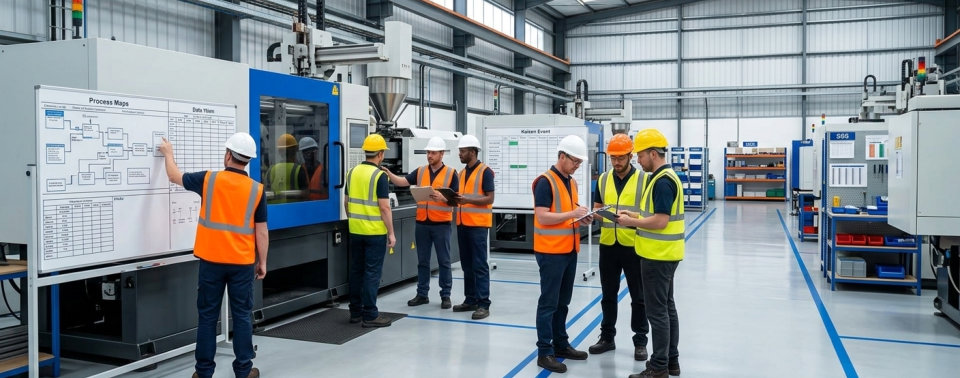
The Hidden Waste
A 1mm layer of scale forces boilers to burn 7-10% more fuel, increases cooling tower blowdown by 20-30%, and drives up maintenance frequency—all forms of "muda" (waste) that lean methodologies aim to eliminate.
The Seven Wastes of Lean—And the Eighth: Scale
Traditional lean manufacturing identifies seven forms of waste (TIMWOOD). Scale creates or exacerbates every single one.
Transportation
Scale-narrowed pipes reduce flow rates, requiring more pumping energy and longer transport times.
Inventory
Chemical water treatment requires storage space for drums, bags of salt, and treatment chemicals—inventory that adds cost without value.
Motion
Maintenance staff waste motion constantly checking chemical feed systems, cleaning scale-clogged equipment, and responding to failures.
Waiting
Production lines waiting for boilers to recover from scaling-related downtime or heat exchangers to be cleaned.
Overprocessing
Overtreating water with chemicals "just in case"; burning excess fuel to overcome scale insulation.
Overproduction
Running equipment longer to compensate for scale-induced inefficiency.
Defects
Scale particles breaking loose can contaminate products; inconsistent water temperatures affect quality.
The Eighth Waste: Scale
Scale is the root cause multiplier—amplifying all seven wastes simultaneously.
How Lean Tools Reveal the Scale Problem
Developing a facility water balance helps quantify inputs and outputs across your operation, making it easier to pinpoint where waste occurs [1]. Scale-related inefficiency appears as unexplained energy consumption, excessive blowdown, and frequent maintenance cycles.
Water-focused kaizen events bring together cross-functional teams to drive incremental reductions through process modifications [1]. Teams can investigate scaling patterns, measure heat exchanger delta-T degradation, and implement root cause countermeasures.
Operator-led cleaning and inspection routines reveal scale buildup early. Without root cause prevention, cleaning becomes endless rework—the opposite of lean [2].
A study on continuous improvement techniques demonstrated that Lean Water resources reduced waste by 12%, Six Sigma reduced defects by 18%, and Predictive Maintenance reduced equipment downtime by 20% [3]. Scale prevention delivers all three benefits simultaneously.
Critical Distinction: Chemical Treatment vs. Vulcan in a Lean System
Lean manufacturing demands the elimination of waste—including the waste embedded in traditional water treatment approaches. Understanding the difference between managing symptoms and eliminating root causes is essential for continuous improvement.
- Creates inventory waste - Drums of chemicals, bags of salt require storage space and handling [4]
- Requires motion waste - Staff must constantly check chemical levels, mix solutions, adjust feed rates
- Generates waiting waste - System downtime during chemical cleaning outages [2]
- Overprocessing - Chemicals fed continuously regardless of actual need
- Environmental waste - Chemical discharge requires treatment and permits [4]
- Temporary solution - Manages symptoms but does not prevent root cause
Traditional water softeners use ion-exchange to remove minerals, requiring salt and daily backwashing (20-100 gallons per day) [2]. Cities are banning these systems due to environmental impact [2].
- Zero inventory waste - No chemicals, no salt, no consumables [2]
- Zero motion waste - Install and forget; no daily checks or adjustments
- Zero waiting waste - No downtime for chemical cleaning; external installation [4]
- Right-sized treatment - Physical impulses only when water flows
- Zero discharge - No chemicals to discharge, no permits required [2]
- Permanent solution - Prevents scale at molecular level, not just symptom management
Vulcan does NOT remove minerals—it temporarily changes (1-7 days) the molecular construction of minerals so they do not bond to surfaces [4]. You retain healthy minerals while preventing scale.
The Lean Perspective
From a lean standpoint, chemical treatment is a "countermeasure" that creates its own waste streams. Vulcan is a root cause solution—eliminating the problem without creating new forms of muda. When water flows between the impulse band's primary treatment zone, the sticky structure of untreated water scale crystals are broken into smooth rod-shaped mono-crystals preventing the hard water minerals from bonding to surfaces [2].
How Vulcan Works: Technology That Supports Continuous Improvement
Physical Impulse Technology
Vulcan's impulse bands wrap around the pipe—no cutting, no plumbing modifications. The high copper alloy purity bands guarantee the cleanest possible frequency transfer output, maximizing the interactive frequency coverage area [2].
Treatment Zone:
Impulses radiate 9-16 feet on both ends of the impulse bands across the pipeline to make up the primary water treatment zone [2].
Scale Prevention Mechanism:
When water flows between the impulse band's primary treatment zone, the sticky structure of untreated water scale crystals are broken into smooth rod-shaped mono-crystals preventing the hard water minerals from bonding to surfaces [2].
Billions of microscopic rod-shaped descaling crystals behave like brushes, interacting with existing mineral deposits, loosening them and removing the scale with the water flow [2].
Additional Benefits for Lean Operations:
- Corrosion protection: Generates electrophoresis effect resulting in a metal-carbonate shield on metal surfaces, protecting against corrosion [2]
- Biofilm control: Bacteria use scale as food source and breeding environment—removing scale removes the biofilm habitat [2]
- Zero maintenance: Once installed, Vulcan never requires maintenance or adjustment [2]
- Universal application: Works on iron, copper, stainless steel, galvanized iron, plastic, PVC, PE-x—every pipe material [2]
Real Proof: Beverage Bottling Plant, Pennsylvania
Facility: Large beverage bottling plant
Location: Northeastern Pennsylvania
Application: Reverse osmosis system, water purification
The Challenge
The plant aimed to reduce overall water usage by 25% over ten years. Penn State Technical Assistance Program (PennTAP) conducted a value stream mapping exercise to evaluate water usage in every step of the 45-minute automated bottling process [9].
The Results
- New RO machine reduced effluent from 20% to 11%
- 12,010,781 gallons water saved annually
- $85,132 water cost savings + $75,065 wastewater savings
- Product yield loss reduced by 20% [9]
"The savings for the replacement of the reverse osmosis machine were estimated to be 12,010,781 gallons of water and wastewater per year." [9]
The Vulcan Connection
This case study demonstrates the power of lean water assessment—but it addresses only one machine.
Imagine the impact of combining lean assessment with Vulcan scale prevention:

- RO membranes stay scale-free longer
- Boilers maintain peak efficiency
- Cooling towers operate at higher cycles
- Zero chemical treatment costs
Real Proof: Indonesian Food Processing Plant
Facility: Food Processing Plant (Delicatessen)
Location: Indonesia
Application: Boilers, heat exchanger, sterilizers
The Challenge
The food processing facility was experiencing severe scaling issues across multiple systems. They sought to replace traditional water softeners with a chemical-free solution that would make old scale manageable and prevent future deposits [6].
The Vulcan Solution
- 1 x Vulcan 3000 for the boilers
- 1 x Vulcan 3000 for the heat exchanger
- 1 x Vulcan 5000 for 2 sterilizers system
- Results: 0.5mm scale cleared within 2 months; 15-year scale buildup disappeared within 3 months [6]
Real Proof: Ferrum Contract, Kazakhstan
Kaizen in Action
The Ferrum Contract mineral water company introduced Kaizen lean manufacturing practices and saw immediate results:
- Employees learned to save raw materials (PET containers, glue, labels)
- Water and electricity costs decreased
- Process water reused for washing tanks and watering trees [5]
The company received 14 million tenge reimbursement from the Kazakhstan Center for Industry and Export for their lean implementation [5].
The Vulcan Advantage
Ferrum's Kaizen program saved water through behavioral changes and process improvements. Vulcan would add the missing piece: equipment efficiency.
With Vulcan installed on their process water lines, they would also achieve:

- Scale-free boilers and heat exchangers
- Reduced energy consumption
- Longer equipment life
- Zero chemical treatment costs
The ROI of Scale Prevention: Measured in Lean Metrics
Direct Savings
| Energy reduction (7-10% boiler efficiency) | $$$ |
| Water savings (higher cycles of concentration) | $$$ |
| Chemical treatment elimination | 100% |
| Maintenance labor reduction | 50-75% |
| Equipment life extension | 2-3x |
Lean Metrics Improved
| Overall Equipment Effectiveness (OEE) | ↑ 5-15% |
| Mean Time Between Failures (MTBF) | ↑ 200%+ |
| Mean Time To Repair (MTTR) | ↓ 50%+ |
| Energy intensity per unit | ↓ 5-10% |
| Water intensity per unit | ↓ 20-30% |
Integrated MFCA-IoT-Lean Study [8]
A 2024 study integrating Material Flow Cost Accounting (MFCA), IoT, and lean management systems in the beverage industry demonstrated:
- 24.1% production rate increase
- 4.5% cost reduction (71,010 THB savings per year)
- Real-time monitoring of positive and negative costs enabled continuous improvement [8]
Vulcan Integration: Adding scale prevention to this MFCA-IoT-lean framework would further reduce negative costs by eliminating the root cause of equipment degradation.
Recommended Vulcan Models for Lean Manufacturing Facilities
Different manufacturing processes require different models. Create an account for detailed specifications and pricing.
Vulcan S50 / S100
Individual equipment / small plants
Package boilers
Heat exchangers
Small cooling systems
✓ Ideal for kaizen pilot projects
Vulcan S150 / S250
Mid-sized plants / multiple systems
Central boiler plants
Cooling towers
Process water loops
✓ Zero maintenance, zero consumables
Vulcan X-PRO Series
Large plants / multiple buildings
Central utility plants
Large industrial complexes
District systems
✓ 9-16 foot treatment zone each direction [2]
Lean Water Implementation Checklist (with Vulcan Integration)
- Establish water balance baseline through VSM [1]
- Identify scale-prone equipment (boilers, heat exchangers, cooling towers)
- Measure current energy and water intensity per unit of production
- Calculate total cost of chemical treatment (purchase + storage + handling + discharge)
- Conduct kaizen event focused on water system optimization
- Install Vulcan on main water lines serving critical equipment
- Implement visual management: post conductivity targets, temperature ranges
- Track OEE, MTBF, and energy intensity post-installation
- Standardize successful practices across all production lines
References
- CCI. (2025). Drip by Drip: How Lean Manufacturing Transforms Water Stewardship.
- Vulcan Descaler. Wobbling Impulse Frequency Mineral Descaling Technology.
- Journal of Open Innovation. (2024). Continuous improvement techniques on water resources initiatives.
- Vulcan Descaler. Electronic Anti-Scale System - Residential Applications.
- Qazindustry. (2024). Kaizen helps save raw materials and water in production.
- Vulcan Indonesia. (2024). Food Processing Plant Installation Case Study.
- ScienceDirect. (2024). Integrated MFCA-IoT-lean management system for water use efficiency.
- PennTAP. (2020). Beverage Bottling Plant Water Savings Case Study.
Questions for Your Lean Water Kaizen Event
- Where is scale visible in our equipment?
- What is our current boiler stack temperature compared to baseline?
- How many maintenance hours are spent on scale-related issues?
- What is our annual spend on water treatment chemicals?
- How many gallons of water are wasted through excessive blowdown?
- Could we eliminate chemical inventory entirely?
- What would a zero-discharge facility look like?
Vulcan provides the answers—and the solution.
Eliminate the Eighth Waste
Join manufacturers worldwide in applying lean principles to water systems—starting with scale prevention.
About the Author
Waslix (Vulcan Mineral Descaler) provides non-chemical, maintenance-free scale prevention for manufacturing facilities worldwide. Our physical impulse technology supports lean and continuous improvement programs by eliminating the root cause of water system inefficiency. Unlike chemical treatment or softeners, Vulcan introduces nothing into your water—just physical impulses that prevent scale at the molecular level. Create an account for detailed model specifications and pricing.

