
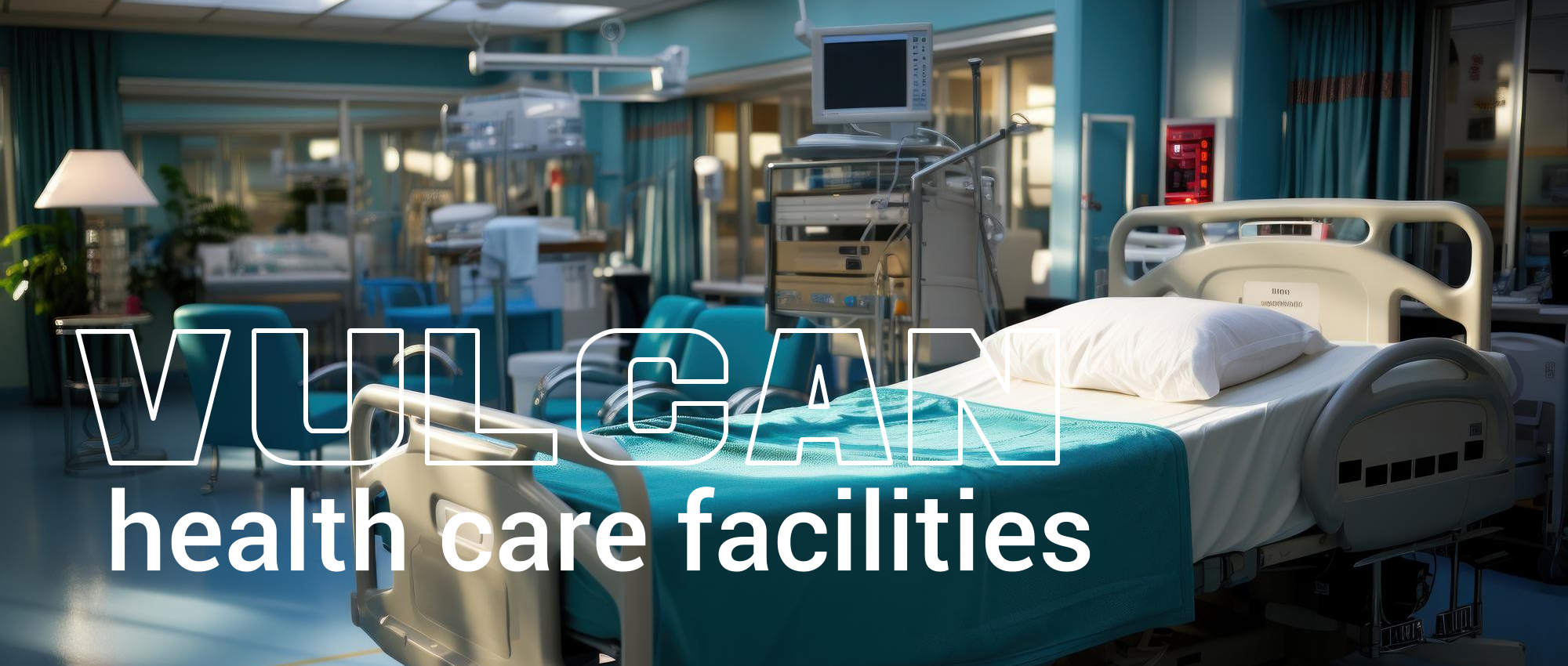
Mineral Scaling in Health Care Facilities
the hidden infection control risk affecting patient safety and operational costs
Hospitals, long-term care facilities, and clinics face a unique challenge: protecting vulnerable patients from healthcare-associated infections while managing aging infrastructure and tight budgets. Mineral scale creates the perfect breeding ground for dangerous pathogens - including Legionella - by providing habitat and nutrients for biofilm formation. Vulcan's chemical-free descaling technology eliminates the scale where bacteria thrive, supporting infection prevention protocols and extending equipment life.
What Health Care Facilities Must Know
The Centers for Disease Control (CDC), ASHRAE, and the World Health Organization (WHO) all mandate comprehensive water management programs for health care facilities. Scale control is explicitly identified as a critical component of infection prevention [citation:1][citation:2][citation:3].
CDC Guidelines
The CDC requires water management programs (WMPs) for hospitals and long-term care facilities to identify hazardous conditions and minimize waterborne pathogens. Key principles include maintaining devices to prevent sediment, scale, corrosion, and biofilm - which provide habitat and nutrients for Legionella [citation:1].
ASHRAE Standard 188
ANSI/ASHRAE Standard 188-2021 establishes minimum legionellosis risk management requirements for building water systems. Written in enforceable language for adoption into codes, it mandates systematic evaluation of physical and chemical conditions where hazardous conditions may occur [citation:2].
WHO Requirements
The WHO emphasizes that adequate water, sanitation, and hygiene (WASH) in health care facilities are essential for quality care. WASH contributes to reducing healthcare costs by protecting staff health and preventing hospital-acquired infections [citation:3].
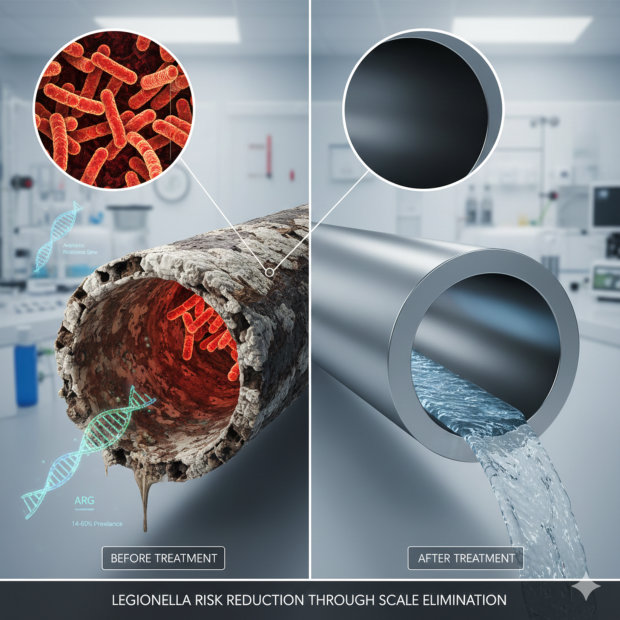
scale creates a breeding ground for deadly pathogens
According to the CDC, "sediment, scale, corrosion, and biofilm provide a habitat and nutrients for Legionella" [citation:1]. When mineral scale builds up inside pipes, it creates rough surfaces where bacteria can attach and form protective biofilms - communities of microorganisms that resist disinfection.
Legionnaires' disease is a serious form of pneumonia caused by Legionella bacteria, most commonly associated with water systems where water is not adequately monitored or treated [citation:2].
of hospital water samples contain antibiotic resistance genes, with higher occurrences in biofilm [citation:4]
Staphylococcus isolates found in hospital water distribution systems [citation:4]
Biofilm: The Silent Threat in Hospital Water Systems
A 2024 study published in the Journal of Infection and Public Health examined water and biofilm samples from nine hospitals. The findings were alarming [citation:4]:
- Staphylococcus spp. were highly detected in water distribution systems (90 isolates), with 33% harboring the mecA antibiotic resistance gene [citation:4]
- Multiple antibiotic resistance genes (ARGs) were found in 14-60% of samples, with higher occurrences in biofilm samples [citation:4]
- Gram-negative bacteria containing ARGs were identified, mainly belonging to Stenotrophomonas, Sphingomonas, and Brevundimonas genera [citation:4]
Key Conclusion:
"Our results underscore the importance of biofilms in water taps as hotspots for the dissemination of opportunistic bacteria and ARG within hospital environments. The identification of multiple opportunistic bacteria and ARGs raises concerns about the potential exposure and acquisition of healthcare-associated infections, emphasizing the need for proactive measures, particularly in controlling biofilms, to mitigate infection risks in healthcare settings" [citation:4].
What Accrediting Organizations Require
The American Society for Health Care Engineering (ASHE) outlines comprehensive requirements for water management in health care facilities [citation:5]:
Systematic Evaluation
The designated team must evaluate the physical and chemical conditions of each step in the water system flow diagram to identify where hazardous conditions may occur. This includes identifying areas where patients have reduced immunity and higher probability of infection [citation:5].
Control Limits & Monitoring
The systematic evaluation identifies control locations and establishes control limits - acceptable ranges for chemical or physical parameters including water flow rate, water temperature, disinfectant residual, and pathogen concentration. Control measures may include disinfecting, heating, cooling, filtering, or flushing [citation:5].
Maintenance Protocols
The team must ensure standardized maintenance protocols are adequate and followed. Maintenance protocol development should be based on best practices for each piece of equipment. Standard maintenance must be performed at correct intervals by knowledgeable staff [citation:5].
Periodic Review
The building water management plan must be evaluated annually, including review of the water flow diagram, monitoring activities, and risk mitigation strategy results. Findings must be summarized and reported to organization leadership [citation:5].
ASHRAE Standard 188-2021 establishes minimum legionellosis risk management requirements for building water systems and is written in enforceable language to facilitate adoption into codes and public health regulations [citation:2].

How Vulcan Supports Infection Control
Vulcan's chemical-free descaling technology directly addresses the core requirements of water management programs by:
- ✓
Eliminating scale habitat - Removes the rough, calcified surfaces where bacteria attach and form biofilms [citation:1]
- ✓
Preventing biofilm formation - Without scale, bacteria lose their protected environment and become susceptible to disinfection [citation:4]
- ✓
Maintaining control measure effectiveness - Clean pipes ensure disinfectant residuals and temperatures work as designed [citation:5]
- ✓
Chemical-free compliance - Meets infection control requirements without introducing additional chemicals into sensitive healthcare environments
- ✓
Documented maintenance - Zero-maintenance design simplifies compliance documentation for accrediting organizations [citation:5]
What Scale Costs Your Healthcare Facility
Beyond infection risk, scale drives significant operational costs. The Caribbean Smart Hospitals Program demonstrated that targeted retrofits can achieve dramatic savings [citation:6]:
Energy Savings
26-47%
energy reduction documented in healthcare retrofits [citation:6]
Water Savings
7-58%
water consumption reduction in healthcare facilities [citation:6]
Annual Energy Cost
$47,000+
potential annual energy savings with scale prevention
Annual Water Cost
$12,000+
potential annual water savings with scale prevention
Annual Energy Cost
$150,000+
potential annual energy savings with scale prevention
Annual Water Cost
$35,000+
potential annual water savings with scale prevention
Key Insight: The Smart Hospitals Program achieved water consumption reductions of up to 58% (40,456 gallons per month) through targeted retrofits. Scale prevention is a critical component of these savings [citation:6].
Healthcare Success Stories
From hospitals to long-term care facilities - see how Vulcan delivers results in healthcare settings
King Salman Hospital
- Scale in boilers, chillers, and pool
- Biofilm risk in water systems
- High maintenance costs
- Multiple Vulcan descalers installed
- Chemical-free scale prevention
- Zero-maintenance operation
"Several mineral descalers were installed to treat the hospital water supply and to keep their equipment free of mineral scale buildup. The hospital now maintains boilers, chillers, and pool equipment without chemical treatment."
- Facilities Management
King Salman Hospital

"Chiller cleaning reduced from every 2-3 weeks to every 6 months. 100% chemical savings and reduced electricity usage after two years." Read →

"We have stopped consuming acids to clean drinking water containers. Water softeners have been taken out of operation, dishwashers are clean." Read →

"We no longer receive limestone related service calls for tenant showers. Completely satisfied and impressed with this descaling system." Read →

"Leading healthcare safety company solves scaling problems in hot water systems with high temperature (more than 80°C) in their steam room." Read →
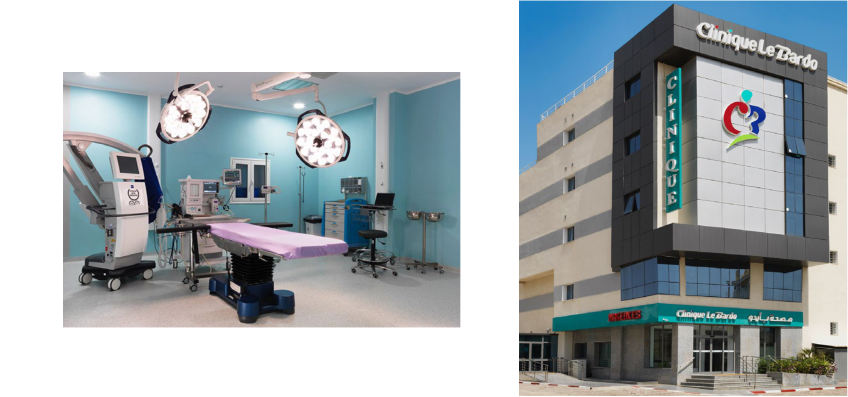
"Private multidisciplinary health establishment protects water systems with Vulcan chemical-free descaling technology." Read →

"Manufacturing plant for para-pharmaceutical syringe products uses Vulcan to support injection molding equipment." Read →
How Vulcan Protects Healthcare Facilities
Whole-Facility Protection
A single unit at the main water line protects boilers, chillers, and the entire piping system - eliminating scale throughout the facility where Legionella and other pathogens thrive [citation:1].
Critical Area Support
Additional units can protect high-risk areas including ICUs, operating rooms, dialysis units, and long-term care wings where patients are most vulnerable [citation:5].
Point-of-Use Equipment
Protect ice machines, dental equipment, hydrotherapy pools, and kitchen appliances - all potential sources of waterborne pathogen exposure.
Related Resources

Legionella Prevention: A Guide for Healthcare Facilities
Understanding ASHRAE Standard 188 and CDC requirements for water management programs. (Coming soon)
Article in development
Biofilm and Antibiotic Resistance in Hospital Water Systems
How scale creates hotspots for antibiotic-resistant bacteria. (Coming soon)
Article in development
Water Management Program Implementation
Practical steps for healthcare facilities to meet accreditation requirements. (Coming soon)
Article in developmentReferences:
- Centers for Disease Control and Prevention (CDC). Overview of Water Management Programs, 2024
- ASHRAE Standard 188-2021, Legionellosis: Risk Management for Building Water Systems
- World Health Organization (WHO). Promoting water, sanitation and hygiene in health care facilities, 2025
- Gholipour S, Nikaeen M, Mohammadi F, Rabbani D. "Antibiotic resistance pattern of waterborne causative agents of healthcare-associated infections: A call for biofilm control in hospital water systems." Journal of Infection and Public Health, 2024. PMID: 38838607.
- American Society for Health Care Engineering (ASHE). Water Management in Health Care Facilities, Second Edition, 2025
- Smart Hospitals Program, Caribbean healthcare facility study. Journal of Climate Change and Health, 2025
Ready to Protect Your Healthcare Facility?
Join hospitals and care facilities worldwide that have eliminated scale, reduced infection risk, and improved operational efficiency with Vulcan.


