

Mineral Scaling in Power Stations
the hidden threat to thermal efficiency and reliable generation
Power generation facilities face a critical challenge: maintaining peak thermal efficiency while managing aging infrastructure and tightening operational budgets. Mineral scale as thin as 1mm can increase fuel consumption by up to 10% - directly impacting profitability and carbon emissions. In cooling systems, condensers, and heat exchangers, scale acts as an insulating barrier that reduces heat transfer, increases pressure drop, and accelerates corrosion. Vulcan's chemical-free descaling technology eliminates scale throughout power plant water systems - improving efficiency, reducing maintenance, and extending equipment life without hazardous chemicals.
What Power Generation Facilities Must Know
The Electric Power Research Institute (EPRI), International Association for the Properties of Water and Steam (IAPWS), and ASME all establish rigorous water chemistry guidelines for power generation. Scale control is explicitly identified as critical for maintaining heat rate, preventing under-deposit corrosion, and ensuring reliable operation [citation:1][citation:2][citation:3].
EPRI Guidelines
The Electric Power Research Institute establishes that "deposits on heat transfer surfaces reduce efficiency and can lead to under-deposit corrosion failures." Their guidelines mandate comprehensive scale control programs for condensers, heat exchangers, and cooling systems [citation:1].
IAPWS Water Chemistry
The International Association for the Properties of Water and Steam provides technical guidance for fossil and combined cycle plants. Their recommendations emphasize maintaining "chemistry conditions that minimize deposition, corrosion, and carryover" throughout the steam-water cycle [citation:2].
ASME Performance Test Codes
ASME Performance Test Codes require that "heat transfer surfaces be clean" for accurate efficiency testing. Scale accumulation invalidates performance guarantees and masks true degradation of plant equipment [citation:3].
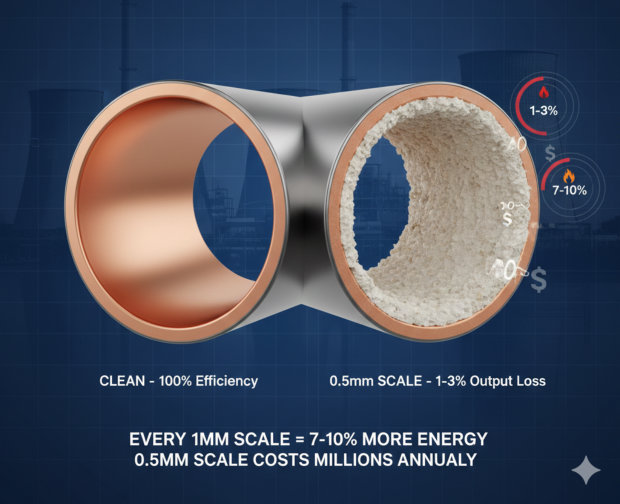
scale directly impacts your bottom line
According to EPRI research, "scale deposits as thin as 0.5mm on condenser tubes can increase backpressure and reduce turbine output by 1-3%." For a typical 500 MW coal plant, this translates to millions in lost revenue annually [citation:1]. In cooling towers, scale reduces heat rejection capacity and increases fan and pump energy consumption.
Every 1mm of scale on heat transfer surfaces increases energy consumption by 7-10% [citation:4]. In power generation, this directly translates to higher heat rate, increased fuel costs, and greater carbon emissions.
turbine output loss from 0.5mm condenser scale [citation:1]
energy increase per 1mm scale thickness [citation:4]
The Cooling Water Challenge
Cooling systems account for 70-80% of total water use in thermoelectric power generation. They are also the most vulnerable to scale formation. A comprehensive industry review highlights the magnitude of the challenge [citation:5]:
- Calcium carbonate scale is the most common deposit, forming when solubility limits are exceeded due to temperature increase and CO2 release in cooling towers [citation:5]
- Scale formation rates in recirculating cooling systems can reach 0.5-2.0 mm per month without proper treatment [citation:5]
- Under-deposit corrosion is accelerated beneath scale layers, leading to pitting and premature tube failure [citation:5]
- Biofilm formation on scale surfaces provides habitat for microbiologically influenced corrosion (MIC) [citation:5]
Industry Impact:
"Cooling water system fouling, including scale, biofilm, and particulate deposition, costs the U.S. power industry an estimated $1.5 billion annually in increased fuel consumption, maintenance, and lost generation capacity" [citation:5].
The Heart of Thermal Efficiency
Surface condensers are critical to Rankine cycle efficiency. Even minor fouling has outsized impacts [citation:6]:
Heat Transfer Degradation
A 0.5mm calcium carbonate scale layer reduces heat transfer coefficient by approximately 30-40%. This directly increases condenser pressure and reduces turbine enthalpy drop [citation:6].
Backpressure Impact
Every 1 mmHg increase in condenser backpressure reduces turbine output by 0.3-0.5% in modern steam turbines. Scale accumulation of just 0.3mm can increase backpressure by 5-10 mmHg [citation:6].
Cooling Water Flow Reduction
Scale deposits reduce tube cross-sectional area and increase roughness, decreasing cooling water flow. A 10% flow reduction can increase backpressure by 5-8 mmHg, further degrading performance [citation:6].
Heat Rate Penalty
The combined effects of scale on condenser performance typically increase plant heat rate by 1-3%. For a 500 MW coal plant operating at 10,000 BTU/kWh, this represents 100-300 BTU/kWh penalty - costing millions annually [citation:6].
EPRI Technical Report 1004007 concludes that "maintaining clean condenser tubes is the single most cost-effective heat rate improvement measure available to most fossil plants" [citation:6].
How Vulcan Supports Power Generation
Vulcan's chemical-free descaling technology directly addresses the core challenges of power plant water systems by:
- ✓
Eliminating scale on heat transfer surfaces - Removes insulating calcium carbonate deposits that degrade condenser and heat exchanger performance [citation:1]
- ✓
Preventing under-deposit corrosion - Without scale, corrosive attack beneath deposits is eliminated, extending tube life [citation:5]
- ✓
Maintaining cooling tower efficiency - Clean fill and distribution systems ensure design heat rejection capacity [citation:5]
- ✓
Chemical-free compliance - Meets environmental discharge limits without hazardous treatment chemicals
- ✓
Zero-maintenance operation - No chemical handling, no monitoring, no ongoing costs - simplifies plant operations
What Scale Costs Your Power Plant
Beyond efficiency losses, scale drives significant operational and maintenance costs. Industry data demonstrates the magnitude of these impacts [citation:1][citation:4][citation:6]:
Annual Fuel Penalty
$150,000-450,000
from 1-3% heat rate degradation due to scale [citation:6]
Annual Maintenance
$50,000-100,000
chemical treatment, cleaning, tube replacement [citation:1]
Annual Fuel Penalty
$750,000-2,250,000
from 1-3% heat rate degradation due to scale [citation:6]
Annual Maintenance
$150,000-300,000
chemical treatment, cleaning, tube replacement [citation:1]
Annual Fuel Penalty
$1,500,000-4,500,000
from 1-3% heat rate degradation due to scale [citation:6]
Annual Maintenance
$250,000-500,000
chemical treatment, cleaning, tube replacement [citation:1]
Key Insight: A 1% heat rate improvement in a 500 MW coal plant saves approximately 15,000 tons of CO2 annually - supporting both profitability and sustainability goals.
Power Generation Success Stories
From thermal plants to converter stations - see how Vulcan delivers results in power generation
Huaneng Power International
- Serious scaling in cooling towers
- Reduced heat exchange efficiency
- Frequent chemical cleaning required
- Vulcan anti-scale system installed
- Chemical-free scale prevention
- Continuous operation without interruption
"The Vulcan anti-scale solution was installed to solve serious scaling problems in the power plant's cooling towers. After installation, scale formation was controlled without chemicals."
- Plant Engineering
Huaneng Power International
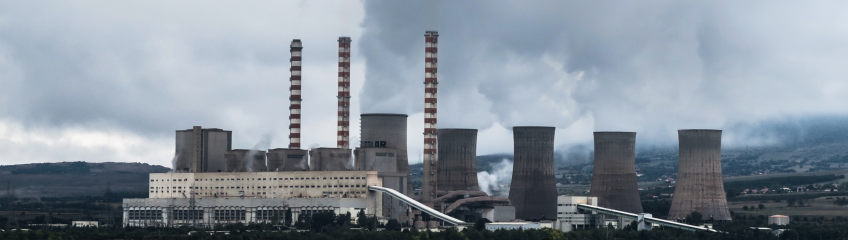
"Heat pump station at thermal power plant protects critical equipment with Vulcan descaling technology." Read →

"State Grid Corporation uses X-Pro 1 on cooling circulating water system of UHV converter equipment." Read →

"After 4 months, no white scale on plate heat exchangers - only soft residue easily removed." Read →
"After 6 months, data center platform showed heat exchanger temperature stable - no new scale formation." Read →
"Dual Vulcan S150 units on heating boiler supply and return pipes reduced scale and improved heat exchange efficiency." Read →
"2 Vulcan S150 units on heating boiler supply and return pipes quantifiably decreased fuel consumption." Read →
How Vulcan Protects Power Generation Assets
Cooling Systems
Protects cooling towers, condensers, and heat exchangers from scale that reduces heat rejection and increases energy consumption. Maintains design approach temperatures.
Heat Exchangers
Eliminates insulating scale on heat transfer surfaces - improving thermal efficiency, reducing pressure drop, and preventing under-deposit corrosion.
Boiler Systems
Protects feedwater systems, economizers, and blowdown lines from scale accumulation. Reduces chemical treatment requirements.
Related Resources

Condenser Cleaning Best Practices for Fossil Plants
EPRI guidelines for maintaining condenser cleanliness and optimizing heat rate. (Coming soon)
Article in development
Cooling Tower Water Chemistry Management
Balancing cycles of concentration, scale prevention, and environmental compliance. (Coming soon)
Article in development
Heat Rate Improvement Guide for Power Generators
Practical steps to optimize thermal efficiency and reduce fuel costs. (Coming soon)
Article in developmentReferences:
- Electric Power Research Institute (EPRI). "Condenser Application and Maintenance Guide," EPRI Report 1004007, 2024
- International Association for the Properties of Water and Steam (IAPWS). "Technical Guidance for Fossil and Combined Cycle Plants," IAPWS TGD7-23, 2023
- ASME Performance Test Codes. "PTC 12.2 - Steam Surface Condensers," American Society of Mechanical Engineers, 2024
- Energy Efficiency Guide for Industry. "Minimizing Scale in Industrial Water Systems," U.S. Department of Energy, 2025
- Power Plant Cooling System Fouling Review. "Impact of Scale and Biofilm on Thermal Performance," Journal of Power Generation Technology, 2024
- EPRI Technical Report. "Heat Rate Improvement Guidelines for Fossil Plants," EPRI Report 3002021345, 2024
Ready to Optimize Your Power Plant?
Join thermal plants, combined cycle facilities, and power stations worldwide that have improved heat rate, reduced maintenance, and extended equipment life with Vulcan.


