
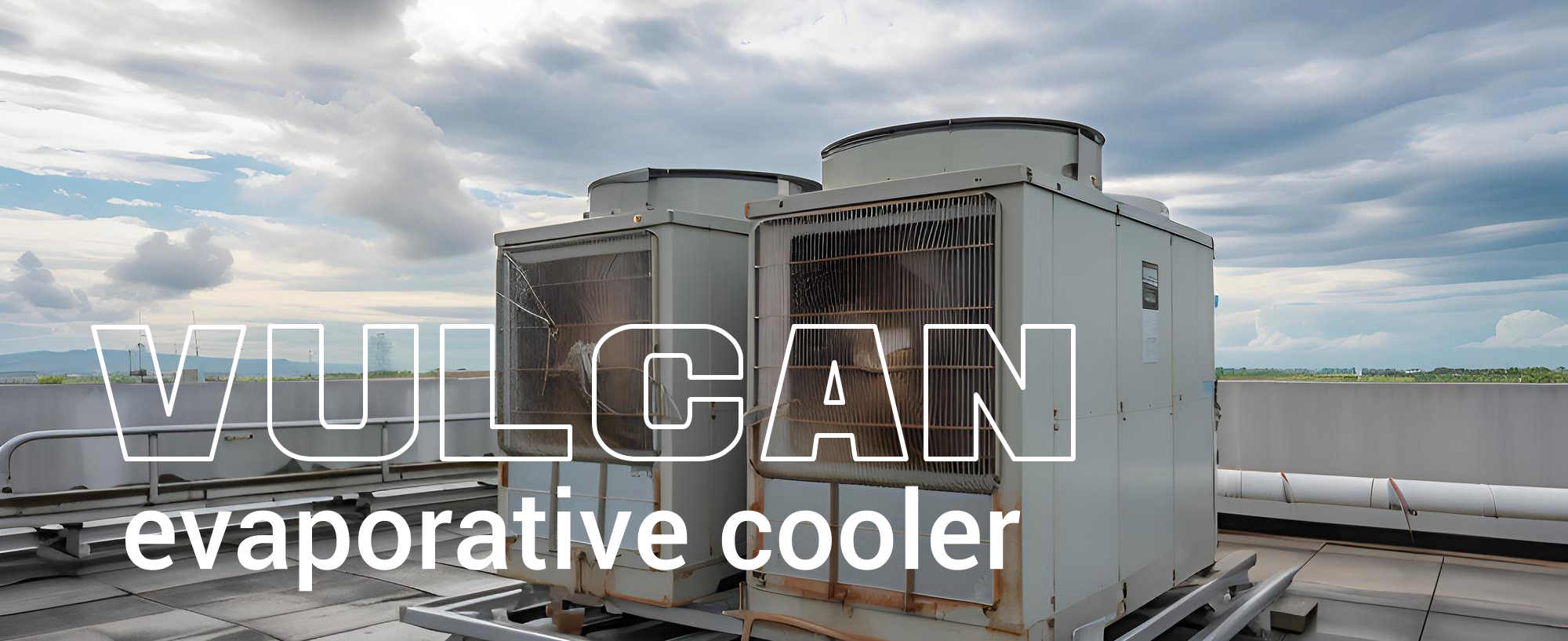
The Scale Problem: How Evaporative Coolers Work and Why Scale Destroys Them
Evaporative cooling is a method of cooling a gas stream, usually air, by evaporating a liquid, usually water [2]. The temperature of the air is reduced by introducing water vapor into it through evaporation. Given the right environment, evaporative cooling represents a far more economical means of cooling over standard refrigeration—with initial capital costs running one third the cost of refrigeration and operational costs up to 75% less [4].
#1
Cause of efficiency loss [3]
$1,000+
Pad replacement cost [4]
8x
More water without treatment [4]
However, evaporative coolers have a fundamental problem: water typically contains dissolved minerals. When water evaporates, only pure water molecules are given off, leaving the minerals behind on the surface from which the water evaporated [2]. The residue accumulates over time, resulting in scale buildup on the cooler pads and heat exchange surfaces [5].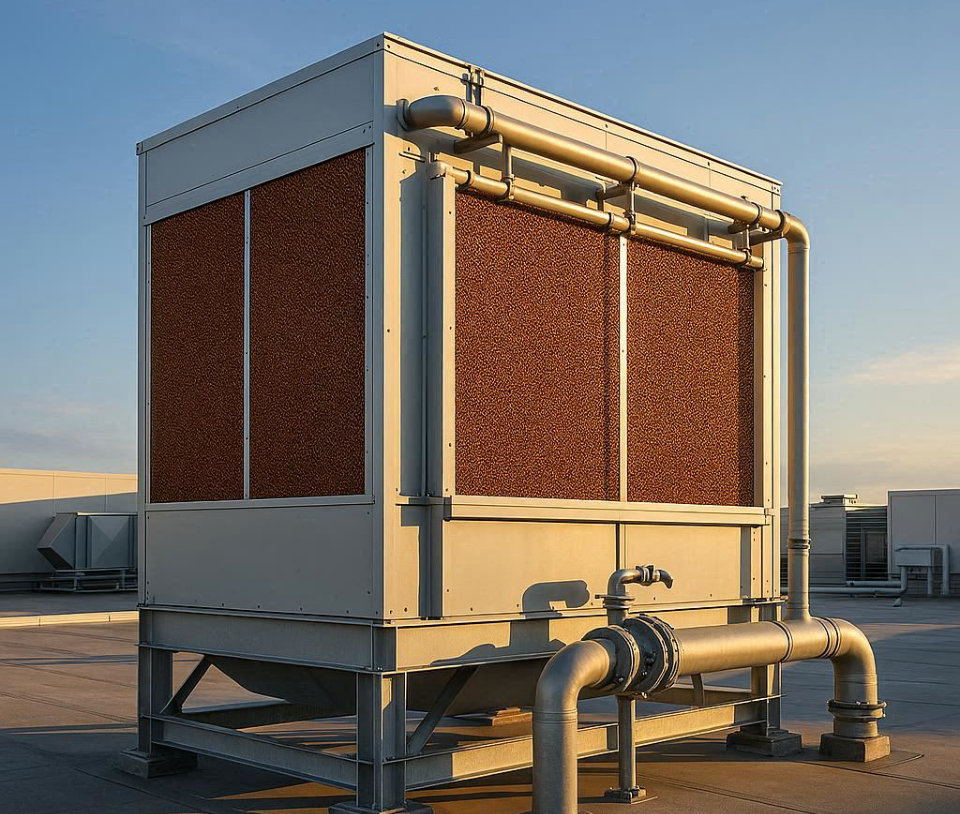
The Scaling Process
Think of it like the limescale you see in your kettle. Over time, as water evaporates, minerals are left behind and accumulate. In an evaporative cooler, the same thing happens on a much larger scale, with serious consequences [10].
When water evaporates from the cooler pads, only pure water is given off (good), but the minerals in the water stay on the cooler pad surfaces forming a dense scale buildup (bad) [4].
Scale is perhaps the number one reason evaporative condensers lose their efficiency over time. Just a small quantity of scale can have a dramatic effect on performance [3].
Researched Impacts:
- Scale acts as an insulator—reducing heat transfer efficiency [10]
- Scale narrows water passageways, restricting flow and creating hot spots [10]
- Within a short period, scale thickness builds up on pads to such an extent that cooling is actually reduced [4]
- Over time, sections of the pad can plug up completely, and cooling occurs at a mere fraction of what it was when the unit was new [4]
- The added weight from scale deposits can cause deformation or collapse of insufficiently supported media [5]

Using Chemicals to Descale Evaporative Coolers: Is That Really the Best Answer?
Traditional approaches to scale management in evaporative coolers involve chemical treatments—but they come with significant drawbacks.
The Chemical Approach:
Products like Evap-Treat use polyphosphates to "sequester" hardness minerals, attempting to prevent scale formation [1]. But these chemicals require constant replenishment, precise dosing, and regular maintenance.
The Vulcan Approach
- Zero ongoing chemical costs
- No bleed-off required—save water
- Zero chemical discharge
- Permanent scale prevention
- Pad life extended 2-3x
- Install once, protect forever
The old-fashioned method has been to set the "bleed-off" to remove concentrated mineral-laden water and replace it with fresh water. But this process quickly becomes cost prohibitive—in some cases using up to eight times more water than can be achieved by using modern technology [4].
You Could Just Use the Vulcan Descaler
Zero Effort to Manage Mineral Scaling Concerns

Vulcan S100 — chemical-free scale prevention for evaporative coolers and entire building water systems
Simple. Effective. Permanent.
Install over your main water line and let science and nature take care of the entire descaling process.
Scale buildup reduces cooling efficiency, restricts water flow, and forces expensive pad replacements.
The Vulcan descaler's proprietary technology continuously prevents scale formation—so your evaporative cooler always operates at design efficiency.
The Vulcan descaler continuously protects your:
The Numbers
Years of proven technology
Countries worldwide
Water savings potential [4]
Pad replacement savings
Contact us for a holistic building-wide implementation plan:
Response within 24 hours
Install once, protect forever — zero maintenance, zero chemicals, zero ongoing costs.
Scale Is Part of a Much Larger Problem

Mineral scale issues in evaporative coolers are about more than maximizing equipment efficiency.
Waterborne pathogens and biological growth use mineral scale buildup as a breeding ground and food source.
The Biological Problem:
Evaporative coolers have several problems not present with refrigerant systems, including scale build-up and the growth of mold, algae and other microbes. These problems require regular maintenance, adding to the cost of operation. Mold, algae and mildew can develop that attack the contact media, create objectionable odors and present a potential health hazard. [5]
The Hidden Danger:
Scale creates the perfect environment for biofilm and pathogens to thrive—and odors to develop [4].
Research: Monitoring Degradation in Cooling Media
ASME research on accelerated degradation testing of wet cooling media identified that sump water conductivity is the key maintenance parameter for monitoring replenishing and draining cycles. The average water conductivity in the sump during wetting cycles increases monotonically as scale accumulates [7].
This information helps manufacturers guide customers for maintenance of media pads and sump water drain cycles [7].
The Scale-Biofilm Connection
- Rough scale surfaces trap organic matter, feeding bacteria
- Biofilm forms on scale, protecting pathogens
- Mold and algae attack contact media [5]
- Objectionable odors develop from biological growth [4]
"When water evaporates only water molecules get evaporated and the other chemicals in the water are left behind on the surface as residue." [7]
The Vulcan Solution
- Eliminates scale — removes biofilm habitat
- Smooth surfaces — pathogens have nowhere to hide
- Zero chemicals — no discharge, no hazards
- 40+ years proven — 70 countries worldwide
- Continuous protection — 24/7 scale prevention
- 8x water savings — compared to bleed-off [4]
Technology developed over 40+ years across 70 countries
The Vulcan anti-scale solution continuously removes and prevents lime scale buildup — protecting both your equipment and the people who depend on it.
Scale control is biological control
Preventing scale means preventing the mold, algae, and odors that plague evaporative coolers. Read our comprehensive Legionella Prevention Guide →
Real-World Impact: Industry Research
"Scale is perhaps the number one reason condensers lose their efficiency over time. Just a small quantity of scale can have a dramatic effect on condenser performance. Therefore, controlling the level of minerals in the water is very important." [3]
"Areas of the pad that are not wetted effectively allow air to pass through without being cooled and the edges between wetted and dry surface establish sites for scale formation." [7]
"Replacing the pads on the cooler eventually becomes necessary. Whether it is a residential cooler or a large industrial cooler, pad replacement is expensive. It is not uncommon for this expense to cost in excess of $1,000, depending upon the size of the cooler." [4]
"Evaporative coolers have several problems not present with refrigerant systems, including scale build-up and the growth of mold, algae and other microbes. These problems require regular maintenance, adding to the cost of operation." [5]
"The built environment is responsible for about 42% of annual global CO2 emissions. Every day, your cooling system supports these environmental consequences due to the direct correlation between mineral scale and wasted energy consumption." — Waslix, LLC

"NYC Accelerator (decarbonize NYC by 2050, Local Law 97) has allowed this technology to be part of an implementation solution to help decarbonize New York City buildings due the significant impact that mineral scaling has on energy efficiencies."
Research & Studies

Centre for Environmental Chemistry
Download PDF
Impact of Water Hardness on Energy Consumption
Eskom Research Center found mineral scaling led to increased power consumption.
Read Study
Influence of Water Scale on Thermal Flow Losses
International Journal study: scale impacts energy efficiency by 10% to 60%.
Read Study
Impacts of Water Quality on Equipment Life
PNNL: Scale can decrease equipment life by more than half.
Read StudyRelated Articles & Resources
Cooling Tower Water Chemistry Management
Balancing cycles of concentration, scale prevention, and environmental compliance.
Read Article
Cooling Tower Water Treatment Without Chemicals
Achieve high cycles of concentration while eliminating chemical discharge.
Read Article
Legionella Prevention Guide
Understanding ASHRAE Standard 188, CDC requirements, and how scale control reduces biofilm habitat.
Read ArticleRecommended Vulcan Models for Evaporative Coolers
Vulcan S50 / S100
Up to 6,500 CFM
Single evaporative coolers
Residential swamp coolers
Small commercial units
View S100 DetailsVulcan S250 / S350
Up to 10,000+ CFM
Multiple evaporative units
Industrial cooling systems
Warehouse facilities
View S250 DetailsVulcan X-PRO Series
Multiple large units
Industrial evaporative condensers
Process cooling systems
Central cooling facilities
View X-PRO DetailsReferences
- Evap-Treat Product Information. (2025).
- Patent WO2014205204A1. Reduction of scale build-up in an evaporative cooling apparatus.
- IIAR. (2017). Tech Tip: Maintain Your Evaporative Condenser.
- Facilitiesnet. (2012). Getting The Most Out Of Evaporative Cooling.
- Patent US20050001339A1. Contact media for evaporative coolers.
- Vulcan Descaler. Electronic Anti-Scale System Technology.
- ASME. (2018). Accelerated Degradation Testing of Rigid Wet Cooling Media.
- Latino Cooling. (2025). What is the effect of scaling on an evaporative condenser?
- USPTO. (2025). Control System for Evaporative Cooling Facilities.
- Lublin University of Technology. (2006). Research on incrustation in a model evaporative cooler.
Protect Your Evaporative Coolers
Join thousands of facilities worldwide eliminating scale-driven efficiency losses, extending pad life, and reducing water consumption—without chemicals, without downtime, without compromise.
About the Author
Waslix (Vulcan Mineral Descaler) provides non-chemical, maintenance-free scale prevention for evaporative coolers worldwide. Our physical impulse technology keeps cooling pads scale-free, maintains heat transfer efficiency, and eliminates chemical treatments—trusted by residential homeowners, commercial facilities, and industrial operations globally. Create an account for detailed model specifications and pricing.


